
Silencing the Inner Critic: Where Does Negative Self-Talk Come From and How to Stop It
A deep dive into the psychology of your inner voice, real-world examples, and actionable strategies to rewire your brain for positivity.
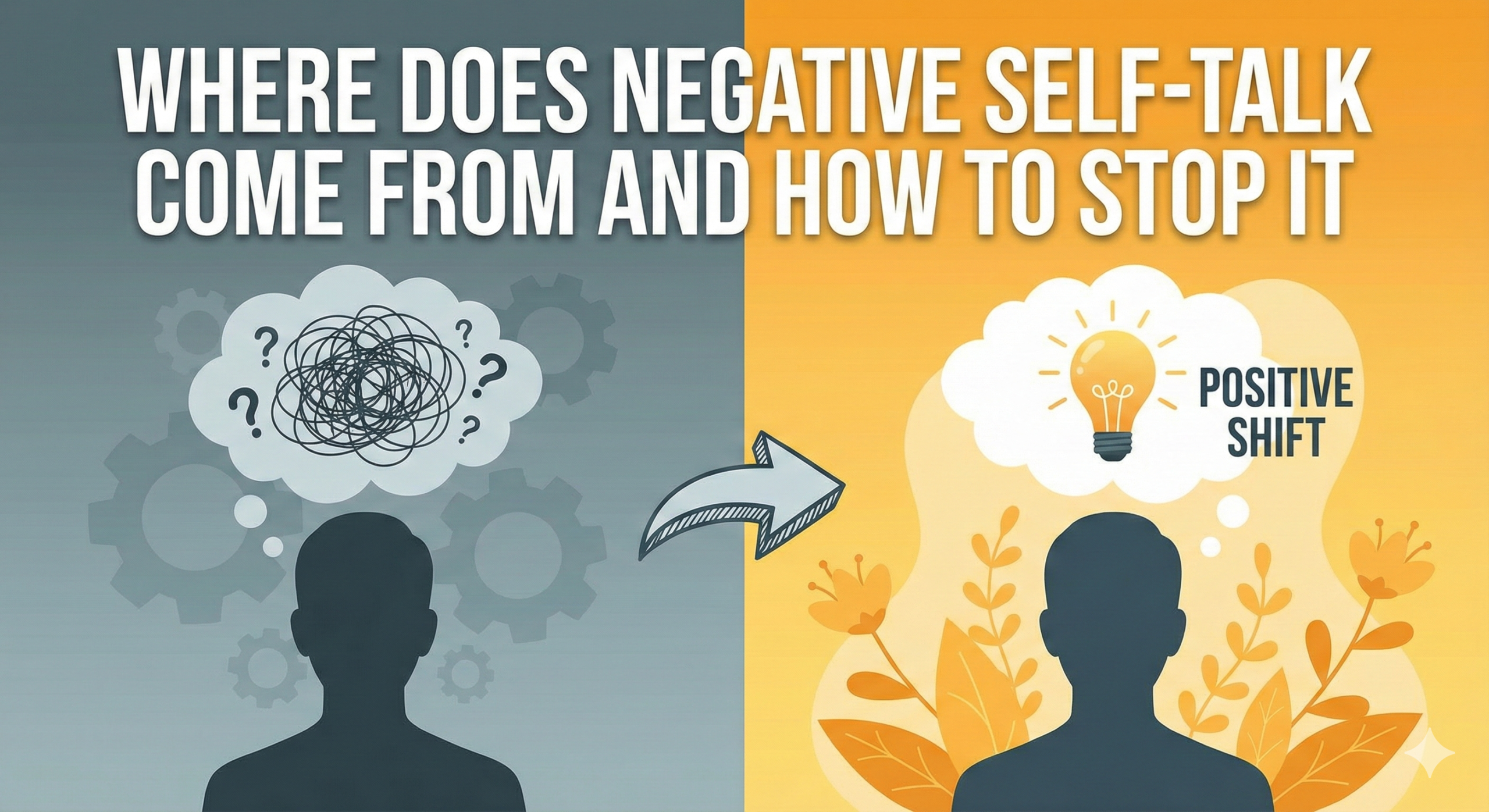
We all have a voice in our heads. For some, it is a supportive coach, offering encouragement during tough times. For many others, however, it acts more like a relentless bully. This voice—the one that whispers (or screams) that you aren’t good enough, that you will fail, or that everyone is judging you—is known as negative self-talk.
It is the invisible barrier standing between you and your potential. It is the reason you might procrastinate on a project, avoid social gatherings, or feel exhausted despite getting enough sleep. The constant mental chatter can lead to severe decision fatigue, making even simple choices feel overwhelming.
But here is the truth: that voice is not you. It is a habit, a psychological pattern that can be unlearned. In this comprehensive guide, we will explore exactly what negative self-talk is, the evolutionary and childhood roots of where it comes from, and most importantly, proven methods to stop it in its tracks.
What Is Negative Self-Talk?
Negative self-talk is an inner dialogue that limits your ability to believe in yourself and your abilities, and to reach your potential. It is any thought that diminishes your confidence and ability to make positive changes. It is not just “feeling down”; it is a repetitive cycle of cognitive distortions.
This internal monologue often feels like a realistic assessment of a situation, but in reality, it is fear-based and biased. It’s closely linked to the habit of rumination. If you find yourself constantly replaying mistakes or worrying about the future, you may need to learn how to stop overthinking everything, as overthinking is the fuel that keeps negative self-talk burning.
Where Does Negative Self-Talk Come From?
Understanding the origin of your inner critic is the first step toward dismantling it. It rarely arises from a single event; rather, it is a complex cocktail of biology, upbringing, and environment.
1. Evolutionary Biology: The Negativity Bias
Our brains are not designed for happiness; they are designed for survival. Early humans who were paranoid about rustling bushes (assuming it was a lion) survived longer than those who were optimistic. This has left us with a negativity bias—our brains naturally pay more attention to negative stimuli than positive ones to keep us safe.
2. Childhood Conditioning
The roots of self-talk often stretch back to childhood. If you had critical parents, teachers, or peers, their external voices can become your internal voice. This is often referred to as the “internalized parent.” If you were constantly told you were “messy” or “lazy,” your adult brain might still be repeating that script.
3. Social Comparison and Media
In the digital age, we are bombarded with curated perfection. Scrolling through social media triggers immediate comparison: “Why aren’t I that fit? Why aren’t I that rich?” This comparison culture is a massive generator of inadequacy. Implementing ways to reduce screen time is often a necessary medical intervention for chronic negative self-talk.

Chatter: The Voice in Our Head, Why It Matters, and How to Harness It
An award-winning psychologist reveals the hidden power of our inner voice and how to harness it for success rather than self-sabotage.
Check Price on AmazonCommon Examples of Negative Self-Talk
Negative self-talk is slippery; it changes its form to convince you it is true. Psychologists have identified four common categories of this destructive thinking.
1. Personalizing
This occurs when you blame yourself for everything that goes wrong.
Example: “My friends canceled dinner; they must not want to see me.” (Reality: They might just be busy or sick).
2. Filtering
You magnify the negative aspects of a situation and filter out all the positive ones.
Example: You receive a performance review with 9 compliments and 1 critique. You spend the next week obsessing over the 1 critique.
3. Catastrophizing
You automatically anticipate the worst-case scenario.
Example: “I made a typo in this email. My boss is going to fire me, and I’ll lose my house.”
4. Polarizing (Black and White Thinking)
You see things only as either good or bad, with no middle ground. Perfectionism thrives here.
Example: “I ate one cookie, so I’ve ruined my diet completely. I might as well eat the whole box.”
This type of all-or-nothing thinking is a major barrier to progress. It often leads to procrastination because we fear the result won’t be perfect. If this sounds like you, check out our ultimate list of 7 ways to beat procrastination.
The Dangerous Impact on Your Life
Negative self-talk is not benign background noise. It has tangible physiological and psychological effects.
- Increased Stress: It triggers the release of cortisol, keeping your body in a constant state of fight-or-flight.
- Depression and Anxiety: It is a core symptom and driver of mental health disorders.
- Relationship Strain: If you constantly tell yourself you are unlovable, you may sabotage relationships or project insecurities onto partners.
- Physical Health: Chronic stress from self-criticism can weaken the immune system and lead to cardiovascular issues.
Just as you might prioritize physical health by researching Pilates versus Yoga, you must prioritize mental hygiene to prevent these long-term damages.
How to Stop Negative Self-Talk: 5 Proven Strategies
Rewiring your brain takes time. This is neuroplasticity in action. Here is a step-by-step framework to silence the critic.
Step 1: Catch Your Critic (Mindfulness)
You cannot change what you do not notice. The first step is simply awareness. When you feel a sudden drop in mood, pause and ask: “What was I just thinking?”
Mindfulness apps can be incredibly helpful for training this awareness. If you are unsure which to use, read our comparison of Headspace vs Calm vs Insight Timer to find the right tool for you.
Step 2: Give Your Inner Critic a Name
Psychologists suggest distancing yourself from the voice. Call it “The Grump,” “Judge Judy,” or “Voldemort.” By naming it, you separate your identity from the thought.
Instead of: “I am stupid.”
Say: “Oh, Voldemort is trying to tell me I’m stupid again. That’s interesting.”
Step 3: The Cross-Examination (CBT Technique)
Put your thoughts on trial. Ask yourself:
- Is this thought 100% true?
- What is the evidence for this thought?
- What is the evidence against this thought?
- What would I say to a best friend who had this thought?
Step 4: Shift to “Neutral” Before “Positive”
Going from “I hate myself” to “I love myself” can feel fake. Instead, aim for neutral self-talk.
Negative: “I am such a failure.”
Neutral: “I made a mistake, but I can learn from it.”
Positive: “I am capable and growing.”
Step 5: Change Your Environment
Sometimes your environment reinforces negativity. A cluttered desk reflects a cluttered mind. Taking time to organize your space with the best desk accessories or learning how to organize notes can provide a sense of control and calm that quiets the mind.
The Reframing Table
Use this table as a cheat sheet for rewriting your internal script.
| Negative Self-Talk (The Lie) | Constructive Reframe (The Truth) |
|---|---|
| “I’ve never done this before, I’ll mess it up.” | “It’s an opportunity to learn something new.” |
| “There’s no way this will work.” | “I can try to make it work, or try a different approach.” |
| “I am so lazy for not finishing this.” | “I need to rest now so I can be productive later.” |
| “Everyone else is better than me.” | “I am on my own journey and comparing helps no one.” |

The Five Minute Journal: A Happier You in 5 Minutes a Day
Gratitude is the antidote to negativity. This journal helps you focus on the good in your life, scientifically training your brain to scan for positives.
Check Price on AmazonBuilding a Positive Mental Ecosystem
Stopping negative self-talk isn’t a one-time fix; it’s a lifestyle. You need to build habits that support a healthy mind.
Start Your Day Right
The first hour of the day sets the tone. If you wake up and immediately scroll through news or emails, you invite stress. Instead, adopt a structured routine. We recommend checking out these 5 morning routine checklists for success to find a rhythm that empowers you.
Prioritize Self-Care
When you are tired, hungry, or burnt out, your inner critic gets louder. Self-care is not a luxury; it is maintenance. Ensure you are following the ultimate self-care checklist to keep your physical and emotional reserves high.
Surround Yourself with Positivity
Jim Rohn said we are the average of the five people we spend the most time with. This applies to content too. Read books that uplift you. If you are looking for guidance, start with the top 5 habits of highly effective people to see how successful individuals manage their mindset.
Frequently Asked Questions
Not entirely. In small doses, self-criticism can serve as a reality check or motivation to improve. However, when it becomes repetitive, abusive, or irrational, it becomes destructive to mental health.
Chronic negative thinking triggers the body’s stress response, releasing cortisol and adrenaline. Over time, this can lead to high blood pressure, weakened immune response, digestive issues, and chronic fatigue.
Yes, journaling is one of the most effective tools. Writing down thoughts helps externalize them, making it easier to identify distortions and challenge them with logic and compassion. Using apps like the best goal tracking apps can also help you focus on progress rather than perfection.
Negative self-talk is your own internal monologue—your thoughts. Hearing voices (auditory hallucinations) sounds like an external sound coming from outside your head and is often a symptom of conditions like schizophrenia. If you hear external voices, seek professional help immediately.
Conclusion: Reclaiming Your Inner Narrative
Your inner voice has been narrating your life for years, but it doesn’t have to dictate your future. By understanding where negative self-talk comes from and actively practicing the strategies outlined above—mindfulness, reframing, and self-compassion—you can turn your inner critic into an inner ally.
Remember, this is a journey. There will be days when the negativity creeps back in. That is okay. Treat yourself with the same kindness you would offer a friend. If you are ready to make a serious commitment to improving your mindset and life, take the next step and read our guide on how to change your life in 30 days.
The conversation you have with yourself is the most important conversation you will ever have. Make it a good one.
Start Your Positivity Journey Today
Don’t let another day go by ruled by fear. Equip yourself with the right tools.
Read Next: Building Better Communication Skills