
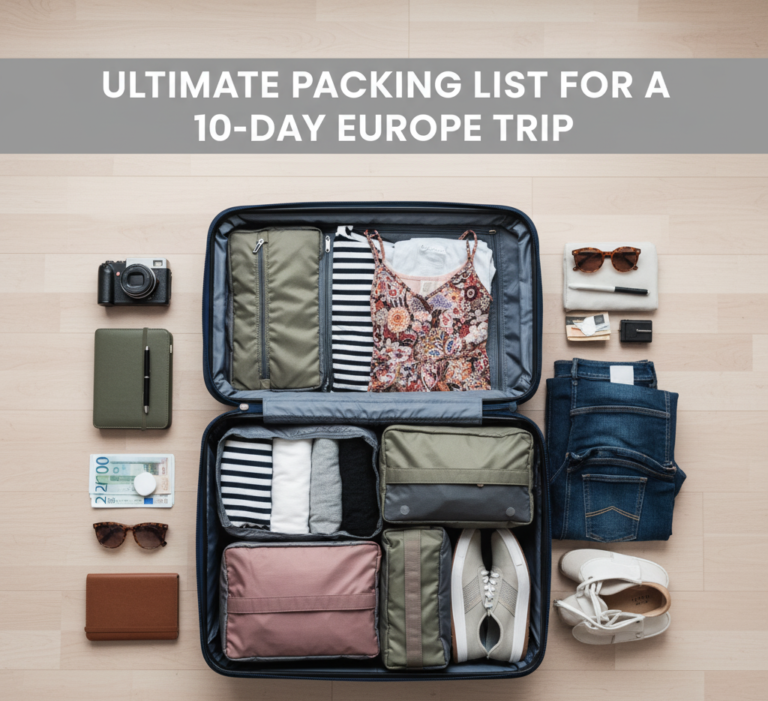
Ultimate Packing List for a 10-Day Europe Trip: Carry-On Only & Stress-Free
There are two types of travelers in Europe: those dragging massive suitcases across cobblestone streets while sweating profusely, and those gliding effortlessly with a single carry-on, sipping an espresso before their train departs. This guide is designed to put you in the second category.
Packing for 10 days in Europe does not require a Sherpa. It requires a strategy. Whether you are visiting the cheapest European cities or doing a luxury tour of the capitals, the principles remain the same: versatility, mobility, and intentionality.
This isn’t just a list of clothes; it’s a comprehensive system covering tech, security, toiletries, and the financial prep needed to make your trip seamless. We will leverage the habits of highly effective people—preparation and efficiency—to ensure you pack exactly what you need and nothing you don’t.
The Real Cost of Checked Luggage (It’s Not Just Money)
Most travelers assume that checking a bag is simply a matter of paying a fee. The true cost is far higher—and most of it is invisible at the time of booking.
Beyond the financial cost, checked luggage fundamentally changes your travel experience. You are tethered to airport terminal carousels. You cannot take advantage of last-minute train bookings that require immediate boarding. You are physically restricted on narrow staircase entries to older European hotels, funicular railways, and cobblestone streets where wheeled luggage becomes an obstacle rather than a convenience. Every unnecessary kilogram in a checked bag is a constraint on the spontaneity that makes European travel memorable.
European Carry-On Dimensions: Know Before You Go
European budget carriers apply stricter carry-on limits than US airlines—and they enforce them. Ryanair’s free personal item allowance is 40 × 20 × 25 cm; their paid priority boarding carry-on is 55 × 40 × 20 cm. easyJet allows 56 × 45 × 25 cm for overhead bin bags (paid) and 45 × 36 × 20 cm for the free underseat bag. Wizz Air allows 55 × 40 × 23 cm for overhead with priority boarding. Always verify the specific airline’s current policy before packing—these limits change and budget carriers profit from non-compliance fees at the gate.
1. The “Carry-On Only” Philosophy
Why carry-on only? Because European infrastructure is not built for massive American suitcases. You will encounter narrow staircases, smaller rental cars, and trains with limited luggage racks.
The 5-4-3-2-1 Rule
To survive 10 days without checking a bag, we use the capsule wardrobe method. This ensures every item matches every other item.
- 5 Tops: A mix of t-shirts and blouses (stick to neutrals).
- 4 Bottoms: Jeans, trousers, or skirts.
- 3 Accessories: Sunglasses, hat, scarf.
- 2 Shoes: One for walking, one for dinner.
- 1 Jacket: Versatile and weather-appropriate.
The Science of the Travel Capsule Wardrobe
A capsule wardrobe works because it applies constraints that force better decisions. When every item must work with every other item, you eliminate the “just in case” logic that fills most overpacked bags. The principle is not deprivation—it is intentional versatility. Five neutral-toned items that each pair with all four bottoms produce twenty possible outfit combinations. Five items in contrasting prints and colors that only pair with specific bottoms produce perhaps six or seven workable outfits despite the same item count.
Best Fabrics for European Travel
Merino wool: The gold standard. Naturally odor-resistant (can be worn 3–4 days between washes), temperature-regulating (cool in summer, warm in autumn), wrinkle-resistant, and quick-drying. A merino t-shirt washed in a sink dries overnight.
Synthetic blends (nylon/polyester): Superior durability and fastest drying time. Best for activewear and base layers. Slightly less comfortable in sustained heat than merino.
Avoid: 100% cotton (heavy when wet, slow to dry, wrinkles badly), linen (beautiful but extremely wrinkle-prone), and thick denim (heavy, slow to dry, uses disproportionate packing space).
The Neutral Color Palette System
Build around a base of three neutrals that all work together: navy, white/cream, and khaki/stone are the most versatile trio for European travel. Add one accent color (burgundy, olive, or terracotta) through one or two items. Every possible combination produces a coherent outfit.
Shoes follow the same logic: White or tan sneakers pair with virtually everything casual. Dark leather loafers or Chelsea boots handle evenings and smart-casual occasions. Two shoes cover ten days because the palette is cohesive.
Packing by Season: Europe Has Four Distinct Zones
“Europe” is not a climate—it is a continent spanning Mediterranean beach resorts and Scandinavian fjords. A packing list optimized for July in Lisbon is dangerously inadequate for October in Edinburgh. The following seasonal framework adjusts the 5-4-3-2-1 rule for actual European climate realities:
| Season | Key Add | Key Subtract | Critical Item | Shoe Adjustment |
|---|---|---|---|---|
| Summer (Jun–Aug) | Sun protection, light dress/shorts | Heavy knits, thermal layers | Compact packable hat | Sandals replace dinner shoes |
| Shoulder (Apr–May, Sep–Oct) | Light merino layer, rain layer | Heavy coat (layer instead) | Packable rain jacket | Add ankle boots or waterproof sneakers |
| Winter (Nov–Mar) | Thermal base layer, warm mid-layer | Summer tops (replace with thermal) | Packable down puffer | Waterproof boots only |
| Multi-region | Layering system (3 thin beats 1 thick) | Any single-use items | Versatile scarf (warmth + style) | Waterproof walking shoe covers both |
2. The Foundation: Choosing the Right Gear
Your luggage is your home base. If you choose poorly, the trip becomes a physical burden.
The Suitcase vs. Backpack Debate
If you are staying in one city, a spinner suitcase is fine. If you are hopping trains between cities, a travel backpack is superior.
- Hard-Shell Spinner: Best for airports and smooth pavements. Ensure it meets international carry-on dimensions (often stricter than US airlines).
- Travel Backpack: Best for cobblestones, stairs, and mobility.
- Day Bag: You need a small bag for daily exploration. This is one of the 8 essential items to include in your carry-on.

For 10 days in Europe, this is the gold standard. It is incredibly lightweight (under 6.5 lbs), durable enough to withstand being tossed in a train rack, and features 360-degree spinner wheels that actually work on rougher terrain. The internal organization is minimal, which is perfect because you should be using packing cubes. It fits in the overhead bin of almost every major European carrier.
Check Price on AmazonPacking Cubes: The Interior Architecture of a Perfect Bag
Packing cubes are not optional—they are the system that makes carry-on-only travel practical. Without them, a carry-on becomes a chaotic jumble that requires full unpacking to find a specific item. With them, the interior of your luggage functions like a set of organized drawers, regardless of how many times the bag has been handled, searched, or stuffed into an overhead bin.
The most effective packing cube system for a 10-day trip uses three cubes of different sizes: a large cube for bottoms and bulkier items, a medium cube for tops and layering pieces, and a small cube for underwear, socks, and small accessories. Color-coding the cubes by category means you can locate any item by touch in seconds without opening every cube.
The Bundle Method vs. Roll vs. Fold
Rolling clothes into cylinders is the most space-efficient technique for most items and reduces creasing significantly compared to flat folding. Bundle wrapping—where clothes are wrapped concentrically around a central core—produces the least wrinkled results for dress shirts and blouses but requires more time. The optimal approach for travel: roll casual items (t-shirts, jeans, knitwear) and bundle formal items (button-downs, dresses) with a soft packing cube as the core. Compression packing cubes that zip to a reduced volume add approximately 30% more space efficiency for the same item count.
The Day Bag: Your Most Important European Companion
Your main carry-on stays at the hotel or apartment. Your day bag travels with you through every museum, market, and meal. It is the bag that determines how comfortable, secure, and organized your daily experience is—and it is frequently the most under-considered purchase in a traveler’s kit.
The ideal European day bag sits flat against the body when worn as a crossbody or sling (making pickpocket access from behind far more difficult), has a zip closure rather than a magnetic snap or open top, holds a 1-liter water bottle, a compact umbrella, a small battery pack, sunscreen, a map or guidebook, and your wallet without becoming uncomfortably bulky. Anti-theft features—lockable zippers, slash-resistant body panels—are not paranoia; they are appropriate preparation for the tourist-dense neighborhoods of Paris, Barcelona, Rome, and Prague.
3. The Digital Nomad Kit (Even for Vacationers)
Modern travel requires power. You will be using your phone for maps, tickets, translations, and photos. Running out of battery isn’t an inconvenience; it’s a safety issue.
Electronics Checklist
- Smartphone: Before you leave, review the 7 smartphone settings you need to change immediately to avoid massive roaming bills.
- Power Bank: Non-negotiable. You will be out of the hotel for 12+ hours.
- Universal Adapter: UK plugs are different from EU plugs. Get a universal one.
- Headphones: Noise-canceling is essential for flights and trains.
- Laptop (Optional): If you must work, bring one of the top budget laptops that are lightweight. If not, leave it at home and disconnect.

Stop buying cheap adapters for every single country. This single unit covers over 150 countries (including UK, EU, and US). Crucially, it includes multiple USB-C and USB-A ports, allowing you to charge your phone, watch, and power bank simultaneously from a single outlet—a lifesaver in older European hotels where outlets are scarce.
Check Price on AmazonConnectivity: eSIM vs. International SIM vs. Roaming Plan
Your smartphone becomes your most essential travel tool in Europe—for navigation, translation, transit apps, digital tickets, and real-time communication. Ensuring reliable, affordable connectivity is no longer optional, and the options have improved dramatically for modern travelers.
| Option | Setup | Coverage | Typical Cost | Best For |
|---|---|---|---|---|
| eSIM (Airalo, Holafly) | App-based, purchase before trip | Multiple countries, one plan | $15–$40 for 10 days / 5–10GB | Multi-country itineraries, newer phones |
| Local Physical SIM | Buy at airport or convenience store | Single country, best local rates | $10–$20 per country | Single-country stays, older phones |
| Home Carrier Roaming | None (auto-activates) | Global, inconsistent quality | $10–$15/day or expensive plans | Emergency backup, very short trips |
| Pocket Wi-Fi Rental | Rent from airport or pre-book | Multi-country available | $8–$15/day rental | Groups sharing one data source |
For most travelers with a phone released after 2020, an eSIM from a provider like Airalo or Holafly is the most convenient and cost-effective option for a multi-country European itinerary. Purchase and activate the eSIM before departure while connected to home Wi-Fi. Upon landing, data connectivity is immediate—no queue at a telecom kiosk, no language barrier, no fumbling with a physical SIM tool in an airport bathroom.
Essential Travel Apps to Download Before Departure
Download these before you leave home while on fast Wi-Fi. Several European destinations have inconsistent mobile data speeds, and having apps cached locally makes the difference between smooth navigation and frantic searching in an unfamiliar city:
- Google Maps with offline areas downloaded: Download each destination city’s map for offline use. Navigate without data consumption.
- Citymapper: Superior to Google Maps for transit navigation in major European cities. Real-time disruption alerts, bike and scooter integration.
- Rome2Rio: Multimodal route planning across train, bus, ferry, and flight for inter-city travel with price comparisons.
- Trainline or Rail Europe: Book European train tickets; manage bookings digitally. Many routes require seat reservations even with a rail pass.
- Google Translate with offline language packs: Download offline packs for French, Spanish, Italian, German, and any other languages on your itinerary. The camera translation feature reads menus in real time.
- XE Currency: Real-time exchange rates; works offline with cached rates. Prevents overpaying at currency exchange booths.
4. Security: Protect Your Identity and Wealth
Europe is safe, but pickpocketing is a professional sport in cities like Barcelona, Paris, and Rome.
The Fortress Protocol
Treat your documents with the same level of care as you would your investment accounts.
- Digital Backups: Scan your passport, ID, and insurance. Store them in a secure vault using one of the 5 free password managers. If your physical bag is stolen, you can still prove who you are.
- RFID Wallet: Protect your credit cards from digital skimming.
- Physical Copies: Keep one paper copy of your passport in a separate bag from the original.
- Apple AirTag: Place one in your bag. If the airline loses it, you will know exactly where it is.

This bag is built like a tank but looks like a standard accessory. It features slash-resistant mesh body panels (so thieves can’t cut the bottom), locking zippers (so they can’t unzip it in a crowd), and RFID-blocking card slots. It gives you the peace of mind to enjoy the Eiffel Tower without constantly checking your pockets.
Check Price on AmazonEurope’s Pickpocket Hotspots: Know the Tactics Before You Go
Pickpocketing in European tourist destinations is not opportunistic crime—it is organized and tactical. Professional pickpocket teams typically involve two to four individuals: one to create a distraction (dropping something, asking for directions, pressing close on a crowded metro), one to execute the theft while attention is elsewhere, and one to receive the stolen item and immediately walk in a different direction. Understanding the playbook is the best defense.
- Metro and tram doorways: The moment of boarding or alighting—when you are physically squeezed and focused on movement—is the most common theft window. Keep your bag in front of your body, not on your back.
- Tourist landmark queues: The Eiffel Tower, the Colosseum, the Sagrada Família—anywhere large crowds form in close proximity is a working environment for pickpocket teams.
- Petition and bracelet scams: Someone approaches to sign a petition or ties a bracelet on your wrist as a distraction while a partner accesses your bag or pocket.
- Restaurant chair-back theft: Bags hung on the back of a chair or placed under the table are accessible to thieves who walk past. Keep the strap looped around your leg or keep the bag in your lap.
- ATM distraction: Someone “helps” with a card machine while a partner observes your PIN or steals your card during a moment of confusion.
Travel Insurance: The Packing Item You Can’t Touch But Must Have
Travel insurance is the most commonly skipped preparation step and the one with the most catastrophic consequences when omitted. European medical care is excellent, but non-EU/non-EEA visitors without insurance face full private rates that can reach tens of thousands of euros for hospitalization, surgery, or medical evacuation.
A comprehensive travel insurance policy for a 10-day European trip typically costs $50–$120 per person depending on age and coverage level. It should include: emergency medical coverage (minimum $100,000), medical evacuation coverage (minimum $300,000), trip cancellation and interruption, baggage loss and delay, and 24/7 emergency assistance. For EU/EEA citizens traveling within the EU, the European Health Insurance Card (EHIC) or Global Health Insurance Card (GHIC) provides access to state healthcare at resident rates—but does not cover all eventualities and does not replace comprehensive travel insurance.
5. Toiletries: The Art of “Decanting”
Liquid limits are strict in Europe (100ml). Do not bring full-sized bottles.
The Minimalist Bathroom
- Skincare: You don’t need your full shelf. Stick to the essential 4-step skincare routine and decant products into small containers.
- Solids over Liquids: Use solid shampoo bars and solid deodorant to save space in your liquids bag.
- Meds: Bring a small blister pack of painkillers, Imodium, and band-aids. Pharmacies in Europe are great, but they aren’t open 24/7 like in the US.
The Complete Decanting and Solid Toiletries Strategy
European aviation security follows IATA and national standards that, like US TSA rules, require all liquids, gels, aerosols, creams, and pastes to be in containers of 100ml or less and to fit within a single transparent resealable bag of approximately 1 litre capacity (roughly 20 × 20 cm). Each traveler is permitted one such bag. This constraint, which many travelers find frustrating, is actually an invitation to audit and simplify a toiletry routine that has likely accumulated years of rarely-used products.
The decanting strategy: invest in a set of leak-proof silicone travel bottles (30ml, 50ml, and 100ml sizes cover all needs) and transfer only the quantity of each product you will realistically use in 10 days. A standard shampoo bottle is 250–400ml; you need 30–50ml for 10 days of washing. Decanting reduces toiletry packing volume by 60–80% compared to bringing full-sized products.
Products That Work Better as Solids
- Solid shampoo bars (equal 2–3 bottles of liquid; last 60–80 washes)
- Solid conditioner bars (smaller than a bar of soap; no liquid allowance needed)
- Solid facial cleanser (many premium brands now offer these)
- Solid deodorant (no liquid rules; most effective brands use baking soda or mineral salt)
- Sunscreen stick (no liquid, no spill risk; major SPF brands offer 50+ in stick format)
- Dry shampoo powder (lighter and more TSA-friendly than aerosol)
The 10-Day First Aid Kit
- Ibuprofen or paracetamol (10 doses)
- Imodium / anti-diarrheal (6 capsules)
- Antihistamine (10 doses — seasonal allergies are intense in European spring)
- Blister plasters (10 — cobblestones are merciless)
- Small wound dressings and antiseptic wipe sachets
- Any prescription medications in original labeled packaging with a doctor’s note
- Electrolyte sachets (invaluable for hot-weather cities and after long travel days)
6. Money Matters: Spending Smart Abroad
Before you fly, you need to ensure your finances are travel-ready.
The Wallet Audit
- Cards: Bring two credit cards and one debit card. Ensure at least one is from our list of the best 5 travel rewards credit cards to avoid foreign transaction fees.
- Notification: Tell your bank you are traveling so they don’t freeze your card.
- Currency: Don’t exchange money at the airport (terrible rates). Use an ATM upon arrival in the city center.
- Budgeting: Use the zero-based budget checklist to allocate a specific amount for “Guilt-Free Spending.” Knowing your limit allows you to enjoy that fancy dinner without stress.
The Hidden Financial Traps of European Travel
Even well-prepared travelers lose money to financial traps in Europe that are entirely avoidable with advance knowledge:
- Airport and tourist-area ATMs: ATMs located inside airports, train stations, and high-traffic tourist squares frequently charge higher fees and use less favorable exchange rates. Walk five minutes from the tourist center to find a bank-branded ATM with standard rates.
- Currency exchange booths advertising “No Commission”: “No commission” does not mean “good rate.” The profit is embedded in the spread between buy and sell rates. The rate displayed in the window is almost always worse than what a bank ATM would offer.
- Which countries use the Euro vs. their own currency: Non-eurozone EU countries (Switzerland, Sweden, Norway, Czech Republic, Poland, Hungary, Croatia before 2023) use their own currencies. Euro left over from France is not usable in Prague. Plan currency needs by destination, not by continent.
- Tipping culture varies dramatically: Tipping in France, Belgium, and the Netherlands is appreciated but not expected—service charges are often included. In Italy, a small coperto (table cover charge) replaces tipping. In the UK, 10–15% is standard in restaurants. Research specific country customs to avoid both under-tipping in the UK and anxious over-tipping in France.
7. Surviving the Long-Haul Flight
The flight is the first day of your trip. If you arrive wrecked, you lose a day of exploration.
The 8-Hour Protocol
- Hydration: Drink water. Avoid alcohol.
- Movement: Stand up every 2 hours.
- Productivity vs. Rest: Decide beforehand. Are you going to read one of the top 10 finance books, or are you going to sleep? Use time blocking to structure the flight.
- Download: Download your maps, movies, and productivity apps while you still have fast home Wi-Fi.
Jet Lag: A Science-Based Protocol for Arriving Ready
Jet lag is not inevitable—it is largely manageable with preparation and a deliberate arrival strategy. The fundamental problem is a misalignment between your internal circadian clock and the local time at your destination. Most transatlantic flights to Europe arrive in the morning, meaning the traveler’s body clock is somewhere between midnight and 4 AM while local time calls for an active day. Without intervention, the resulting fatigue compounds across the first two to three days of the trip.
- Begin the shift before departure: In the 2–3 days before a westbound-to-eastbound flight, go to bed 1 hour earlier each night. This partial clock shift reduces the total realignment required upon arrival.
- Set your watch to destination time immediately upon boarding: Psychologically commit to the new timezone from the start of the journey.
- Sleep strategically on the plane: If it is nighttime at your destination, sleep. If it is daytime, stay awake. Use a sleep mask, earplugs or noise-canceling headphones, and a travel pillow to optimize sleep quality if the timing is right.
- Avoid alcohol entirely on the flight: Cabin air is already dehydrating at 6–8% humidity (desert-level dryness). Alcohol compounds dehydration, disrupts sleep architecture, and worsens jet lag symptoms significantly.
- Upon arrival, go outside immediately: Natural light exposure is the most powerful zeitgeber (time cue) for resetting the circadian clock. A 30-minute walk in morning light upon arrival in Europe is more effective than any supplement or sleep aid.
- Do not nap longer than 20 minutes on arrival day: A brief nap combats acute sleepiness without preventing nighttime sleep. Sleeping 2+ hours during the day locks in the wrong timezone for another 24–48 hours.
- Use melatonin correctly: Melatonin is a timing signal, not a sedative. Take 0.5–1mg (low dose) at local destination bedtime for the first 2–3 nights. Higher doses (5–10mg, common in US supplements) are not more effective and cause grogginess.

Packing cubes are the secret weapon of carry-on travelers. They compress your clothes, keep clean items separate from dirty ones, and organize your bag so you don’t have to explode your suitcase to find a pair of socks. The “Isolate” version is antimicrobial, keeping odors contained—essential for a 10-day trip with limited laundry.
Check Price on Amazon8. The Final 24-Hour Countdown
The day before you leave is critical. Use this checklist to ensure you lock your door with zero anxiety.
- Home Prep: Unplug non-essential electronics (like your custom PC build or kitchen gadgets) to save energy and reduce fire risk.
- Download Maps: Download Google Maps for your destination for offline use.
- Check-In: Check in online 24 hours prior to secure the best seat.
- Morning Routine: Plan your travel day morning using our morning routine checklists. A calm start leads to a calm trip.
The Complete Pre-Departure Checklist
The 24 hours before departure is when most travel anxiety originates—not because the trip itself is complicated, but because the list of things to verify feels endless. This structured checklist converts that anxiety into methodical completion:
Documents and Finance
- Passport valid for at least 6 months beyond return date
- Travel insurance policy downloaded and accessible offline
- Hotel, accommodation, and transport bookings confirmed
- Digital copies of passport in password manager
- Bank and credit card travel notifications set
- Emergency cash in local currency for arrival
- Travel rewards credit card charged and ready
Tech and Home
- Phone fully charged, eSIM activated
- Offline maps downloaded for all destinations
- Translation app language packs downloaded
- Universal adapter packed in carry-on
- Heating, air conditioning, and water turned off
- Pet or plant care arranged
- Mail held or neighbor notified
Airport Efficiency: The 20 Minutes That Determine Your Mood
The airport experience with carry-on only is categorically different from checked luggage travel. Without a bag to drop, check-in becomes a 2-minute app interaction rather than a queue. Security is the only potential time sink, and it is entirely optimizable. Wear slip-on shoes or loafers rather than laced boots. Place your liquids bag and electronics in the top layer of your carry-on for fast removal. Wear minimal metal. If your departure airport offers a trusted traveler program (TSA PreCheck in the US, or equivalent EU fast-track programs), the investment pays for itself on the first use.
Arrive at the gate with time to spare rather than rushing—not because the flight requires it, but because starting a trip at a brisk walk through a terminal is a physiological stress trigger that carries over into the first hours at the destination. A calm airport transit, a sit-down coffee before boarding, and a deliberate review of your first day’s agenda turns the airport from an obstacle into a genuine transitional ritual.
Bonus: European Cultural Etiquette Quick Reference
Packing the right gear is only part of travel preparation. Understanding basic cultural norms prevents the small misunderstandings that leave travelers feeling like tourists rather than guests. These are the most commonly encountered etiquette differences between North American and European social norms:
- Greeting customs: In France, a light kiss on each cheek (la bise) is standard between acquaintances; in Germany, a firm handshake is preferred; in the UK, a simple “hello” without physical contact is common in business contexts. Attempting a local greeting, even imperfectly, is universally appreciated.
- Restaurant service pace: European dining is not fast food. A waiter who does not immediately appear to take your order is not neglecting you—they are giving you time. Flagging down a waiter enthusiastically is considered rude in France and Italy; brief eye contact and a slight nod is the appropriate signal for the bill.
- Silence in public spaces: Germans, Austrians, and Scandinavians maintain notably lower volume in public transport, museums, and restaurants than many North Americans are accustomed to. Matching the ambient volume of your surroundings is not antisocial—it is respectful.
- Queue culture: In the UK, queue-jumping is treated as a near-moral offense. In Mediterranean countries, what appears to be a queue may function more as a loose gathering. Read the local norm before assuming structure exists.
- Sunday closures: Many European shops, supermarkets, and businesses are closed on Sundays, particularly in Germany, Austria, and rural France. Plan grocery and shopping needs for Saturday in countries where Sunday trading restrictions apply.
- Church and religious site dress codes: Shoulders and knees must be covered when entering most Southern European churches and cathedrals (the Vatican, Florence’s Duomo, Barcelona’s Sagrada Família). Pack a lightweight scarf to serve as a cover-up—it doubles as a travel accessory and costs no packing space.
Frequently Asked Questions: Europe Packing and Travel
Absolutely—and once you do it, you will never check a bag again for a trip of this length. The key is the 5-4-3-2-1 capsule wardrobe system combined with one laundry session mid-trip. Most European hotels and apartments have laundry facilities or a nearby laundromat. Even hand-washing five items in a sink and leaving them to dry overnight eliminates the need for a duplicate set of clothing. The adjustment period is psychological, not practical: you have everything you actually need, and significantly less to worry about.
The safest universal carry-on size for European airlines is approximately 55 × 40 × 20 cm for the main bag (which may require paying for priority boarding on Ryanair and Wizz Air) and 40 × 20 × 25 cm for a free personal item. Verify the specific airline’s current policy before packing—these change seasonally and are enforced at the gate. A bag that is 2–3 cm over the limit will be gate-checked at a fee significantly higher than the original bag fee would have been.
Cards work everywhere in Western European cities and most tourist destinations, but cash remains essential in three situations: outdoor markets and street food vendors (frequently cash-only), small rural restaurants and farms (card machines often absent), and tipping in countries where cash tips are culturally expected. A working budget of €100–€150 in cash provides ample coverage for these scenarios without unnecessary exposure. Withdraw from a bank-branded ATM in the city center, never from airport exchange booths.
Plan one laundry stop around day 5–6. Options in order of convenience: many Airbnb and apartment rentals include a washing machine (check the listing); laundromats (lavomatiques in France, Waschsalon in Germany, laundromat in the UK) are in every city neighborhood and typically cost €4–€8 for a wash and dry cycle; hotel laundry service is available but expensive; hand-washing in a sink works for underwear, socks, and merino wool items, which dry overnight. Merino wool specifically is worth the premium cost precisely because it can be worn 2–3 days between washes without odor.
Yes, without reservation. The cost ($50–$120 for 10 days) is negligible relative to the risks it covers. A single hospitalization in a country without a national health agreement for your citizenship could cost tens of thousands of dollars out of pocket. Trip cancellation coverage alone—which reimburses non-refundable flights, hotels, and tours if you cannot travel due to illness, family emergency, or other covered events—frequently exceeds the policy cost in value on a single cancellation. Travel insurance is the packing item that weighs nothing and protects everything else.
Final Verdict: Pack Less, Live More
The more you pack, the more you worry. The less you pack, the more freedom you have. This 10-day list is designed to give you maximum freedom. By focusing on versatile gear, digital security, and smart financial prep, you are setting yourself up for the trip of a lifetime.
The traveler who moves through Europe unburdened—no checked bag fees, no baggage carousel waits, no cobblestone struggles with a 30kg suitcase—experiences a different kind of trip than the one who packs for every contingency. They board trains at the last minute. They upgrade to a better hotel because the room is available and they are not locked into pre-booked luggage storage. They walk farther, explore more, and carry the entire journey in one bag that fits under their seat.
Now that your bag is packed, the only thing left to do is check your trip planning checklist one last time and head to the airport. Safe travels!
The One-Bag Challenge
Before your trip, do a full dress rehearsal: pack your bag completely, close it, and walk around your neighborhood with it for 30 minutes. If the weight or bulk is uncomfortable after 30 minutes of walking, it will be unbearable after 10 days. Remove anything that does not earn its place through regular, daily use. The items you never take out of your bag are the items you should have left at home.