
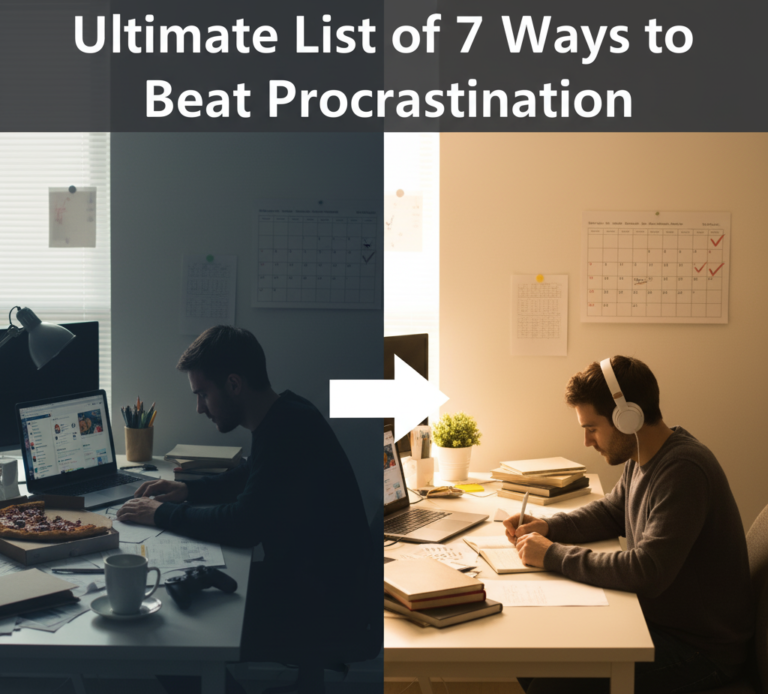
The Ultimate Anti-Procrastination Playbook: 7 Proven Ways to Start Now
Procrastination is not laziness; it’s a deep-seated emotional avoidance mechanism. We delay difficult tasks not because we are unmotivated, but because we fear failure, complexity, or negative feelings associated with the work. Fortunately, this isn’t a moral failing—it’s a psychological habit that can be broken with the right strategies.
Mastering the art of “starting” is the most valuable skill a person can possess. It is the core difference between people who struggle and those who possess the top 5 habits of highly effective people. This comprehensive playbook gives you seven powerful, psychological, and practical methods to get out of your own way and get to work.
The Neuroscience of Procrastination: What Is Actually Happening in Your Brain
Understanding why procrastination happens at a biological level is the first step to defeating it. This is not self-help mythology—it is measurable, peer-reviewed brain science that explains exactly why the most intelligent, motivated people still find themselves staring at a blank screen instead of working.
The Amygdala Hijack
Your brain contains a small, almond-shaped region called the amygdala—the threat detection center responsible for your fight-or-flight response. In evolutionary terms, it protected you from predators. In the modern workplace, it reacts to the emotional threat of difficult tasks: the fear of failure, the discomfort of complexity, or the anxiety of judgment. When you look at a daunting project, your amygdala registers it as a threat and initiates avoidance behavior—reaching for your phone, making unnecessary coffee, reorganizing your desk—anything to escape the emotional discomfort.
The prefrontal cortex (PFC)—the rational, planning region of the brain—knows you should work. But the amygdala is faster and more powerful in moments of emotional activation. This is the neurological core of procrastination: an ancient threat-response mechanism being triggered by modern psychological stressors.
🧠 The Research: Neuroimaging studies comparing procrastinators and non-procrastinators found that chronic procrastinators have a larger amygdala and weaker connectivity between the amygdala and the dorsal anterior cingulate cortex (dACC)—the region that translates intention into action. Procrastination, at a brain level, is a connectivity problem between feeling and doing, not a character flaw.
The Dopamine Trap
Every time you check social media, receive a like, read a news headline, or respond to a non-urgent email, your brain releases a small pulse of dopamine—the neurotransmitter associated with reward anticipation. These micro-rewards are immediate, predictable, and effortless. The reward from completing a difficult, meaningful task is delayed, uncertain, and requires sustained effort to reach. Your dopamine system is not equipped by evolution to choose delayed, uncertain rewards over immediate certain ones—that choice requires active prefrontal cortex intervention, which is fatigable and depletable over the course of a day. This is why procrastination typically gets worse in the afternoon: your willpower battery is running low.
The Zeigarnik Effect: Your Brain’s Most Powerful Anti-Procrastination Tool
Soviet psychologist Bluma Zeigarnik discovered in the late 1920s that the human brain remembers incomplete tasks far more vividly than completed ones. Waiters could recall every detail of orders they had not yet delivered, but forgot them almost immediately after serving the food. This phenomenon—the Zeigarnik Effect—has a powerful practical implication for procrastination: starting a task, even incompletely, keeps it mentally active and creates a drive toward completion. Your brain genuinely dislikes loose ends. The moment you open a document and write a single sentence, your brain begins allocating background cognitive resources toward finishing it. This is the scientific mechanism behind the 5-Minute Rule: starting, even minimally, harnesses your brain’s natural completion drive.
“The hardest part of any task is not the doing—it is overcoming the initial psychological inertia. Once motion begins, continuation is neurologically easier than stopping.”
The 6 Types of Procrastination: Which One Is Holding You Back?
Not all procrastination is the same. The specific strategy that will work for you depends on the specific type of avoidance pattern you are running. Misdiagnosing your procrastination type and applying the wrong strategy is the reason most self-help advice fails to produce lasting change.
🌐 Perfectionism Procrastination
The Pattern: “I can’t start until conditions are perfect / until I know exactly how to do it right.” The project doesn’t get started because starting means risking an imperfect result.
The Fix: Deliberate imperfection. Set a rule that the first version must be bad. Write “Draft 0” at the top of the document. Remove quality as a criterion for starting.
💡 Overwhelm Procrastination
The Pattern: The task is so large or ambiguous that your brain cannot generate a first step. You delay indefinitely because you don’t know where to start.
The Fix: Mandatory micro-chunking. Break the task into the smallest possible physically completable unit. Not “write the report”—”write the first sentence of the introduction.”
💥 Fear-Based Procrastination
The Pattern: Avoidance rooted in fear of judgment, failure, or success. Common in creative work, high-stakes presentations, and job applications. Not starting means you can’t be criticized.
The Fix: Separate creation from evaluation. Write the email draft with the explicit agreement not to send it for 24 hours. Create without the threat of immediate judgment.
📋 Decisional Procrastination
The Pattern: Delaying because you cannot decide between options. Analysis paralysis keeps you researching indefinitely rather than committing to a choice.
The Fix: Time-boxed decisions. Give yourself a hard deadline: “I will make this decision by 2 PM today with the information I currently have.” Perfect information is never available; adequate information usually is.
🌞 Hedonic Procrastination
The Pattern: Pure present-bias—choosing immediate pleasure over long-term benefit. “I’ll do it later” when later means never. Most common with health habits, financial tasks, and administrative chores.
The Fix: Temptation bundling. Pair the avoided task with something genuinely enjoyable—listen to your favorite podcast only while doing admin tasks, or treat yourself to a special coffee only during financial review sessions.
💥 Resentment Procrastination
The Pattern: Passive resistance to tasks that feel imposed, unfair, or meaningless. Common in workplace settings where autonomy is limited. “I don’t want to do this” masquerading as “I’ll get to it.”
The Fix: Autonomy reframing. Identify one dimension of the task you can control—the order, the approach, the environment, the timing—and deliberately exercise that control. Reclaiming any agency reduces resentment-based avoidance.
Procrastination, ADHD, and Anxiety: When It Goes Deeper
For a significant portion of the population, procrastination is not merely a productivity problem—it is a symptom of underlying neurological or psychological conditions. Understanding the distinction between situational procrastination and clinical patterns is important both for self-compassion and for choosing appropriate interventions.
ADHD and Chronic Procrastination
Attention Deficit Hyperactivity Disorder (ADHD) and chronic procrastination share a significant neurological overlap. Both involve dysregulation of the dopamine and norepinephrine systems in the prefrontal cortex—the executive function center responsible for planning, initiating tasks, sustaining attention, and managing time. For individuals with ADHD, the standard procrastination advice (“just start,” “build a routine,” “use a timer”) often fails because the underlying problem is not motivation or character—it is neurological executive function impairment.
⚠ ADHD-Specific Procrastination Patterns
- Task initiation failure despite genuine intention to start
- Hyperfocus on interesting tasks, complete avoidance of boring ones
- Time blindness—underestimating how long tasks take or how soon deadlines arrive
- Emotional dysregulation—tasks feel overwhelming or anxiety-inducing at a disproportionate level
- Working memory deficits that make multi-step tasks feel impossible to begin
✅ ADHD-Adapted Strategies That Work Better
- Body doubling (working alongside another person, in-person or virtually)
- External accountability structures (coaches, accountability partners)
- Interest engineering—finding a genuinely engaging angle into a boring task
- Deadline manufacturing—creating artificial urgency for non-urgent tasks
- Physical cues and visual reminders over app-based systems
💡 Important Note: If you experience chronic, severe procrastination that significantly impacts your work, relationships, or finances despite repeated attempts to change, speaking with a mental health professional or psychiatrist is a legitimate and valuable step. ADHD is highly treatable, and treatment often produces more dramatic productivity improvements than any organizational system.
Anxiety and Procrastination: The Feedback Loop
Anxiety and procrastination exist in a self-reinforcing cycle that can be extremely difficult to escape without understanding its mechanics. Anxiety about a task drives avoidance (procrastination). Procrastination leads to the task becoming more urgent and the stakes feeling higher. Higher stakes produce more anxiety. More anxiety produces more avoidance. Understanding this loop clarifies why simply “trying harder” or “caring more” often makes anxiety-driven procrastination worse rather than better—higher stakes equal higher anxiety equal more avoidance.
Breaking the anxiety-procrastination loop requires reducing the perceived stakes of starting, not increasing the pressure to perform. This is the deeper psychological rationale behind the 5-Minute Rule, Draft Zero, and other low-commitment starting techniques: they lower the threat level registered by the amygdala, allowing the prefrontal cortex to take over.
Perfectionism Is Procrastination in Disguise
Among all the procrastination types, perfectionism deserves extended attention because it is the most socially praised and therefore the hardest to self-identify. Perfectionism sounds like high standards and dedication. In reality, for many people, perfectionism is fear—specifically, the fear that an imperfect output will reveal an imperfect self.
The Paradox of Perfectionist Procrastination
The perfectionist’s tragic irony is that by waiting for perfect conditions to produce perfect work, they produce nothing at all—or produce work of dramatically lower quality under deadline pressure than they would have produced with more time. The unpublished novel, the business plan that never launched, the application never submitted—these are perfectionism’s real costs, and they are enormous.
Research by Dr. Brené Brown on shame and vulnerability illuminates the core dynamic: perfectionism is not about doing better—it is about avoiding the emotional experience of being judged as inadequate. The procrastinating perfectionist is not protecting their work quality; they are protecting their self-concept from the threat of negative evaluation.
The “Good Enough” Standard: Evidence and Application
Nobel Prize-winning psychologist Herbert Simon introduced the concept of “satisficing”—finding a solution that is good enough rather than optimal. In conditions of uncertainty and time pressure (i.e., real life), satisficers consistently outperform maximizers (perfectionists) across measures of decision quality, mental health, and life satisfaction. Satisficers finish things. Maximizers often don’t.
The Draft Zero Technique: Bypassing the Inner Critic
The most effective tool for perfectionist procrastinators is institutionalizing deliberate imperfection through the Draft Zero protocol. Draft Zero is explicitly not a first draft—it is a pre-draft whose sole purpose is existence. The rules of Draft Zero:
- Label the document “Draft Zero — Not For Evaluation” before writing a word.
- Write as fast as possible. Speed prevents the inner critic from engaging.
- No editing while writing. Forward momentum only. Wrong words, incomplete sentences, and placeholder notes (“[STAT GOES HERE]”) are all permitted.
- The goal is a complete, terrible first attempt. Editing a terrible draft is dramatically easier than creating a perfect one from scratch.
- Schedule editing as a separate session, ideally the next day, to create psychological distance from the creation session.
🌟 Immediate Application: Open whatever project you have been avoiding. Type “DRAFT ZERO —” at the top. Write for 10 minutes without lifting your hands from the keyboard. You now have something to edit instead of a blank page to fear.
1. The Psychology of Starting: Why It’s So Hard
Before implementing the fixes, you must understand the cause. Procrastination almost always stems from the size of the task or the unpleasantness of the feeling it generates. Your brain chooses the immediate, easy dopamine hit (scrolling, checking email) over the delayed gratification of finishing a hard task.
Strategy 1: The 5-Minute Rule (Lower the Activation Energy)
The goal isn’t to finish the task; the goal is to start the task for just five minutes. If you are struggling to write, just commit to writing five sentences. If you dread cleaning, commit to wiping down one counter. Once you have momentum, it is psychologically easier to continue than to stop. This technique reframes a massive, overwhelming project into a tiny, achievable step.
Application:
- For Complex Projects: Instead of “Start financial planning,” commit to “Open the zero-based budget checklist document.”
- For Chores: Instead of “Clean the entire house,” commit to “Load three dishes into the dishwasher.”
2. Structural Fixes: Building Your Day to Prevent Delay
When your environment and schedule are chaotic, your brain defaults to the path of least resistance. We need systems that make the hard work automatic.
Strategy 2: Environmental Design (The Digital Fortress)
Your digital environment is your biggest weakness. The human brain cannot resist the pull of infinite scroll. You must make the distracting path harder to access than the productive path.
Application:
- Lock Down: Use distraction-blocking apps like Freedom to block social media and news sites across all your devices simultaneously.
- Reduce Notifications: Implement the changes in our 7 smartphone settings you need to change immediately guide. Turn off all non-essential notifications to maintain focus.
- Physical Space: Just like packing only the 8 essential items in your carry-on bag, keep your workspace clear of everything that isn’t required for the immediate task.
Strategy 3: The Time Block Commitment (Non-Negotiable Scheduling)
Tasks without assigned time are just wishes. Procrastination thrives in ambiguity. You must commit to doing the work when the clock says it’s time.
Application:
- Hard Scheduling: Follow the complete guide to time blocking. Instead of a to-do list that says “Write Report,” your calendar must say “9:00 AM – 10:30 AM: Deep Work – Draft Report Introduction.”
- Prime Time: Schedule your most important task (MIT) during your peak energy window. This is the “Productivity Peak” step from our morning routine checklists for success.
Chronotypes and Procrastination: Are You Fighting Your Own Biology?
One of the most underappreciated contributors to procrastination is the mismatch between when a person is scheduled to work and when their brain is biologically optimized to perform. Forcing a night owl to do their most important creative work at 8 AM is not just suboptimal—it is neurologically counterproductive, producing the exact low-energy, low-motivation state that makes procrastination feel irresistible.
Understanding Your Chronotype
A chronotype is your genetically influenced predisposition toward morning or evening alertness. Sleep researcher Dr. Michael Breus identifies four chronotypes:
| Chronotype | Natural Wake Time | Peak Cognitive Window | Best Time for Deep Work | % of Population |
|---|---|---|---|---|
| Lion (Early Riser) | 5:30–6:00 AM | 8:00–12:00 PM | Morning (8–10 AM) | ~15% |
| Bear (Middle) | 7:00–7:30 AM | 10:00 AM–2:00 PM | Mid-morning (9–11 AM) | ~55% |
| Wolf (Night Owl) | 9:00 AM or later | 5:00–9:00 PM | Late afternoon/evening | ~15% |
| Dolphin (Light Sleeper) | Variable, fragmented | 10:00 AM–12:00 PM | Late morning | ~10% |
The practical implication is significant: if you are a Wolf (night owl) trying to force your most cognitively demanding work into a 9 AM time block, you are scheduling deep work during your biological low-performance window. The resulting poor output quality and labored effort feel like procrastination, but are actually biology. Where possible, design your schedule around your chronotype rather than trying to override it with willpower. The morning routine checklists work brilliantly for Lions and Bears—but Wolves need a modified evening routine strategy to match.
3. Motivational Fixes: Rewiring Your Brain for Action
We often focus on the stick (the fear of missing the deadline), but the carrot (the reward) is a far more powerful motivator for beating procrastination.
Strategy 4: Habit Stacking and Momentum Building
Link a new, desired behavior (the work you procrastinate on) to an existing, automatic habit. This leverages the momentum you already have.
Application:
- Link to Reward: Commit to “After I finish the five-minute chore (e.g., loading the dishwasher), I immediately open my work document.”
- Daily Chain: Treat essential tasks like a streak. This technique is great for consistency in managing financial tasks or engaging with content in the top 10 books on personal finance.
Strategy 5: The Anti-Reward (Temptation Bundling in Reverse)
Make the procrastination unpleasant. If checking social media is your weakness, make it harder.
Application:
- Physical Barrier: If you find yourself checking your phone too much, put it in another room. Use a time-locking safe box to physically lock it away for a 60-minute deep work block.
- Digital Un-Comfort: Never save your passwords for non-work sites. The friction of typing your password (which should be stored in one of the best password managers) is often enough to stop the urge.
Implementation Intentions: The Science of Committing to When and Where
One of the most robust findings in behavior change research is the dramatic effectiveness of a deceptively simple technique: the implementation intention. Developed by psychologist Peter Gollwitzer, an implementation intention converts a vague goal into a specific if-then plan: “When situation X arises, I will perform behavior Y.”
Why Implementation Intentions Work
Standard goal-setting (“I will exercise more”) leaves the initiation of behavior dependent on motivation—a depletable and unreliable resource. Implementation intentions (“When I arrive home from work and change out of my work clothes, I will immediately put on my running shoes and leave the house”) delegate the initiation decision to the environment itself. The trigger (changing clothes) automatically cues the behavior (running shoes) without requiring a volitional decision in the moment. Multiple meta-analyses covering over 100 studies have found that implementation intentions increase the likelihood of goal achievement by 200–300% compared to simple goal setting alone.
Building Implementation Intentions for Your Biggest Procrastinated Tasks
The formula is precise and must be specific to be effective: “When [specific time/situation/trigger], I will [specific first action], at/in [specific location].”
Examples Across Common Procrastination Scenarios:
- Financial Review (often procrastinated): “When Sunday arrives and I finish breakfast, I will open my budget spreadsheet at the kitchen table and log last week’s transactions before watching anything on TV.”
- Exercise: “When my work alarm goes off at 6:45 AM, I will put on my workout clothes before I open my phone or make coffee.”
- Important Email: “When I sit down at my desk tomorrow morning and before opening any other tab, I will write the first paragraph of the difficult email I have been avoiding.”
- Creative Project: “When I make my morning coffee, I will carry it to my desk and write for 20 minutes before checking any messages.”
✍ Right Now: Identify your single most procrastinated recurring task. Write an implementation intention for it using the formula above. Write it physically—on paper or in a calendar entry. Research shows written implementation intentions are significantly more effective than mental ones.
Body Doubling: The Surprisingly Powerful Social Productivity Technique
Body doubling is one of the most underrated procrastination remedies in existence—particularly for individuals with ADHD, social learners, and anyone who finds solitary work demotivating. The concept is simple: you work in the physical or virtual presence of another person who is also working, without necessarily collaborating or even communicating. The presence of another person doing focused work creates a gentle but powerful accountability field that makes starting and sustaining attention significantly easier.
Why It Works
Body doubling works through multiple psychological mechanisms simultaneously. First, social presence activates the brain’s social monitoring systems, creating a mild performance awareness that counteracts the isolation that often enables procrastination. Second, the ambient focus of another working person serves as a behavioral anchor—their steady, task-oriented presence creates a social norm of productivity in the immediate environment. Third, for individuals with ADHD specifically, body doubling appears to provide external regulation that compensates for impaired internal executive function—the other person’s presence literally helps regulate attention in ways the ADHD brain struggles to do independently.
🏠 In-Person Body Doubling
Work alongside a friend, colleague, or family member who is also working on their own tasks. Coffee shops and libraries work because other focused workers serve as de facto body doubles for everyone present. Co-working spaces formalize this dynamic.
📷 Virtual Body Doubling
Video call a friend with both of you working silently on separate tasks. Platforms like Focusmate.com match strangers for 25-50 minute virtual co-working sessions with a brief accountability check-in at the start and end. Over 1 million sessions have been completed on Focusmate with extremely high completion rates.
🎵 Simulated Body Doubling
YouTube “study with me” videos—long recordings of someone visibly working, sometimes with ambient music—provide a simulated body doubling effect that many people find genuinely helpful. Search “study with me” or “pomodoro session” for options.
📞 Accountability Partners
A formalized accountability relationship where two people commit to specific tasks and check in with each other at agreed intervals. More structured than body doubling—involves declaring intentions, setting deadlines, and reporting outcomes. Extraordinarily effective for long-term projects.
4. Holistic Fixes: Fueling Your Focus
Procrastination is often a symptom of low energy or high stress. Taking care of your body is the ultimate productivity hack.
Strategy 6: Fueling the Focused Brain
Decision fatigue and low blood sugar are physical roots of procrastination. When you are tired, your brain chooses the easy path.
Application:
- Eat Smart: Ensure you are getting protein and fiber to maintain stable energy. Use the quick recipes in our list of 7 quick and healthy weeknight dinner ideas to minimize evening decision fatigue.
- Hydration Check: Keep a water bottle on your desk. Dehydration is a guaranteed focus killer.
- Movement Breaks: Stand up and move every 30 minutes. This resets the brain and helps to sustain focus far longer than simply pushing through the fatigue.
Strategy 7: The Financial Accountability Lock
Procrastination in work often leads to financial stress. Use your money habits to create accountability.
Application:
- Budget Before Fun: Commit to reviewing your budget or logging your expenses (following the 7 habits of people who are good with money) before you allow yourself any leisure activity.
- Link Rewards: If you hit a productivity milestone, reward yourself with something that serves a long-term goal, like putting money toward your travel fund or into one of the four types of investment accounts.
- Travel Goal Anchor: Use a major goal, like planning a trip using the trip planning checklist, as your anti-procrastination anchor. If you finish your task, you spend 15 minutes planning your dream trip to one of the cheapest European cities.
Burnout vs. Procrastination: Knowing the Difference Matters
One of the most damaging mistakes a high-achiever can make is treating burnout as procrastination and responding with more pressure, more accountability, and more forcing. Burnout and procrastination can look identical from the outside—both involve not doing the work—but they have opposite neurological underpinnings and require opposite interventions.
| Dimension | Procrastination | Burnout |
|---|---|---|
| Core Experience | Emotional avoidance of a specific task or type of work | Pervasive exhaustion, detachment, and cynicism across all domains |
| Energy Level | Energy available—directed toward avoidance activities | Genuine depletion—even enjoyable activities feel flat |
| Selectivity | Specific tasks are avoided; others proceed normally | All tasks feel impossible; motivation is globally absent |
| Emotional Tone | Anxiety, guilt, self-criticism, anticipatory dread | Numbness, emptiness, detachment, hopelessness |
| Response to Rest | Rest triggers guilt; procrastinator cannot truly relax | Rest provides temporary relief but problem returns quickly |
| Correct Intervention | Lower activation energy; implementation intentions; environment design | Genuine recovery time; workload reduction; professional support |
⚠ Critical Caution: Applying anti-procrastination strategies to genuine burnout accelerates collapse rather than recovery. Pressure, accountability, and “push through it” advice are contraindicated for burnout. If you experience persistent exhaustion, emotional detachment, and loss of satisfaction in work that previously felt meaningful, treat this as a health issue requiring recovery, not a productivity issue requiring more discipline.
The Self-Compassion Paradox: Being Kinder to Yourself Reduces Procrastination
Counter-intuitively, research by psychologist Kristin Neff and others demonstrates that self-criticism—the most common response to procrastination—is one of the primary drivers of continued procrastination, not a solution to it. People who treat themselves harshly after procrastinating generate shame, which produces avoidance, which produces more procrastination. Self-compassion, by contrast, interrupts this loop.
The Research: Self-Forgiveness and Future Procrastination
A landmark study published in Personality and Individual Differences examined university students’ procrastination patterns across two exam preparation periods. Students who forgave themselves for procrastinating on the first exam were significantly less likely to procrastinate on the second exam. The mechanism: self-forgiveness reduced the shame and negative affect associated with the behavior, making it psychologically safe to re-engage. Self-criticism maintained the shame, which maintained the avoidance.
Practical Self-Compassion for Procrastinators: A Three-Step Protocol
Dr. Kristin Neff’s self-compassion model involves three components that can be applied directly to procrastination episodes:
- Step 1 — Mindfulness (Acknowledge without exaggeration): “I notice that I have been avoiding this task. This feels uncomfortable.” Neither denying the avoidance nor catastrophizing about it. Simply observing it with honest clarity.
- Step 2 — Common Humanity (Connect to the universal): “Every person struggles with motivation and avoidance at times. This is a normal human experience, not evidence of personal inadequacy.” Procrastination is one of the most universal human experiences across all cultures, ages, and achievement levels.
- Step 3 — Self-Kindness (Respond as you would to a friend): Ask: “What would I say to a close friend who told me they were struggling to start this task?” Then say exactly that to yourself. Most people apply dramatically harsher standards to themselves than they would ever apply to someone they care about.
✍ After your next procrastination episode: Write three sentences—one for each step of the protocol. The act of writing activates the rational brain and interrupts the shame spiral that would otherwise perpetuate the avoidance cycle.
Deadline Psychology: Using Time Pressure Without Self-Destruction
Deadlines are the most commonly cited procrastination remedy, and for good reason—external time pressure is neurologically effective at temporarily overriding avoidance behavior. The approaching deadline raises the stakes sufficiently for the prefrontal cortex to override the amygdala’s avoidance signal. But deadline-driven work has serious long-term costs that the standard productivity conversation rarely addresses.
The Hidden Costs of Deadline-Dependent Work
People who exclusively work under deadline pressure—the habitual “I work best under pressure” rationalizers—typically produce work of lower quality than their capabilities allow, experience chronically elevated cortisol and stress, make more errors as cognitive load peaks near deadlines, damage professional relationships through last-minute deliveries, and never develop the self-regulation skills that would free them from deadline dependence entirely. The immediate relief felt after completing deadline-driven work (“I did it again!”) reinforces the pattern, creating a procrastination-deadline cycle that becomes the default operating mode.
Manufacturing Artificial Deadlines That Actually Work
For tasks without external deadlines—or for those whose natural deadlines are too distant to motivate action—artificial deadline creation is essential. The key is specificity and consequence. “I’d like to finish this by next week” is not a deadline. “I will send the first draft to my editor by 5 PM Thursday, after which they will begin planning the publication schedule” is a deadline, because it has a specific time, a specific deliverable, and a real consequence (another person’s workflow is affected).
- 1 Create Social Accountability Deadlines Tell a specific person (not the general public, not your journal) that you will have a specific deliverable ready by a specific time. The social commitment creates real stakes because it involves another person’s expectations—your brain takes these far more seriously than self-imposed deadlines.
- 2 Pre-Commit with Consequences Commitment devices that involve actual costs are far more effective than honor-system deadlines. Platforms like Beeminder.com allow you to put real money on the line—if you fail to meet your committed deadline, a donation is automatically charged to a cause you dislike. The financial loss aversion mechanism is neurologically powerful.
- 3 Schedule the Buffer Set your personal “done” deadline 48–72 hours before the actual external deadline. Treat your personal deadline with the same seriousness as the external one. This buffer eliminates the cortisol spike of last-minute work while maintaining the motivating effect of time pressure.
- 4 Break Projects into Weekly Milestones A deadline six weeks away is neurologically invisible until the final week. Break large projects into weekly milestone deliverables with their own mini-deadlines. Each weekly milestone becomes its own manageable deadline-driven sprint rather than a slow accumulation of anxiety culminating in a final panic.
Taming the Inner Critic: How Self-Talk Drives or Defeats Procrastination
The running internal commentary in your head—your self-talk—is not merely a passive reflection of your emotional state. Research in cognitive psychology demonstrates that self-talk actively shapes emotional experience, motivation, behavior, and performance. Negative, self-critical self-talk creates the exact emotional conditions (shame, anxiety, overwhelm) that drive procrastination. Changing the script, deliberately and consistently, produces measurable changes in behavior.
The Most Common Procrastination Self-Talk Patterns
💥 Procrastination-Driving Self-Talk
- “I’m not in the mood for this right now.”
- “I’ll do a better job when I have more time/energy/inspiration.”
- “This task is pointless / boring / beneath me.”
- “I can’t start until I know exactly what to do.”
- “I always procrastinate. That’s just who I am.”
- “If I can’t do this perfectly, what’s the point of starting?”
✅ Action-Enabling Self-Talk Rewrites
- “I don’t need to be in the mood. I just need to start.”
- “Starting imperfectly now is better than starting perfectly later.”
- “This task connects to a goal I genuinely care about.”
- “I only need to know enough to take the very next step.”
- “I am a person who sometimes avoids. And I can choose differently right now.”
- “Done is better than perfect. A flawed attempt moves me forward.”
The Power of “I Don’t” vs. “I Can’t”
Research by Vanessa Patrick and Henrik Hagtvedt found a remarkable difference in behavioral follow-through between two simple formulations. People who said “I don’t check social media during work hours” maintained their commitments significantly more often than people who said “I can’t check social media during work hours.” The “don’t” framing invokes identity and agency (“this is who I am and what I choose”). The “can’t” framing invokes external restriction and deprivation (“something is stopping me from what I want”), which naturally generates resistance and eventual rebellion. Apply this insight to your self-talk around procrastinated tasks: “I don’t leave important tasks until the day before they’re due” rather than “I can’t procrastinate anymore.”
Procrastination for Students and Academics: Special Strategies
Academic environments create a unique procrastination ecosystem. Long, unstructured time blocks between classes, assignments with distant due dates, simultaneous management of multiple courses, and the constant social competition of campus life all create conditions ideally suited to chronic avoidance. Student procrastination is among the most studied in the research literature, and specific strategies emerge as consistently effective for academic contexts.
The Syllabus Front-Load Strategy
At the start of every semester or term, spend 90 minutes transferring every assignment, exam, paper, and project deadline from every course syllabus into your calendar system with due dates set 48 hours before the actual deadline. Alongside each entry, write the specific first action required to begin that assignment (“Open blank document and write thesis statement”). This single habit—done once per semester—eliminates the “I forgot about this assignment” crisis and ensures no project deadline appears suddenly. It is the academic equivalent of building implementation intentions at scale.
The Study Group Accountability Structure
Structured study groups that incorporate body doubling, social commitment, and peer accountability are among the most effective academic procrastination interventions. The key word is structured—unstructured study groups frequently devolve into social conversation. An effective accountability study group follows a clear format:
- Opening declaration (5 minutes): Each person states exactly what they will work on during the session and for how long.
- Silent work period (45–60 minutes): All members work independently on their declared tasks. No social conversation. Phone-free.
- Progress check (5 minutes): Each person reports what they completed versus what they committed to. No judgment—honest assessment only.
- Break and optional social time (10 minutes).
- Repeat as needed.
Essential Gear to Create an Anti-Procrastination Environment
Your physical environment and your time tracking tools are the two most important factors in beating procrastination. These products are designed to create friction with distractions and clarity with your work.
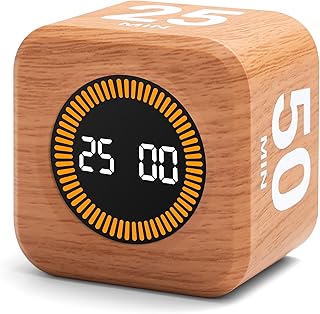
This physical timer is the ultimate tool for Strategy 1 (The 5-Minute Rule) and Strategy 3 (Time Blocking). Simply flip the cube to the desired time (e.g., 25 minutes for a Pomodoro sprint or 5 minutes for your “start time”). The benefit is that it is non-digital, preventing the urge to check your phone while setting a timer. This simplicity is key to focused deep work and helps you overcome the initial inertia of reducing screen time during work hours.
Check Price on Amazon
Procrastination often kicks in when we feel low energy or minor discomfort. An ergonomic vertical mouse forces your hand into a neutral “handshake” position, drastically reducing wrist strain and fatigue during long work blocks. This investment in your health is part of the ultimate self-care checklist, ensuring that physical discomfort doesn’t become another psychological excuse to delay work. It’s an essential upgrade for your home office setup.
Check Price on AmazonBeyond the Quick Fix: Building Long-Term Anti-Procrastination Habits
Every strategy in this guide can produce immediate results in the short term. But the real goal—the one most guides never address—is building the long-term habit architecture that makes non-procrastination your default state rather than a daily battle. This requires understanding how habits form and how to leverage that formation process deliberately.
The Habit Loop and Procrastination
Charles Duhigg’s habit loop model—cue, routine, reward—explains how procrastination becomes automatic and how it can be replaced. Your current procrastination pattern is a habit: a specific cue (opening a work document, feeling the discomfort of complexity) triggers a routine (checking Instagram, making unnecessary coffee) that delivers a reward (relief from discomfort, dopamine hit). Replacing this habit requires keeping the cue and reward constant while substituting a new routine—one that delivers relief through momentum rather than escape.
The 30-Day Anti-Procrastination Habit Installation Protocol
Habit research suggests that new behaviors require consistent repetition in a specific context before they become automatic. The following 30-day protocol is designed to systematically install anti-procrastination as default behavior:
Week 1: Foundation (Days 1–7)
- Identify your single most procrastinated recurring task or category of work.
- Write one implementation intention for it (When X, I will Y at Z).
- Apply the 5-Minute Rule to this task every day for 7 days. The only goal is starting—not finishing.
- At day’s end, write one sentence in a journal noting whether you started and how it felt.
Week 2: Environment Design (Days 8–14)
- Design your distraction-free environment: install Freedom or a comparable blocker, remove your phone from your workspace, clear physical clutter from your desk.
- Establish a consistent start ritual—a 3-minute sequence you perform before beginning your most important task (e.g., make tea, put on headphones, open your task manager, identify today’s single most important task).
- Track your actual start time versus your intended start time each day. The goal is closing this gap over 7 days.
Week 3: Identity Reinforcement (Days 15–21)
- Rewrite your self-talk using the “I don’t” formulation for your primary procrastination triggers.
- Implement a body doubling practice for your most challenging work sessions—even virtual, even 25 minutes.
- Begin each day by writing one sentence completing: “Today I am someone who [desired behavior].” Identity-based framing activates behavioral consistency beyond the individual moment.
Week 4: System Consolidation (Days 22–30)
- Conduct a daily end-of-day review (5 minutes): what did I avoid today, what pattern does that reflect, and what one change will I make tomorrow?
- Add one weekly review (30 minutes every Sunday): review all active projects, identify any accumulating avoidance patterns, reset implementation intentions for the coming week.
- At day 30, assess: which strategies produced the most dramatic results for your specific procrastination type? Double down on those and release the rest.
The Hidden Financial Cost of Procrastination
Procrastination is rarely discussed as a financial issue, but the economic costs of chronic delay are very real and very large. Understanding these costs creates compelling motivational stakes beyond the abstract desire to “be more productive.”
💰 Late Payment Fees
Procrastinating on bill payments generates late fees that are purely avoidable. Credit card late fees, utility late charges, and tax penalties represent hundreds of dollars annually for chronic procrastinators—money paid specifically because a task was delayed, not because it couldn’t be afforded.
📊 Investment Opportunity Cost
Delaying investment account setup or contribution increases by even 6–12 months produces compounding losses that are difficult to recover. The habit of procrastinating on financial tasks discussed in the 7 habits of people who are good with money translates directly into lower long-term wealth.
🏠 Insurance and Maintenance
Avoiding home maintenance tasks, car service scheduling, or health check-ups until they become emergencies dramatically inflates their cost. A $200 car service procrastinated for 6 months can become a $2,000 repair. Prevention is always cheaper than emergency response.
🚀 Career and Income
Missed deadlines, delayed project delivery, and lost opportunities due to procrastination have measurable career costs: delayed promotions, damaged professional reputation, and foregone income from unstarted side projects. The income impact of chronic professional procrastination over a decade is substantial.
Final Verdict: The Act of Starting is the Solution
The ultimate way to beat procrastination is to stop thinking of yourself as a procrastinator. You are a person who sometimes employs an emotional defense mechanism. By using these strategies—breaking the task down, locking down your environment, using momentum, understanding your brain’s biology, applying implementation intentions, and extending self-compassion when you fall short—you can retrain your brain to favor action over avoidance.
The Quick-Reference Anti-Procrastination Cheat Sheet
When procrastination strikes in the moment, you often don’t have time to re-read a comprehensive guide. Bookmark this section for rapid deployment when avoidance kicks in.
| If You Are Feeling… | Your Procrastination Type | The Immediate Fix | The 5-Minute Action |
|---|---|---|---|
| Overwhelmed and don’t know where to start | Overwhelm Procrastination | Micro-chunk to one sentence or one physical action | Write “Step 1:” and finish the sentence |
| Paralyzed by wanting it to be perfect | Perfectionism Procrastination | Draft Zero — label it “not for evaluation” | Write or do the worst possible version on purpose |
| Anxious, dreading judgment or failure | Fear-Based Procrastination | Create without commitment — draft with no send button | Write the email draft. Do not send for 24 hours |
| Spinning in options, can’t decide | Decisional Procrastination | Time-box the decision. 10 minutes, then commit | Flip a coin. Note your emotional reaction. That’s your answer |
| Just don’t want to do it — pure resistance | Hedonic Procrastination | Temptation bundle — pair the task with pleasure | Put on your favorite music and start for exactly 5 minutes |
| Resenting the task, it feels imposed | Resentment Procrastination | Find one dimension of the task you can control and exercise it | Change the location, the order, or the approach. Then start |
| Genuinely exhausted and empty | Possible Burnout (not procrastination) | Rest without guilt. This is not a productivity problem | Take a 20-minute nap or a 10-minute walk, then reassess |
🌟 Your One Action Right Now: Pick one strategy from this guide. Not seven. Not three. One. Write down the specific procrastinated task you will apply it to and when you will begin. The next 20 minutes represent the most productive opportunity you have had all day. Use them.