
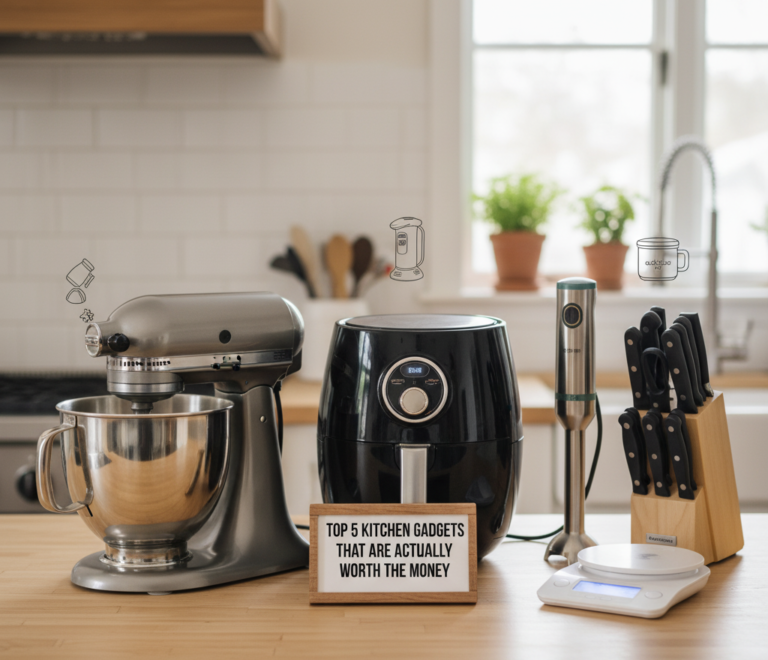
Top 5 Kitchen Gadgets That Are Actually Worth the Money (ROI Mastery)
The modern kitchen is filled with unitaskers—gizmos that promise culinary magic but end up collecting dust in a drawer. As productivity experts, we believe that an investment is only “worth the money” if it provides a high Return on Investment (ROI) in time, health, and saved capital.
The kitchen is a critical efficiency center. If you master your cooking, you save money (bolstering your financial habits), improve your health (boosting your skin’s health), and reclaim precious time for focused work. We have curated the top five tools that do just that, offering maximum versatility and minimal clutter.
The Hidden Financial Cost of Not Cooking: Why This Is a Money Problem
Before evaluating any kitchen gadget, it is worth quantifying the actual financial and health cost of the alternative—the default behavior that kitchen gadgets exist to replace. For most busy professionals, the alternative to cooking at home is some combination of restaurant meals, delivery orders, and takeout. The cumulative cost of this pattern is one of the largest unexamined drains on personal finances in modern life.
The average meal at a sit-down restaurant costs roughly $15–$25 per person before tip and drinks. The average delivery order costs $30–$50 for one or two people after delivery fees, service fees, and the near-mandatory tip for a driver. A home-cooked meal using quality ingredients costs $3–$8 per person for most dishes. The arithmetic is stark: a professional who eats out or orders delivery for dinner five nights per week at an average of $20 per meal spends approximately $5,200 per year on dinner alone. Replacing four of those five nights with home cooking at $6 per meal saves approximately $3,600 annually—money that, redirected to a Roth IRA and invested in an index fund, compounds to a significant sum over a working career.
The health cost is equally significant. Restaurant and delivery meals average 60% more calories than equivalent home-cooked meals, contain significantly more sodium, added sugars, and saturated fat, and provide meaningfully less dietary fiber and micronutrient density than meals prepared from whole ingredients at home. The association between frequent restaurant dining and weight gain, elevated cardiovascular risk markers, and higher rates of type 2 diabetes is well-documented in nutritional epidemiology research.
Kitchen gadgets are the mechanism that closes the gap between knowing you should cook at home and actually doing it consistently. The barrier to home cooking is not cost or motivation—it is time and friction. The five gadgets in this guide specifically target the highest-friction steps in the cooking process.
1. The ROI Philosophy: Why Kitchen Gadgets Matter to Productivity
Choosing a kitchen gadget requires the same rigorous evaluation as choosing the components for a custom PC build or the essential gadgets for your home office. The criteria are simple: Does it automate a time-consuming step, improve accuracy, or enable healthier cooking?
- Time-Blocking Mastery: The biggest time sink in cooking is preparation (chopping) and cooking time. The right gadget helps you implement time-blocking by compressing these activities, freeing up evenings for rest or strategic planning.
- Combatting Procrastination: Decision fatigue around meal prep often leads to expensive takeout. Automating the cooking process (as taught in our quick dinner guide) is a powerful way to beat procrastination.
- Financial Health: Every meal cooked at home reinforces the goals of the zero-based budget checklist, helping you accumulate capital that can be directed toward investment accounts.
The 5-Question Gadget Evaluation Framework
Before purchasing any kitchen tool—including the five reviewed in this guide—applying a consistent evaluation framework prevents the impulse buys that produce drawer clutter and wasted money. The five questions:
- Does it replace multiple tools or a significant time block? A gadget that replaces one other gadget is a lateral move at best. A gadget that replaces three other tools or saves 20+ minutes per week delivers genuine positive ROI.
- How difficult is it to clean? The most powerful cooking tool in existence becomes worthless if the cleanup friction prevents you from using it. Any gadget that requires disassembly, hand washing of multiple components, or prolonged soaking will be used once and shelved.
- Does it require specialist knowledge or skill to operate? Gadgets that require technique—a sous vide circulator, a mandoline slicer, a stand mixer with multiple attachments—are only high-ROI if you will invest time in learning to use them well. For most busy professionals, set-it-and-forget-it beats precision-requiring every time.
- How often will you realistically use it? A pasta maker used twice per year does not justify its counter space or drawer footprint. Estimate realistic weekly or monthly usage, not aspirational usage, when evaluating any tool.
- What is the durability-adjusted cost? A $30 knife that requires replacement every 18 months costs more over ten years than a $90 knife that lasts a decade. Calculate cost per year of expected use, not upfront price, for any significant kitchen purchase.
2. The Top 5 Worthy Kitchen Investments (High Value, Low Clutter)
Gadget 1: The Multi-Cooker (Air Fryer / Instant Pot)
ROI: Speed, Versatility, and Energy Efficiency
This is the ultimate efficiency tool. It replaces a slow cooker, pressure cooker, steamer, and often an air fryer or rice cooker in one unit. For the busy professional, the ability to cook a frozen chicken breast into a tender meal in 20 minutes is a non-negotiable time saver.
- Productivity Win: Enables set-it-and-forget-it cooking, perfect for executing dinner during your post-work time block before bedtime.
- Health Win: Makes batch cooking (essential for healthy eating) a simple process, aligning with the principles of the morning routine checklists.
Deep Dive: How to Get Maximum ROI From a Multi-Cooker
The multi-cooker’s ROI depends entirely on how you use it, and most owners use only a fraction of its capability. The pressure cooking function is the highest-value feature for time compression: dishes that take 90 minutes in a conventional oven—braised meats, dried bean dishes, bone broth—take 20–35 minutes under pressure. But the function that drives the greatest weekly behavior change for most people is the “sauté then seal” workflow: brown aromatics and proteins in the sauté mode (one pan, no stovetop burner needed), add liquids and remaining ingredients, seal, and set a timer. Walk away completely until done.
The air fryer lid (on combo models) transforms the unit’s utility for weeknight cooking: reheating refrigerated meal-prep containers in the air fryer produces results dramatically superior to microwave reheating, with crispness restored and moisture preserved. This single feature makes batch cooking far more appealing because the reheated meal tastes nearly as good as freshly cooked.
The batch cooking protocol that produces the highest weekly ROI: on Sunday, cook a large protein batch (a whole chicken, 3–4 pounds of seasoned chicken thighs, or a pork shoulder) in the multi-cooker while simultaneously using the stovetop or oven for grains and roasted vegetables. The combined Sunday prep time is 45–60 minutes of active work producing 8–12 servings of base components that can be assembled into different meals throughout the week in under 10 minutes per meal.
View Top-Rated Multi-Cooker on AmazonGadget 2: Digital Instant-Read Thermometer
ROI: Accuracy, Safety, and Food Waste Reduction
This seems simple, but it is one of the most financially responsible tools you can own. It eliminates guesswork, ensuring chicken is safe to eat and steak is perfectly cooked. It prevents overcooking, saving the quality (and cost) of expensive proteins.
- Financial Win: Prevents food waste—a major habit of people who are good with money. You never ruin an expensive meal.
- Efficiency Win: The “instant-read” feature means you can pull food the moment it hits the perfect temperature, saving 5-10 minutes of unnecessary cooking time.
Deep Dive: The Temperature Cheat Sheet
The thermometer’s value compounds with knowledge of the correct temperature targets. The USDA-recommended safe internal temperatures represent the minimum safe threshold; professional chefs often target slightly higher temperatures for optimal texture in certain applications. The practical targets for the proteins most commonly cooked at home:
| Food | Safe Min (USDA) | Ideal Texture Target | Note |
|---|---|---|---|
| Chicken breast | 165°F / 74°C | 160°F / 71°C (carry-over cooks to 165) | Pull early; rest 3 min |
| Chicken thighs | 165°F / 74°C | 175–185°F / 79–85°C | Higher temp = more tender |
| Beef steak (medium) | 145°F / 63°C | 130–135°F / 54–57°C | Rest 5 min; temp rises |
| Ground beef / pork | 160°F / 71°C | 160°F / 71°C | No rare for ground |
| Pork loin/chops | 145°F / 63°C | 145°F / 63°C | Slight pink is safe |
| Fish (most types) | 145°F / 63°C | 125–130°F / 52–54°C (salmon) | Varies by fish type |
The carry-over cooking principle—food continues to cook after being removed from heat as the exterior temperature equalizes with the interior—means pulling food 5°F before the target temperature and resting it produces optimal results. This single piece of knowledge, applied with an instant-read thermometer, eliminates the overcooked proteins that represent both food waste and reduced meal quality.
View Instant-Read Thermometer on AmazonGadget 3: High-Powered Immersion Blender (Stick Blender)
ROI: Low Cleanup, Versatility, and Nutrient Density
This single tool handles soups, sauces, smoothies, and even whipped cream, often performing the task right in the pot or cup. It replaces a clumsy stand mixer or a difficult-to-clean conventional blender.
- Health Win: Encourages the quick creation of vegetable-rich soups (a core component of healthy weeknight dinners) with virtually zero cleanup.
- Time Win: Saves the 10-minute cleanup ritual that often causes people to avoid healthy cooking entirely.
Deep Dive: The 5 Highest-ROI Uses for an Immersion Blender
Most immersion blender owners use theirs for soups and smoothies—two excellent applications—but leave the majority of its utility untapped. The five applications that produce the most cooking value per use:
- Batch vegetable soups — the signature use case. A 30-minute vegetable soup cooked in a large pot, blended directly in the pot in 60 seconds, produces 6–8 servings of a nutrient-dense, low-calorie meal that refrigerates for five days and freezes for months. The caloric density of blended vegetable soups is extraordinarily low (200–350 calories per large serving) while satiety is high, making this a weight management tool as much as a cooking tool.
- Sauces and vinaigrettes — blending directly in a tall cup or jar with minimal cleanup, producing emulsified sauces (mayonnaise, hollandaise, pan sauces) that previously required whisking skill or a conventional blender.
- Protein smoothies — in the included blending cup, combining protein powder, frozen fruit, liquid, and leafy greens in under two minutes with a single component to wash. The cleanup advantage over a conventional blender is approximately 8 minutes per use.
- Cauliflower mash — steamed or boiled cauliflower blended with butter, cream, and seasoning directly in the pot produces a low-carbohydrate substitute for mashed potatoes that many people find satisfying as a regular swap.
- Baby food preparation — for households with infants, the ability to blend any cooked food to any consistency directly in its cooking vessel, then portion and freeze in ice cube trays, eliminates the entire commercial baby food category from the grocery budget.
Gadget 4: Dedicated Food Processor (The Prep Automator)
ROI: Automation, Batch Cooking, and Time Compression
Chopping vegetables is the biggest time bottleneck in cooking. A food processor automates the entire “Mise en Place” step. This is a crucial investment if you do large meal prep batches on the weekend.
- Productivity Win: Allows you to batch chop all vegetables for the week in 15 minutes, ensuring your weeknight cooking is truly under 30 minutes. This is the ultimate execution of Habit 2 of the highly effective people: prioritizing preparation.
- Financial Win: Makes it easy to use cheap, whole ingredients rather than expensive pre-chopped vegetables.
Deep Dive: Building the Sunday Prep System Around a Food Processor
The food processor’s ROI is maximized through a systematic Sunday preparation protocol—a single 60-90 minute weekly investment that eliminates weeknight vegetable prep entirely. The protocol, executed in sequence to minimize bowl-washing between tasks:
Step 1: Dry ingredients first. Process nuts, seeds, or dry spice blends (if making spice pastes) before any wet ingredients, so no washing is required between tasks.
Step 2: Onions and aromatics. Process all onions, garlic, and ginger at once using the blade attachment. Divide into daily portions and refrigerate. Pre-processed aromatics keep for five days refrigerated and can be frozen in tablespoon-sized portions in ice cube trays for longer storage.
Step 3: Hard vegetables. Using the shredding disc, process carrots, cabbage, beets, or other firm vegetables for salads, slaws, and stir-fry bases. Store in sealed containers.
Step 4: Medium vegetables. Switch to the slicing disc for zucchini, cucumber, bell peppers, and similar items. These are best used within three days after slicing.
The financial payoff of this system is compounded by the ability to buy whole vegetables—consistently cheaper per pound than pre-cut—and by the elimination of the “I’m too tired to chop” decision that drives delivery app orders. A food processor that enables four additional home-cooked meals per week pays for itself in approximately six to eight weeks in delivery savings alone.
View Food Processor on AmazonGadget 5: Quality Chef’s Knife (The Foundational Tool)
ROI: Safety, Speed, and Durability
While technically not a “gadget,” a single, well-balanced 8-inch chef’s knife is the most crucial tool in any kitchen. A sharp knife is safer and faster than a dull one. This is a lifelong investment, much like choosing a foundational piece of tech or a stable investment account.
- Safety Win: A sharp, ergonomic knife is safer and reduces hand fatigue (crucial for long cooking sessions).
- Durability Win: This tool is analog and requires no digital security, unlike the password managers needed for your digital life. It is the purest form of manual efficiency.
Deep Dive: Knife Maintenance — The Skill That Multiplies Your Investment
A quality chef’s knife is only as good as its edge. The most common mistake of home cooks who invest in a good knife is neglecting maintenance, allowing a $100 blade to perform like a $15 one within six months. Two maintenance practices, properly executed, keep a quality knife performing at its peak indefinitely.
Honing (the most misunderstood maintenance task) realigns the microscopic edge of the blade that deforms with normal use. It does not remove metal or sharpen a truly dull blade; it restores alignment to an edge that is still present but bent. Honing should be done before every significant use, takes 30 seconds, and prevents the need for frequent sharpening. The honing rod that came with your knife set is the right tool—use it with five to eight light strokes per side at a consistent 15–20 degree angle.
Sharpening removes a small amount of metal to create a new edge. For most home cooks, once or twice per year on a whetstone or by a professional sharpening service is sufficient. Regular honing extends the interval between sharpenings significantly. The combination of regular honing and annual sharpening keeps a quality knife performing at peak for a decade or longer.
What destroys knives: the dishwasher (thermal expansion, caustic detergents, and metal-on-metal contact degrade blades rapidly), glass or ceramic cutting boards (much harder than steel; they dull edges immediately), and improper storage (loose in a drawer where blades contact other metal). Store quality knives on a magnetic wall strip or in a wooden knife block.
View Chef’s Knife on AmazonThe Anti-List: Kitchen Gadgets That Are NOT Worth the Money
Applying the ROI framework rigorously means identifying not just the high-value investments but the low-value traps that fill kitchen stores and Amazon recommendation carousels. These categories consistently fail the five-question evaluation:
- Single-purpose gadgets — avocado slicers, strawberry hullers, cherry pitters, mango splitters, egg separators. A sharp paring knife does all of these in comparable time with zero additional storage footprint.
- Electric can openers — a manual can opener is faster for most people, costs $8–12, stores in a drawer, and never needs charging or cleaning beyond a rinse.
- Bulky countertop appliances used rarely — bread makers, waffle irons, quesadilla makers, and sandwich presses that produce good results once per month do not justify their counter real estate.
- Mandoline slicers without a cut-resistant glove — mandolines are genuinely useful for certain preparations but are responsible for a disproportionate share of serious kitchen injuries. Never purchase one without simultaneously purchasing a cut-resistant glove rated for mandoline use.
- Non-stick pans with PTFE coatings — degrading non-stick surfaces release particles into food and require replacement every 1–3 years. A well-seasoned carbon steel or cast iron pan or a quality stainless steel pan is a multi-decade investment that non-stick cannot match on a durability-adjusted cost basis.
3. Maximizing Your ROI: Health, Wealth, and Time
The true value of these gadgets is how they impact your non-kitchen life.
Kitchen Efficiency and Digital Health
Cooking is one of the few high-value, non-screen-based activities left in modern life. By automating the difficult parts with these gadgets, you make the overall activity more appealing, helping you commit to reducing screen time every day. Time spent cooking is time spent away from your computer—a healthy break for your mind and your eyes.
Gadget Investment vs. Financial Investment
Treat buying a quality gadget like funding an investment account. You pay more upfront for a better long-term return.
- Risk Management: Just as you learn about the four types of investment accounts, you learn the risk/reward of buying a specialized vs. multi-functional kitchen tool.
- Compounding Returns: Every dollar saved on takeout is a dollar that can go toward debt reduction, speeding up your journey to improving your credit score fast.
- Education: Use the hands-free time enabled by a multi-cooker to listen to an audiobook from the top 10 books on personal finance.
The Complete Meal Prep System: Using All 5 Gadgets Together
Each of the five tools reviewed above delivers standalone value. But their maximum ROI is realized when used as an integrated weekly meal preparation system—a protocol that treats Sunday cooking not as a chore but as a weekly investment in Monday-through-Friday quality of life.
The system works in sequence, with each tool handling the step it performs best. The food processor handles all vegetable prep first—onions, aromatics, sliced and shredded vegetables—in a single 15-minute session that eliminates all weeknight chopping. The multi-cooker handles the longest-cooking proteins and grains simultaneously: a whole chicken or large protein batch under pressure while grains cook on the stovetop. The immersion blender handles any soups or sauces prepared during the session. The chef’s knife handles anything requiring precision—herbs, delicate produce, proteins that need portioning. The thermometer confirms every protein has reached safe internal temperature before being portioned and refrigerated.
The output of a 75-minute Sunday prep session: pre-chopped aromatics for the week, a large protein batch portioned into daily servings, two to three vegetable side dishes or salad components, one large-batch soup, and cooked grains. Weeknight assembly from these components takes 8–12 minutes per meal. The time investment in Sunday pays a daily dividend of 20–30 minutes recovered on each weeknight, producing a net weekly time savings of 60–90 minutes compared to cooking from scratch each evening—while delivering meaningfully better nutrition than takeout alternatives.
4. The Minimalist Approach: Packing Principles in the Kitchen
The best gadgets are multi-functional, lightweight, and truly essential. This is the same philosophy we use for high-efficiency travel.
- The Carry-On Principle: When you only pack the 8 essential items in your carry-on bag, you prioritize utility over excess. These 5 gadgets are the “carry-on” essentials of the kitchen.
- Packing for Europe: Saving money on food directly enables travel. Use the principles in how to plan a trip and the ultimate packing list to plan your dream vacation to one of the cheapest European cities, financed by your kitchen discipline.
- Rewards: The financial freedom these gadgets provide can be leveraged by using the best travel rewards credit cards to further fund your adventures.
Kitchen Efficiency for Different Lifestyles: Customizing the System
The five-gadget system and meal prep protocol above represents a general-purpose framework. Effective implementation requires adapting it to your specific household context.
Solo Professionals: The One-Person Efficiency Setup
The primary challenge of cooking for one is scale: most recipes and batch quantities produce four to six servings, creating repetitive eating that reduces motivation to continue cooking. The solution is strategic freezing combined with deliberate variety in flavor profiles. A batch of 6 chicken thighs cooked in the multi-cooker can be stored as three separate preparations—plain for use in grain bowls and salads, shredded with one sauce for tacos and wraps, and sliced with different seasoning for stir-fry. Same base protein; three meaningfully different meal experiences across the week.
Couples and Small Families: The Coordination System
For two to four people, the challenge shifts from scale to preference coordination: different dietary needs, different schedule timing, different taste preferences. The multi-cooker’s “keep warm” function is the highest-value feature in this context—a meal held on warm for two hours maintains safe temperature and acceptable quality, accommodating households where members eat at different times without requiring multiple cooking sessions.
Building a shared weekly meal plan on Sunday morning—a 10-minute conversation about the coming week’s schedule, preferences, and constraints—followed by the prep protocol produces far better adherence than individual uncoordinated meal decisions throughout the week. The shared plan also allows grocery shopping to be a single efficient trip with a complete list rather than multiple incremental visits.
The Budget-Maximizing Kitchen: Stretching Dollars Further
The highest-ROI cooking strategy for budget-constrained households is protein batch cooking with cheap, nutrient-dense protein sources: dried legumes (beans, lentils, chickpeas) in the multi-cooker, whole chicken broken down at home rather than purchased as pre-cut pieces, and less popular but highly nutritious cuts (chicken thighs vs. breasts, chuck roast vs. steak, pork shoulder vs. pork chops). Dried beans cooked from scratch in a multi-cooker cost approximately $0.50 per serving of protein; canned beans cost $1.50–$2.00 per equivalent serving; boneless chicken breast costs $3.50–$5.00 per serving. The food processor enables using whole vegetables rather than pre-cut, typically saving $1.00–$2.50 per pound.
Recommended Gadgets for Immediate Productivity Gain
To start your journey into kitchen efficiency, these two products offer the highest immediate return on investment for any busy professional.

This single device is the ultimate time-saving investment. It combines pressure cooking (cooking things 70% faster) with air frying (healthy, crispy results). It enables batch cooking, supports the meal planning necessary for a zero-based budget, and ensures you can stick to your time-blocked schedule even when life gets hectic. This is the ultimate multi-tasker, much like the best budget laptops that handle both work and entertainment.
Check Price on Amazon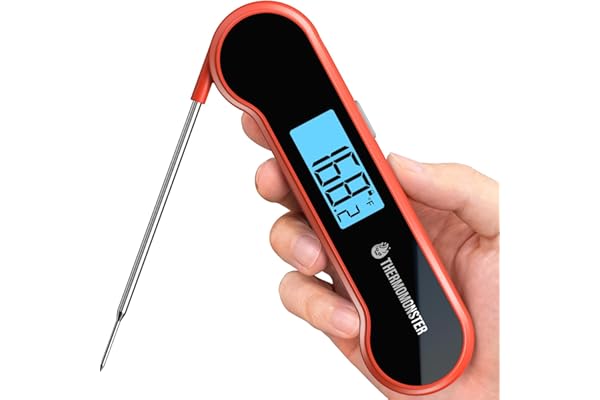
Why is this essential? It eliminates guesswork, guaranteeing food safety and perfect texture in under 3 seconds. It prevents overcooking expensive ingredients, which is a key habit of people who are good with money by reducing waste. This level of precision is comparable to the analytical skills required to master the top productivity apps or to use top finance books to track every minute.
Check Price on AmazonFinal Verdict: Buy Less, Use More
The best kitchen gadgets are those that facilitate your long-term goals. They are multi-functional, durable, and directly enable the healthy, frugal habits that lead to success. Invest in these five tools, prioritize efficiency over excess, and watch your productivity—in and out of the kitchen—soar.