
How to Stop Overthinking: A Master Guide to Reclaiming Your Peace of Mind
Break the cycle of negative thoughts, anxiety, and analysis paralysis. Discover the psychology behind why we overthink and the practical steps to stop.
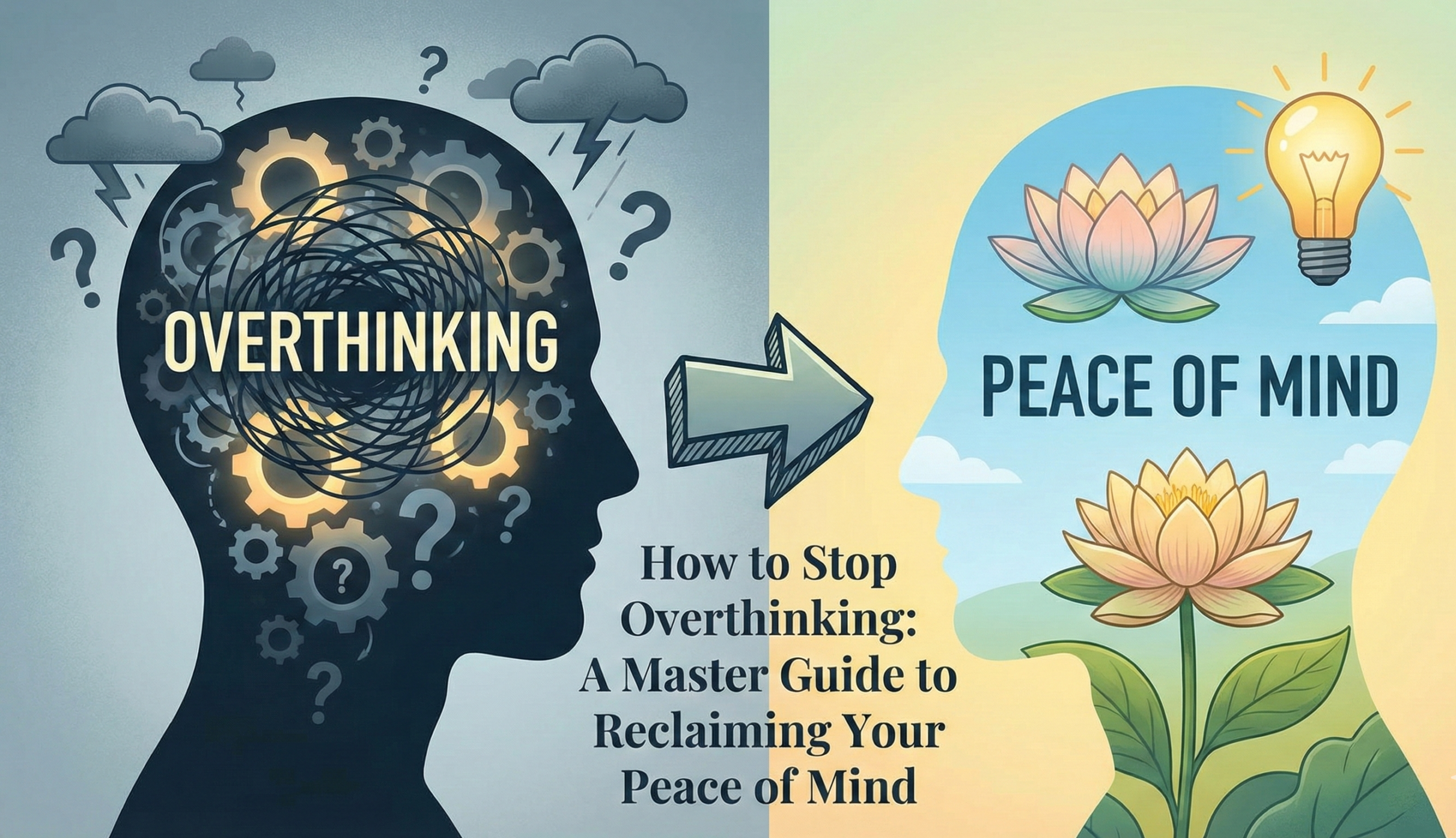
The Mental Prison of “What If”
You lay in bed at 2:00 AM, replaying a conversation from three years ago. You hesitate to send a text because you are drafting seventeen different versions in your head. You struggle to make a simple decision about dinner because you are paralyzed by the potential outcome. If this sounds familiar, you are in the grips of overthinking.
Overthinking is not just “thinking a lot.” It is a debilitating cycle where the mind obsessively dwells on the same thoughts, analyzing them from every conceivable angle until they lose all meaning and become sources of anxiety. It is often described as “analysis paralysis”—a state where you are so busy weighing options that you never take action.
Whether you are trying to figure out how to stop overthinking relationships, dealing with workplace anxiety, or simply wondering why do I overthink everything, this guide is your exit strategy. We will dismantle the mechanisms of the overthinking brain and provide actionable, proven strategies to quiet the noise.
⚠️ The Hidden Cost of Overthinking
A study published in the Journal of Abnormal Psychology found that people who ruminate are significantly more likely to develop depression and anxiety disorders. Overthinking is not a personality quirk—it is a cognitive pattern that compounds over time, worsening the very situations it is trying to solve. The good news: it is a pattern, and patterns can be changed.
What Is Overthinking? (And Is It a Disorder?)
To defeat the enemy, you must define it. What is overthinking? In psychology, it is often referred to as rumination. It involves two destructive thought patterns:
- Rumination: Dwelling on the past (e.g., “I shouldn’t have said that,” “Why did they look at me like that?”).
- Worry: Obsessing over the future (e.g., “What if I fail?” “What if they leave me?”).
Is Overthinking a Disease?
Technically, “overthinking disorder” is not a clinical diagnosis in the DSM-5. However, chronic overthinking is a primary symptom of several mental health conditions, including Generalized Anxiety Disorder (GAD), Depression, and Obsessive-Compulsive Disorder (OCD). It is also heavily linked to executive dysfunction.
Interestingly, there is a strong correlation between decision fatigue and ADHD. For neurodivergent individuals, the inability to filter out irrelevant stimuli often manifests as severe overthinking.
Symptoms of Overthinking
How do you know if you are just thoughtful or if you are an overthinker? Look for these signs:
- Inability to sleep due to racing thoughts (often searching for how to stop overthinking at night).
- Second-guessing every decision, no matter how small.
- Replaying scenarios in your mind repeatedly.
- Imagining the worst-case scenario (catastrophizing).
- Physical fatigue despite no physical exertion.
- Difficulty concentrating on the present task because your mind is “elsewhere.”
- Seeking constant reassurance from others before making decisions.
- Feeling mentally “stuck” or unable to move forward on simple tasks.
Types of Overthinking
Not all overthinking looks the same. Recognizing your specific pattern is the first step to addressing it effectively.
🔄 Rumination
Replaying past events on a loop. “Why did I say that?” or “I should have handled it differently.” Primarily backward-looking and shame-driven.
😰 Catastrophizing
Automatically jumping to the worst possible outcome. “If I mess up this presentation, I’ll lose my job and never find another one.”
🤔 Analysis Paralysis
Over-analyzing options until no decision can be made. Affects everything from restaurant menus to major life choices.
🪞 Mind-Reading
Assuming you know what others are thinking, almost always negatively. “They didn’t reply quickly, they must be annoyed with me.”
🔮 Fortune-Telling
Predicting negative outcomes with certainty. “I know the interview won’t go well” before it even happens.
📏 Perfectionism Spiral
Thinking so long about doing something “perfectly” that it never gets started. The pursuit of perfect becomes the enemy of done.
Why Do I Overthink Everything?
Overthinking is a protective mechanism gone rogue. Biologically, our brains are wired to detect threats. In the stone age, thinking about “what if a tiger is behind that bush” saved your life. Today, that same mechanism is triggered by an ambiguous email from your boss or a vague text from a partner.
The Link to Procrastination
Often, we overthink to avoid doing. It feels like we are being productive because we are “planning” or “analyzing,” but in reality, we are stalling. This is a classic form of procrastination. If you find yourself overthinking tasks to the point of not starting, check out our ultimate list of 7 ways to beat procrastination.
The Illusion of Control
Overthinkers often believe that if they worry enough, they can control the outcome. This is the “worry trick.” You convince yourself that by running through every possible disaster, you can prevent them. In reality, you are only ruining your present moment.
Childhood Conditioning
Many overthinkers were raised in environments where unpredictability was the norm—an emotionally unavailable parent, a volatile household, or an environment where mistakes had disproportionate consequences. As children, hypervigilance (constant environmental scanning) was an adaptive survival strategy. As adults, that same hypervigilance persists in the form of chronic overthinking, long after the original threat has passed.
High Intelligence and Overthinking
Contrary to popular belief, high intelligence is actually a risk factor for overthinking. Highly intelligent people can generate more hypothetical scenarios, see more potential consequences, and make more complex associations between events. What looks like “insight” can quickly become a cognitive trap when the brain’s pattern-recognition machinery runs without pause.
Social Comparison and Overthinking
We are deeply social creatures and our brains are acutely sensitive to status and belonging. The constant low-grade anxiety of “Am I doing enough? Do they like me? Am I falling behind?” is a modern epidemic amplified by social media, which provides an endless stream of curated comparison points. When social comparison becomes a background program running at all times, it feeds the overthinking engine continuously.
The Brain Science Behind Overthinking
Understanding what is happening in your brain when you overthink doesn’t just satisfy curiosity—it gives you leverage. When you can see the mechanism, you can interrupt it.
The Default Mode Network (DMN)
When you are not actively engaged in a task, your brain defaults to a network of regions called the Default Mode Network (DMN). The DMN is responsible for self-referential thinking—thinking about yourself, other people, the past, and the future. It is essentially the “mind-wandering” network. In overthinkers, the DMN is hyperactive and fails to disengage even when a task requires focused attention. The result is intrusive thoughts about yourself and your life even when you are trying to concentrate.
The Amygdala Hijack
The amygdala is the brain’s alarm system. When it detects a threat—real or imagined—it triggers the stress response, flooding your body with cortisol and adrenaline. In overthinkers, the amygdala is chronically over-reactive. Abstract threats (a difficult conversation, an uncertain future) trigger the same biological response as physical dangers. This is why overthinking feels so physically exhausting: your body has been in a state of low-grade emergency all day.
The Prefrontal Cortex (PFC)
The prefrontal cortex is the rational, planning part of your brain. Ideally, the PFC acts as a regulator for the amygdala—putting context around threats and calming the alarm. But chronic stress, sleep deprivation, and high cortisol levels actually impair PFC function. The rational brain goes offline precisely when you need it most. This is why you can know, intellectually, that you are overthinking, and still not be able to stop—the part of your brain that would apply the brakes is temporarily disabled.
The Good News: Neuroplasticity
The brain is not fixed. Every strategy in this guide works, in part, by reshaping neural pathways through a process called neuroplasticity. Repeated meditation physically thickens the prefrontal cortex and shrinks the amygdala. Consistent cognitive reframing creates new default thought paths. Exercise reduces cortisol and improves PFC function. The strategies are not just psychological; they are neurological. Stick with them long enough and the brain literally rewires.
Dopamine Loops and Thought Addiction
There is an uncomfortable truth about overthinking: it can become genuinely addictive. The brain’s dopamine system rewards novelty and problem-solving. Every time you turn over a worry in your mind and find a new angle—even a distressing one—it provides a micro-hit of dopamine. The brain codes this as “useful activity.” Over time, overthinking becomes a compulsive behavior: uncomfortable, unwanted, but somehow difficult to stop. Recognizing that you may be “addicted” to your worries is not self-criticism; it is strategic self-knowledge that unlocks more targeted interventions.
Strategy 1: Cognitive Restructuring
If you want to know how to not overthink, you must change how you talk to yourself. This is the core of Cognitive Behavioral Therapy (CBT), the most rigorously evidence-backed psychological intervention for anxiety and rumination.
The “Stop” Technique
When you catch yourself spiraling, literally say “STOP” out loud. It interrupts the neural pathway. Then, challenge the thought:
- Is this thought based on fact or assumption?
- Is this thought helpful?
- What is the evidence against this thought?
For example, if you are overthinking a relationship and think, “They haven’t texted back, they must hate me,” challenge it. Evidence: They are at work. They are usually busy at this time. Fact: They said they loved me yesterday.
The “Worry Funnel”
One of the most powerful CBT tools for overthinkers is the Worry Funnel. When a worry arises, push it through these questions in sequence until it resolves:
- Is this worry within my control? If no, practice acceptance and move on. If yes, proceed.
- Can I do something about it right now? If yes, do it immediately—even a micro-action. If no, schedule a time to address it.
- Have I scheduled time to address it? If yes, your brain can release the thought. If no, write it down and schedule it now.
The Worry Funnel converts free-floating anxiety into either action or intentional postponement. Both are infinitely better than endless cycling.
Cognitive Defusion
Developed in Acceptance and Commitment Therapy (ACT), cognitive defusion is the practice of creating distance between yourself and your thoughts. Instead of “I am a failure,” you practice saying “I am having the thought that I am a failure.” This small linguistic shift is surprisingly powerful. It repositions the thought as an event passing through your mind rather than a statement of fact. Other defusion techniques include imagining your thoughts as leaves floating down a stream, or visualizing the words of the thought as a silly cartoon font—anything that reduces the thought’s sense of gravity and urgency.
The Best-Case vs. Worst-Case Exercise
Overthinkers typically run worst-case scenarios on autopilot. Force your brain to run all three scenarios for balance: worst case, best case, and most likely case. You will almost always find that the “most likely” outcome is something you can handle, and that the worst case—even if it happened—is survivable. This exercise doesn’t minimize risk; it calibrates it accurately.
Strategy 2: Structure Your Chaos
An idle mind is the devil’s playground. Overthinking thrives in unstructured time. By organizing your life, you remove the ambiguity that fuels anxiety.
Journaling and Note Taking
Get the thoughts out of your head. Writing signals to your brain, “This has been recorded, you can stop holding onto it.” You don’t need a fancy diary; you just need a system. Read our guide on the best ways to organize notes to turn your chaotic brain dump into actionable items.
Time Blocking “Worry Time”
It sounds counterintuitive, but schedule a time to overthink. Dedicate 20 minutes at 4:00 PM to “Worry Time.” If a worry pops up at 10:00 AM, write it down and tell yourself, “I will worry about this at 4:00 PM.” By the time 4:00 PM rolls around, the emotion has usually faded. This is a variation of time blocking specifically for anxiety.
The “Two-Minute Rule” for Small Decisions
Analysis paralysis often builds up from a backlog of unresolved micro-decisions. Apply the Two-Minute Rule: if a decision will take less than two minutes to execute, make it right now and move on. What to eat, which email to respond to first, whether to make that quick call—these decisions should never enter your overthinking queue. Reserving your deliberation energy for decisions that genuinely deserve it dramatically reduces overall cognitive load.
Building a “Done List” Alongside a To-Do List
Overthinkers often suffer from a pervasive sense that they are “not doing enough.” A Done List—a running record of everything you accomplish in a day—counteracts this. At the end of each day, write down everything you completed, no matter how small. Making coffee counts. Sending one email counts. The Done List provides concrete evidence against the catastrophic narrative of “I did nothing today,” interrupting one of the most common rumination loops in high-achieving overthinkers.
Strategy 3: Mindfulness and Grounding Techniques
Mindfulness is not about emptying your mind—it is about changing your relationship with your thoughts. You become an observer of your thoughts rather than a prisoner of them. This single shift is the foundation of almost all modern psychological approaches to overthinking.
The 5-4-3-2-1 Grounding Technique
When you feel yourself spiraling into anxious thoughts, immediately engage your senses to pull yourself into the present moment. Name aloud or in your head:
- 5 things you can see
- 4 things you can physically feel (your feet on the floor, the fabric of your shirt)
- 3 things you can hear
- 2 things you can smell
- 1 thing you can taste
This technique works by forcing the brain’s attention to sensory input, which directly competes with the DMN’s self-referential rumination. It is particularly effective in the acute moment of panic or spiraling—a rapid interrupt that does not require any special equipment or setting.
Box Breathing
The breath is the only autonomic process you can consciously control—and it has a direct line to your nervous system. Box breathing (also called tactical breathing, used by military personnel and elite athletes) works as follows: inhale for four counts, hold for four counts, exhale for four counts, hold for four counts. Repeat four times. This pattern activates the parasympathetic nervous system, directly counteracting the amygdala’s stress response and lowering cortisol within minutes.
Body Scan Meditation
One of the most effective techniques for nighttime overthinking is the body scan: systematically moving your attention from your feet to the crown of your head, noticing any sensations without judgment. The body scan occupies the mind’s attention with physical reality, cutting off the oxygen supply to abstract worry loops. A 10-minute body scan before sleep dramatically reduces sleep onset time in chronic worriers.
Mindful Walking
You do not need a meditation cushion or a quiet room. Mindful walking—simply paying close attention to the sensation of each footstep, the rhythm of your breathing, and the visual details of your environment—is a portable mindfulness practice that can be done anywhere. Many overthinkers find that formal seated meditation feels impossible because the mind is too activated. Walking provides the gentle physical rhythm that anchors attention while allowing the nervous system to settle.
Strategy 4: Better Decision-Making Frameworks
Much overthinking centers on decisions. We loop endlessly because we lack a framework for reaching resolution. Giving yourself a structured decision-making process eliminates much of the anxiety around choice.
The 10/10/10 Rule
When facing a difficult decision, ask yourself three questions: How will I feel about this decision in 10 minutes? In 10 months? In 10 years? This temporal perspective-taking exercise rapidly clarifies which decisions actually matter. The vast majority of things we agonize over have no impact whatsoever at the 10-year time horizon—which is important information. Conversely, it catches genuinely important decisions that deserve more deliberation.
The “Good Enough” Threshold
Perfectionist overthinkers seek the objectively best option in every decision. The problem: in most real-world decisions, there is no objectively best option—only trade-offs. The economist Herbert Simon coined the term “satisficing” (a combination of satisfying and sufficing) for the strategy of choosing the first option that meets your minimum criteria rather than exhaustively searching for the theoretical optimum. Satisficing is not settling; it is an accurate recognition that optimizing every decision has a real cognitive cost that compounds across a day.
Establishing Decision Deadlines
Decisions without deadlines stay open indefinitely, feeding the overthinking loop. For every non-trivial decision you face, establish a decision deadline—a specific time by which you will commit to a choice. Before that deadline, gather information actively. After the deadline, commit and move forward without re-opening the loop. The discipline of decision deadlines trains the brain to understand that information-gathering has a defined endpoint, preventing the compulsive “just one more angle” pattern that characterizes overthinking.
Pre-Mortems for High-Stakes Decisions
A pre-mortem is the inverse of a post-mortem. Before making a major decision, imagine that you have already made it and the outcome was a disaster. Now work backwards: what went wrong? This exercise serves two purposes for overthinkers. First, it channels the natural catastrophizing tendency into a structured, productive format. Second, it actually improves decisions by systematically identifying risks—so you are no longer catastrophizing in the dark, but in the light of a logical process.
Strategy 5: Radical Acceptance
One of the most counterintuitive truths about overthinking is that the attempt to control or eliminate unwanted thoughts often makes them stronger. Psychologist Daniel Wegner’s “White Bear” experiment demonstrated this definitively: when people are told not to think about a white bear, they think about it far more than people who were given no such instruction. The attempt to suppress a thought ironically increases its frequency and intensity.
The ACT Approach: Accept and Defuse
Acceptance and Commitment Therapy (ACT) proposes a radically different relationship with uncomfortable thoughts. Rather than trying to eliminate anxiety or stop overthinking by force, ACT teaches you to accept the presence of difficult thoughts while choosing your behavior independently of them. The thought “what if I fail?” is allowed to be present—you simply do not let it dictate whether you take action. This approach is supported by substantial clinical evidence and is increasingly recognized as more effective than traditional thought-suppression approaches for chronic worriers.
The Uncertainty Tolerance Exercise
At the root of most overthinking is an intolerance of uncertainty. The mind keeps spinning because it is trying to achieve certainty in a world that is fundamentally uncertain. The antidote is deliberately practicing tolerating small uncertainties in daily life. Go to a restaurant without checking the menu first. Take a slightly different route to work without knowing exactly how long it will take. Make small decisions without research. These micro-exposures to uncertainty gradually build your uncertainty tolerance, reducing the anxiety response that fuels overthinking.
Strategy 6: The Action Cure
Overthinking is a thought problem with a behavior solution. You cannot think your way out of overthinking—you act your way out. Action, even imperfect action, is the most reliable interruption of the rumination cycle.
The 2% Rule
When you are paralyzed by a decision or a looming task, ask yourself: “What is 2% of this task I could do right now?” Not the whole thing. Not even a meaningful chunk. Two percent. Send one email. Write one sentence. Make one call. The act of starting—however minimal—breaks the frozen state and provides momentum. The brain codes “starting” as “in progress,” which reduces the anxiety of the unstarted task dramatically.
Physical Movement as Thought Interruption
Physical movement is one of the most neurologically direct ways to interrupt an overthinking loop. Exercise metabolizes cortisol and adrenaline, the stress hormones that physically sustain rumination. Even a ten-minute brisk walk outside provides a measurable reduction in ruminative thinking. For chronic overthinkers, regular exercise is not a lifestyle recommendation—it is a clinical intervention. The research on exercise and anxiety is clear: it works, reliably, across populations, and has essentially no side effects.
“The cure for anxiety is not thinking better thoughts. It is taking meaningful action toward your values in the presence of anxiety.” — Acceptance and Commitment Therapy principle
How to Stop Overthinking Relationships
Relationships are the most common trigger for overthinking. “Why did they say it like that?” “Are they pulling away?” How to stop overthinking in a relationship is about building trust—not just in your partner, but in your ability to handle whatever happens.
The Attachment Theory Lens
Much relationship overthinking has its roots in attachment style. If you have an anxious attachment style (developed in response to inconsistent early caregiving), your nervous system is wired to scan for signs of rejection or abandonment. Every ambiguous signal—a shorter text, a distracted look, a delayed reply—is processed as potential evidence of threat. Understanding your attachment style is not about assigning blame; it is about recognizing why your brain is generating these signals, so you can respond to them as information rather than fact.
How to Stop Thinking About Someone
Whether it is an ex or a crush, obsessive thinking is painful. The brain chemistry here is similar to addiction. To break the cycle of how to stop thinking about someone:
- No Contact Rule: Remove the stimuli. Mute them on social media. Reduce screen time to avoid “doomscrolling” their profile.
- Redirect Focus: When the thought intrudes, physically move your body. Go for a run, clean a room, or engage in a hobby.
- Acceptance: Stop fighting the thought. Say, “I am thinking about them, and that’s okay,” and then let it float away like a cloud. Fighting thoughts makes them stronger (the “White Bear” effect).
For Current Partners
If you suffer from overthinking anxiety in your partnership, communication is the antidote. Instead of analyzing their silence, ask, “I’m feeling a bit anxious about X, can we talk about it?” Vulnerability kills overthinking. It replaces the imagined narrative with actual information, and actual information—even if difficult—is almost always less terrifying than what the overthinking mind generates in the absence of data.
Establishing Relationship “Agreements”
Many relationship overthinkers are anxious about ambiguity in the relationship itself. Explicit agreements about communication expectations—how quickly you aim to reply to texts, how to signal when you need space, how to raise concerns—reduce the interpretive burden on both partners. When a delayed reply has a known explanation (e.g., “I’m often slow to reply during work hours”), it no longer feeds the overthinking engine. Clarity is the antidote to relational anxiety.
The Relationship Inventory
When you find yourself spinning about a relationship, try a written inventory: write down five concrete positive interactions or gestures from the past week. This is not toxic positivity—it is cognitive accuracy. Anxious minds selectively encode and recall negative or threatening information, which means your mental “record” of a relationship is almost always more negative than the actual balance of experiences. The inventory restores accuracy.
Overthinking and Anxiety: Breaking the Feedback Loop
Overthinking and anxiety are not merely correlated—they exist in a mutually reinforcing feedback loop. Anxiety generates the urgent sense that something must be figured out, which drives overthinking. Overthinking generates more “what if” scenarios, which increases anxiety. Breaking this cycle requires intervening at both ends simultaneously.
Somatic Approaches to Anxiety-Driven Overthinking
Anxiety is not only a mental phenomenon—it lives in the body as muscle tension, shallow breathing, a tight chest, and a clenched jaw. Many overthinkers discover that top-down cognitive approaches (trying to think differently) have limited effectiveness because the body is still broadcasting a threat signal. Somatic approaches work from the body up: progressive muscle relaxation, yoga, cold water on the wrists or face, and the physiological sigh (a double inhale through the nose followed by a long exhale) all directly address the body’s stress state, making cognitive strategies more effective.
The Anxiety “Container” Technique
Therapists sometimes use a visualization called the anxiety container: imagine a secure, lockable container—a vault, a chest, a safe. Mentally place your worry inside it, close and lock it, and tell yourself “I can open this at my scheduled worry time.” This is not permanent suppression (which backfires); it is temporary, conscious storage. The distinction is crucial—you are not pretending the worry doesn’t exist; you are choosing when to engage with it.
Recognizing Anxiety as False Alarm
A transformative reframe for chronic overthinkers is learning to experience anxiety as a false alarm rather than important information. The alarm is real; the danger is not. Saying to yourself “my nervous system is activated right now, but I am not actually in danger” may feel almost absurdly simple, but it is neurologically meaningful: it activates the prefrontal cortex’s regulatory function, putting the rational brain back online and reducing amygdala reactivity. Practice this reframe enough times, and it becomes automatic.
Recommended Reading: “Stop Overthinking”
If you need a structured manual to rewire your brain, “Stop Overthinking” by Nick Trenton is the gold standard. It offers 23 techniques to relieve stress, stop negative spirals, and declutter your mind.
 Check Price on Amazon
How to Stop Overthinking at Night
Nighttime is when our defenses are down. The distractions of the day fade, and the “Mental Monster” wakes up. Here is a protocol for nighttime peace:
1. The Digital Sunset
Blue light suppresses melatonin and keeps your cortisol high. Implement a strict rule: no screens 60 minutes before bed. Check our smartphone settings guide to set up auto-shutdowns or grayscale modes to make your phone less stimulating.
2. The Brain Dump
Keep a notebook by your bed. If you worry about tomorrow’s to-do list, write it down. Once it is on paper, your brain knows it won’t be forgotten, allowing you to sleep. Extend this into a “Pre-Sleep Download”: before getting into bed, spend ten minutes writing everything in your head—tasks, worries, unfinished business, random thoughts. The act of externalizing empties the mental RAM and reduces the load your brain tries to process during the transition to sleep.
3. Meditation and Mindfulness
Tools like Headspace or Calm can guide you through body scans to get you out of your head and into your body. If you aren’t sure which app to use, read our comparison of Headspace vs Calm vs Insight Timer.
4. The Bedtime Ritual
Your brain learns from repetition. A consistent pre-sleep ritual—in the same order, at the same time each night—trains the nervous system to associate that sequence with safety and sleep. The ritual does not need to be elaborate: a cup of herbal tea, a few minutes of light reading, a brief meditation, lights out. Consistency is more important than the specific activities. Over weeks, the ritual itself becomes a cue that downregulates arousal.
5. The “Unfinished Business” Protocol
One of the primary drivers of nighttime overthinking is the Zeigarnik effect: the brain holds unfinished tasks in active memory, generating low-level tension until they are complete or deliberately deferred. Before bed, take two minutes to review any unfinished business and make an explicit decision: either add it to tomorrow’s task list (releasing it from active memory) or consciously decide it can wait. This deliberate “closing” of open loops dramatically reduces nighttime intrusion.
Overthinking at Work and Career
The modern workplace is overthinking fuel. Performance reviews, career uncertainty, complex interpersonal dynamics, high-stakes decisions, and the near-constant availability of communication create a perfect environment for rumination. Addressing work-related overthinking requires both immediate coping techniques and longer-term structural changes.
Email and Communication Overthinking
For many professionals, email is the primary vehicle for overthinking. Drafting, redrafting, agonizing over tone, second-guessing whether to send—these micro-loops consume enormous cognitive energy. The fix is implementing a strict email protocol: give yourself a five-minute maximum to draft any email, send it, and close the application. Reserve one or two designated times per day to process email rather than treating it as a continuous stream. The fiction that every email requires careful deliberation is one of the most damaging myths of professional life.
Feedback Rumination
Receiving critical feedback triggers one of the most intense forms of professional overthinking. The mind replays the feedback, generates self-critical narratives, catastrophizes about implications for the career, and searches for counter-evidence and self-justification simultaneously. A structured approach to processing feedback reduces this: write it down as stated, identify one actionable takeaway, note any factual inaccuracies you want to address, and then close the loop by deciding on one concrete behavioral change. The goal is to extract the signal and release the noise.
Imposter Syndrome and Workplace Overthinking
Imposter syndrome—the persistent belief that you are a fraud who will be “found out”—is one of the most common forms of career overthinking. It disproportionately affects high achievers and manifests as constant self-monitoring, over-preparation, and attributing success to luck rather than competence. CBT-based interventions for imposter syndrome focus on building an accurate evidence base for your competence, actively internalizing positive feedback (rather than deflecting it), and recognizing that uncertainty about your performance is universal—not evidence of specific inadequacy.
Overthinking Before Important Presentations or Events
Pre-event rumination—running through all the ways a presentation, interview, or performance could go wrong—is both common and counterproductive. Research on “implementation intentions” shows that the most effective preparation involves mentally rehearsing success (how you will perform well) rather than failure, combined with brief planning for how you will handle specific setbacks. The mental rehearsal of success activates the same neural pathways used in actual performance, improving outcomes while the catastrophic rehearsal activates the stress response without any preparatory benefit.
Overthinking and Perfectionism: The Twin Tyrants
Overthinking and perfectionism are two sides of the same coin. Perfectionism provides the impossible standard; overthinking is the compulsive attempt to meet it. Together, they create a self-reinforcing trap: because the standard is unattainable, every output is scrutinized and found wanting, which generates more overthinking about how to do better, which produces more paralysis, which produces less output, which fuels more self-criticism.
The Origins of Perfectionism
Perfectionism is not a character flaw—it is typically a learned response. Many perfectionists grew up in environments where love, approval, or safety felt conditional on performance. The child who was praised excessively for achievements and criticized for mistakes learns that their worth is tied to flawless output. As an adult, the same equation operates: “If I make a mistake, I will be rejected or diminished.” Understanding the origin of perfectionism is not an excuse to maintain it; it is the compassionate context that allows you to work with it rather than against yourself.
Adaptive vs. Maladaptive Perfectionism
Not all perfectionism is damaging. Psychologists distinguish between adaptive perfectionism (high standards combined with the ability to accept imperfection and learn from mistakes) and maladaptive perfectionism (high standards combined with harsh self-criticism, fear of failure, and difficulty completing tasks). The goal is not to lower your standards—it is to decouple your standards from your self-worth, so that a failure becomes information rather than indictment.
The “Good Enough” Manifesto
Voltaire wrote that “perfect is the enemy of good.” In practice, this means that many tasks have a point of diminishing returns: beyond a certain level of quality, additional effort yields minimal improvement in outcome but enormous cost in time and psychological energy. Identifying the “good enough” threshold for each task—and stopping there, deliberately—is one of the highest-leverage moves a perfectionist overthinker can make. It is an act not of lowering standards but of accurate resource allocation.
When to Seek Professional Help
The strategies in this guide are powerful and evidence-based. But there are situations where they are not sufficient, and recognizing those situations is itself an act of self-awareness, not weakness.
Signs That Overthinking Has Become a Clinical Issue
- Overthinking is significantly interfering with your ability to function at work or in relationships.
- Ruminative thoughts have become intrusive and feel impossible to control despite sustained effort.
- Overthinking is accompanied by persistent low mood, hopelessness, or inability to experience pleasure.
- You are using alcohol, cannabis, or other substances to quiet the mental noise.
- Physical symptoms of anxiety (heart palpitations, shortness of breath, chronic tension) are present.
- You have recurring thoughts of self-harm.
Effective Therapeutic Approaches
Cognitive Behavioral Therapy (CBT) is the most extensively researched treatment for overthinking, anxiety, and rumination. A trained therapist can guide you through CBT protocols far more effectively than any self-help resource, because the therapeutic relationship itself provides a testing ground for new beliefs and behaviors. Acceptance and Commitment Therapy (ACT) is increasingly recommended for overthinkers who have found CBT’s thought-challenging techniques insufficient—particularly those who find that the attempt to identify and replace negative thoughts actually increases focus on them. Mindfulness-Based Cognitive Therapy (MBCT), developed specifically for recurrent depression and anxiety, combines mindfulness practice with CBT principles and has strong evidence for reducing rumination.
Online Therapy as an Accessible Option
Access to professional mental health support has improved significantly with the expansion of online therapy platforms. Services like BetterHelp and Talkspace provide access to licensed therapists via text, audio, and video, often at lower cost and with shorter wait times than traditional in-person therapy. If the idea of therapy has felt logistically out of reach, online options make the threshold significantly lower.
⚠️ A Note on Self-Help Limits
If you are experiencing thoughts of self-harm or suicide, please reach out to a mental health professional or crisis service immediately. This guide is not a substitute for professional mental health care, and no amount of self-help strategy replaces the value of a trained therapist for clinical-level anxiety and depression.
Lifestyle Changes to Reduce Mental Noise
You cannot have a calm mind in a chaotic body. Your physiology dictates your psychology. The following lifestyle factors have direct, documented effects on the neurological substrates of overthinking.
Sleep: The Foundation of Mental Clarity
Sleep deprivation dramatically increases amygdala reactivity and impairs prefrontal cortex function—in other words, it turns up the alarm system and turns off the rational brain simultaneously. This is the worst possible neurological state for an overthinker. Protecting sleep is not a lifestyle luxury; it is the single most impactful intervention available for managing anxiety and rumination. Consistent sleep and wake times, a cool dark room, and pre-sleep rituals that minimize cortisol are all evidence-based sleep hygiene practices that directly reduce overthinking severity.
The Morning Routine
If you start your day reacting to emails and news, you set a tone of anxiety. Start proactively. Use one of our 5 morning routine checklists to begin the day with intention and control. A proactive morning routine—exercise, journaling, a brief mindfulness practice, or simply a quiet coffee before checking your phone—primes the prefrontal cortex and establishes an internal locus of control before the day’s demands begin.
Nutrition and the Gut-Brain Axis
The emerging science of the gut-brain axis reveals that the digestive system produces approximately 90% of the body’s serotonin, the neurotransmitter most associated with mood regulation and anxiety reduction. A diet high in processed foods, refined sugar, and alcohol disrupts the gut microbiome in ways that demonstrably increase anxiety and depressive symptoms. Conversely, a diet rich in fermented foods, fiber, and omega-3 fatty acids supports microbiome health and, through it, mental health. This does not mean that anxiety is simply a dietary problem—but it does mean that chronic overthinkers are wise to pay attention to what they eat.
Self Care is Non-Negotiable
Stress hormones (cortisol) fuel overthinking. You need to metabolize them through exercise and self-care. This isn’t just bubble baths; it’s boundaries, hydration, and movement. Refer to the ultimate self-care checklist to ensure you aren’t neglecting your biological needs.
Social Connection as Medicine
Loneliness is one of the most potent amplifiers of overthinking. When we are isolated, the mind turns inward with no external reality to check its narratives against. Regular, meaningful social connection—not passive social media consumption, but actual human contact—activates the parasympathetic nervous system, reduces cortisol, and provides the relational reality-testing that interrupts rumination. Prioritizing social connection is not a nice-to-have; research identifies it as one of the strongest predictors of mental health and longevity available.
Environment Matters
A cluttered desk leads to a cluttered mind. If you work from home, your environment might be triggering your anxiety. Optimize your space with the must-have home office gadgets to create a zone of clarity and focus. Sometimes, simply knowing where everything is reduces micro-stressors that compound into generalized anxiety over the course of a day.
Healthy Reflection vs. Toxic Overthinking
It is important to distinguish between problem-solving and overthinking. Not all deep thinking is destructive—and failing to make this distinction leads many people to unnecessarily suppress valuable reflective thinking alongside the genuinely unhelpful rumination.
| Healthy Reflection | Toxic Overthinking |
|---|---|
| Focuses on a solution (“How do I fix this?”) | Focuses on the problem (“Why did this happen?”) |
| Leads to action. | Leads to procrastination/paralysis. |
| Time-limited (e.g., 30 minutes). | Endless loops (hours or days). |
| Feeling: Empowered/Ready. | Feeling: Drained/Anxious. |
| Constructive self-evaluation. | Self-flagellation and shame. |
| Considers multiple outcomes equally. | Fixated on worst-case scenarios. |
| Draws on new information. | Replays the same information repeatedly. |
| Has a clear endpoint (“I’ve thought this through”). | Never reaches resolution or peace. |
✅ The “Useful Thinking” Test
When you notice yourself in a long thought loop, apply the useful thinking test: “Has this line of thinking given me new information or led to a concrete decision in the last ten minutes?” If the answer is no, you have crossed from reflection into rumination. This is your cue to apply one of the interruption strategies outlined above—not because thinking is bad, but because this particular thought loop has exhausted its usefulness.
Frequently Asked Questions
Why do I keep thinking about someone?
Obsessive thinking about a person is often triggered by the “Zeigarnik Effect” (unfinished business) or dopamine loops associated with intermittent reinforcement. Your brain is seeking the dopamine hit that person provided, or trying to “solve” the uncertainty of the relationship. The most effective interruption combines no-contact (removing the stimulus), physical activity (metabolizing the stress chemistry), and acceptance (allowing the thought without engaging or fighting it).
Is overthinking a mental illness?
Overthinking itself is not a classified mental illness, but it is a core symptom of Generalized Anxiety Disorder (GAD), Depression, PTSD, and OCD. If overthinking interferes with your daily life consistently, it is a clinical issue worth addressing with a trained therapist. Self-help strategies are valuable, but they have limits—and knowing when to seek professional support is itself an act of self-awareness.
How do I stop overthinking negative thoughts?
Use the “Reframing” technique from CBT. Identify the negative thought, label it as a “story” rather than a fact, and ask yourself for evidence to the contrary. Practicing gratitude can also shift the brain’s focus from “what is wrong” to “what is right.” For persistent intrusive thoughts, ACT’s cognitive defusion techniques (creating deliberate distance between you and your thoughts) are often more effective than direct challenging.
Does meditation really help with overthinking?
Yes, and the evidence is substantial. Meditation trains the “Observer Self”—the capacity to watch your thoughts pass like cars on a highway without running into traffic. Long-term meditation practice physically shrinks the amygdala (the brain’s fear center) and thickens the prefrontal cortex (the rational regulation center). Even eight weeks of consistent mindfulness practice produces measurable structural brain changes associated with reduced anxiety and rumination.
Can overthinking cause physical symptoms?
Absolutely. Chronic overthinking keeps the body in a sustained low-grade stress response, producing elevated cortisol, muscle tension, shallow breathing, digestive issues, headaches, and fatigue. Over time, chronic stress from overthinking contributes to cardiovascular strain, immune suppression, and sleep disruption. This is why addressing overthinking is a physical health matter as much as a mental one.
How long does it take to stop overthinking?
There is no fixed timeline—it depends on the severity of the pattern, how consistently strategies are applied, and whether professional support is involved. Most people who consistently apply CBT-based techniques notice meaningful improvement within four to eight weeks. Full rewiring of habitual thought patterns typically takes three to six months of sustained practice. The key word is consistency: occasional use of these strategies produces occasional relief; daily practice produces lasting change.
What is the fastest way to stop an overthinking spiral in the moment?
The 5-4-3-2-1 grounding technique (naming five things you see, four you feel, three you hear, two you smell, one you taste) is among the fastest interventions for an active spiral. Box breathing (four counts in, four hold, four out, four hold) works within minutes by directly activating the parasympathetic nervous system. Physical movement—even a short walk—rapidly metabolizes the stress chemistry that sustains the spiral. For most people, combining movement with grounding provides the fastest in-the-moment relief available.
Conclusion: Turning the Volume Down
Learning how to stop overthinking is not about silencing your mind completely—that is impossible and not even desirable. A mind that never reflects, never anticipates, and never analyzes is not a healthy mind; it is an inattentive one. The goal is to turn the volume down to a level where you are thinking with your thoughts rather than being tyrannized by them.
The strategies in this guide cover the full spectrum of intervention: from the immediate (grounding techniques, box breathing, the STOP method) to the structural (worry time scheduling, decision frameworks, sleep hygiene) to the fundamental (brain science understanding, attachment theory, professional therapy). No single strategy will solve chronic overthinking. But the consistent application of several strategies—adapted to your specific patterns—will compound into a meaningfully quieter inner life over time.
Remember, you cannot think your way out of a problem that thinking created. Action is the cure. Start small. Adopt one of the top habits of effective people today. Write down your worries. Go for a walk. Call a friend.
Your life is happening right now, outside of your head. Don’t miss it.
Ready to declutter your mind? Start with the right tools.
Shop Best Mindfulness Journals on Amazon
Social Media and Overthinking: The Digital Amplifier
If overthinking is kindling, social media is gasoline. Platforms are algorithmically engineered to maximize engagement—which means they preferentially surface emotionally activating content, social comparison opportunities, and ambiguous social signals, all of which are primary overthinking triggers.
The Analysis of Reactions
Social media has introduced an entirely new category of overthinking content: the analytics of your own posts. How many likes? Why did fewer people react to this one? Who has and hasn’t viewed my story? These metrics provide a constant stream of ambiguous social data that the overthinking brain is poorly equipped to ignore. The neurological reality is that social rejection and social approval activate the same reward and threat circuits as physical safety and danger—your brain genuinely cannot easily distinguish between “17 fewer likes than last time” and “the tribe is pulling away.”
Digital Minimalism as a Therapeutic Strategy
Reducing social media exposure is not just a wellness recommendation—it is a neurological intervention. Studies have found that reducing social media use to 30 minutes per day produces significant reductions in depression and anxiety within three weeks. For chronic overthinkers, implementing structured boundaries around social media use—specific times, specific durations, notifications disabled—is one of the highest-leverage lifestyle changes available. Reducing screen time is not about deprivation; it is about reclaiming the cognitive bandwidth that social media systematically drains.
The Comparison Detox
Social comparison is the engine of social media’s emotional harm. A comparison detox involves auditing your social media feeds and unfollowing, muting, or restricting any account that consistently triggers negative comparison feelings—regardless of whether you “like” the person in real life. This is not pettiness; it is environmental design. The goal is a curated information environment that supports your cognitive health rather than undermining it.