
How Many Decisions Do We Make a Day? The Shocking Reality of Mental Load
From what to wear to high-stakes business moves, your brain is a decision-making engine. Discover the number, the science, and how to stop the fatigue.
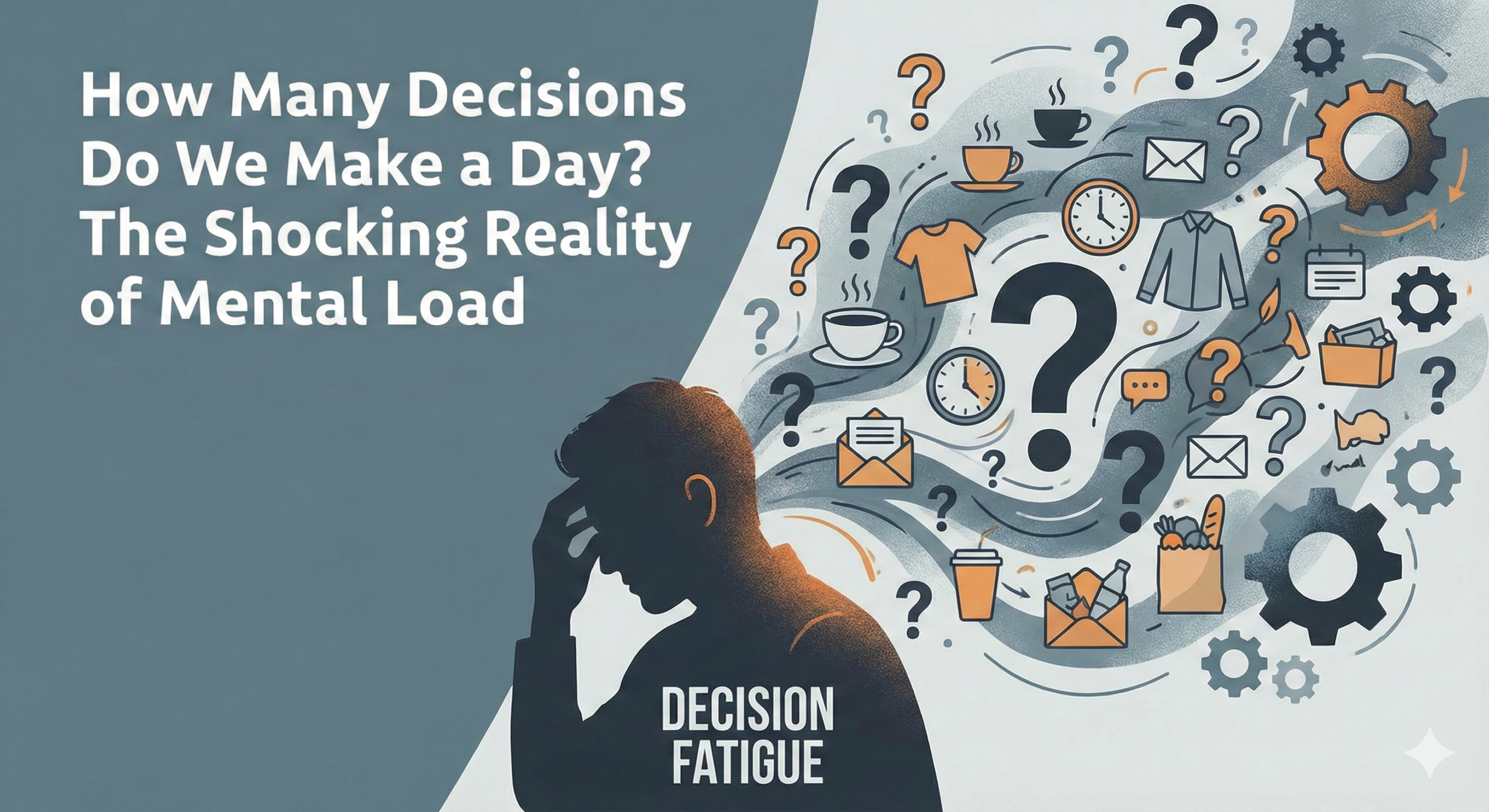
You wake up. Hit snooze or get up? Check your phone now or later? Blue shirt or white shirt? Coffee or tea? Before you have even left your house, you have likely made dozens of choices. We tend to think of “decisions” as the big, life-altering moments—buying a house, choosing a partner, or accepting a job offer. But in reality, human existence is a continuous stream of micro-choices.
In our modern, hyper-connected world, the volume of information we process is unprecedented. Every notification, every email subject line, and every scroll on social media demands a split-second judgment: Engage or ignore? Like or scroll?
Understanding the sheer volume of these decisions is key to understanding why we feel so exhausted by the end of the day. If you have ever felt “brain dead” at 5 PM, unable to decide what to cook for dinner, you are experiencing a biological phenomenon rooted in the limits of your neural processing.
The Magic Number: 33,000 Decisions
The estimated number of remotely conscious decisions an average adult makes every single day.
Various sources, including research from Cornell University, suggest that the average adult makes about 33,000 remotely conscious decisions each day. This number might sound impossibly high, but when you break it down, it begins to make sense.
Consider food alone. The Cornell study found that we make an estimated 226.7 decisions each day on food alone. Most of us would guess we make about 15. The discrepancy lies in the fact that many of these choices are subconscious or habitual.
The Breakdown: Where Do These Decisions Go?
- 226+ decisions about food (When to eat? What to eat? Bite size? Swallow now? More salt?).
- Thousands of micro-adjustments while driving or commuting (Change lanes? Speed up? Watch that pedestrian?).
- Countless digital interactions (Click this link? Read this text? Delete this email?).

The Paradox of Choice: Why More Is Less
Barry Schwartz’s classic book explains why having too many choices increases anxiety and how to find freedom in limitation.
Check Price on AmazonThe Hidden Iceberg: Conscious vs. Unconscious Choices
Not all decisions are created equal. Neuroscientists distinguish between “System 1” (fast, automatic, intuitive) and “System 2” (slow, deliberate, analytical) thinking, a concept popularized by Nobel laureate Daniel Kahneman.
If we had to use System 2 for all 33,000 decisions, our brains would shut down before breakfast. To survive, our brain delegates the vast majority of choices to the autopilot of System 1.
| Feature | System 1 (Unconscious/Habit) | System 2 (Conscious/Deliberate) |
|---|---|---|
| Speed | Extremely Fast | Slow |
| Effort | Effortless (Automatic) | High Effort (Draining) |
| Examples | Walking, typing, mood reactions | Budgeting, strategic planning, complex emails |
| Daily Volume | ~95% or more | ~5% or less |
The danger arises when we allow trivial matters to occupy our System 2 processing. This is why highly effective people often automate the mundane—so they can save their brainpower for what truly matters. (See our guide on the top 5 habits of highly effective people for more on this).
The Cost of Choice: Understanding Decision Fatigue
Willpower is not an infinite resource; it is like a battery. Every decision you make—no matter how small—drains a tiny bit of charge. By the afternoon, if you have spent your energy deciding what to wear, what to eat, and how to reply to 50 emails, you hit a wall known as Decision Fatigue.
When your brain is fatigued, it stops making optimal choices and defaults to two modes:
- Recklessness: Impulse buying, eating junk food, or snapping at a friend.
- Avoidance: Procrastination. You simply do nothing because the “cost” of deciding is too high.
This phenomenon is closely linked to ADHD symptoms, where executive function is already taxed. If you struggle with this, our article on decision fatigue and ADHD provides specific coping mechanisms.
5 Strategies to Reduce Decision Load and Boost Focus
You cannot stop making decisions, but you can optimize how you make them. The goal is to reduce the volume of trivial choices to preserve energy for significant ones.
1. Automate Your Mornings
Steve Jobs wore a black turtleneck every day. Barack Obama wore only gray or blue suits. Why? To eliminate one decision every morning. You don’t have to wear a uniform, but you should have a routine.
Creating a standardized morning flow prevents you from wasting willpower before the workday begins. Check out these 5 morning routine checklists to find a template that works for you.
2. Meal Planning
Remember those 226 food decisions? You can slash that number by planning ahead. If you decide on Sunday what you will eat for the week, you save yourself 21 stressful decisions (“What’s for dinner?”) later. If you are on a tight budget, learn how to plan meals on a budget to solve both financial and mental fatigue.
3. Time Blocking
Instead of constantly asking yourself, “What should I do next?”, give every hour a job. Time blocking is a productivity method where you schedule your day in chunks. This removes the need to decide what to work on in the moment.
If you are new to this, read our complete guide to time blocking.
4. Limit Digital Input
Your phone is a decision-fatigue machine. Every red dot is a demand for a decision. By curating your notifications and reducing screen time, you protect your mental bandwidth. Try implementing 10 simple ways to reduce screen time to reclaim your focus.
5. Use Technology to Decide
Offload memory and choice to apps. Use a password manager so you never have to decide “Which password did I use?” (Check our review of 5 free password managers). Use task managers to hold your to-do list so your brain doesn’t have to loop on it.

Moleskine Classic Notebook
Sometimes the best way to clear your head is to write it down. Use a physical notebook to plan your day the night before.
Check Price on AmazonThe Trap of Overthinking
While we make thousands of micro-decisions, the ones that truly drain us are the ones we ruminate on. This is called “Analysis Paralysis.” We over-research the best vacuum cleaner or obsess over the wording of a text message.
If you find yourself stuck in loops of indecision, it is vital to learn how to stop overthinking everything. One effective technique is the “2-Minute Rule”—if a decision takes less than 2 minutes to execute, do it immediately. For larger decisions, set a timer for research to prevent endless scrolling.
Frequently Asked Questions
Conclusion: Reclaiming Your Mental Space
The number 33,000 is not just a statistic; it is a warning. In a world demanding our constant attention, the ability to choose what not to decide is a superpower. By streamlining your life, organizing your environment (perhaps with the best desk accessories for clarity), and forgiving yourself for the occasional bad choice, you can navigate the sea of decisions with grace.
Remember, a life well-lived isn’t about making perfect decisions every time. It’s about making sure you have the energy left for the decisions that truly define who you are.
Ready to take control of your daily chaos? Start by organizing your digital life.