
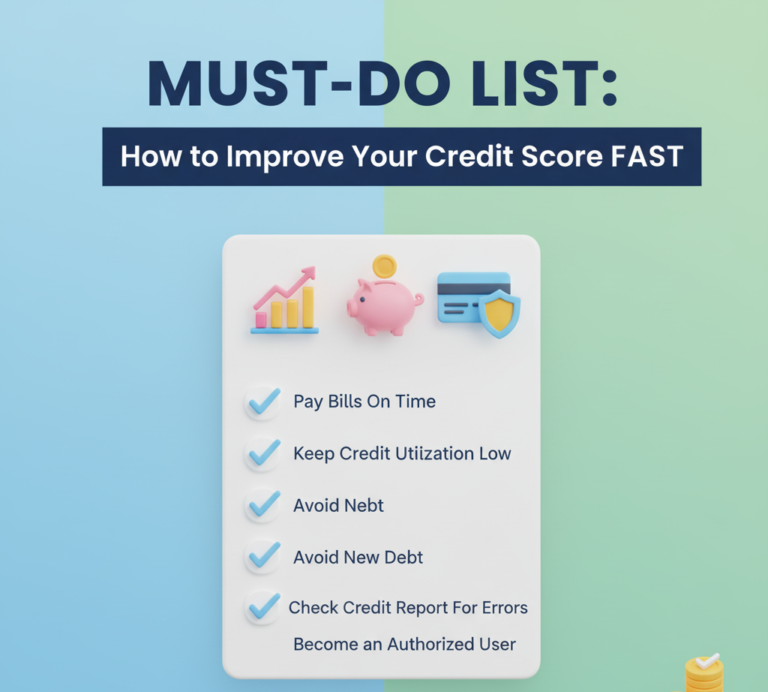
Must-Do List: How to Improve Your Credit Score Fast
In the modern financial world, you are a number. That three-digit number—your credit score—determines where you can live, what car you can drive, and even, in some cases, whether you get the job. A bad score is expensive; it costs you thousands in interest. A good score is the key to freedom.
Fixing a credit score often feels like pushing a boulder uphill, but it doesn’t have to be slow. While “overnight” fixes are myths, strategic, mathematical actions can yield rapid results. This isn’t just advice; it is a tactical protocol. This guide combines the discipline of the top 5 habits of highly effective people with hard financial science to boost your score in record time.
Understanding Credit Scores: The Foundation You Need First
You cannot optimize a system you do not understand. Before taking any action, you need a clear picture of what a credit score is, what it measures, and precisely which levers control it. Most people have a vague understanding that “paying bills on time is good”—but the real power to move a score rapidly comes from understanding the full five-factor model and attacking the highest-weight factors first.
The Score Ranges: Where You Stand
Credit scores in the US range from 300 to 850 under the FICO model (used by 90% of top lenders) and the VantageScore model. The thresholds that matter practically—the scores that unlock better rates and premium financial products—are well-defined:
The most impactful threshold is 740—the point at which most lenders offer their best available mortgage rates. The difference between a 620 score and a 740 score on a 30-year mortgage can translate to $50,000–$100,000 in additional interest paid over the loan’s life. Every strategy in this guide is designed to accelerate your progress toward 740 and beyond.
The Five Factors: Your Score’s Complete Anatomy
FICO scores are calculated from five weighted factors. Understanding the exact weight of each factor allows you to prioritize your effort where it produces the most score impact per unit of time invested.
The two factors that together account for 65% of your score—payment history and credit utilization—are both actionable in the short term. Payment history improves through consistent on-time payments and goodwill adjustments to past negatives. Utilization improves the moment you pay down balances, often reflecting in your score within 30–45 days. This two-factor focus is where the fastest score improvements occur.
FICO vs. VantageScore: Which One Actually Matters
Credit scores are not a single universal number—different scoring models produce different results from the same credit file. FICO Score 8 is the most widely used version for lending decisions; FICO Score 9 and FICO Score 10 are newer versions with different weighting; VantageScore 3.0 and 4.0 are commonly shown on free credit monitoring apps. Understanding which score you are seeing at any given moment prevents confusion when your “score” on a monitoring app differs from the score a lender pulls.
For practical purposes: focus your improvement efforts on your actual credit report data—the underlying payment history and balances that all scoring models draw from. Improving the source data improves all derived scores simultaneously. The specific number you see on a monitoring app is a directional indicator, not the definitive number a lender will use.
Phase 1: The Diagnostic (Stop Flying Blind)
You cannot fix what you do not measure. The first step is not paying a bill; it is intelligence gathering.
Step 1: Secure Your Digital Perimeter
Before you access your sensitive financial data, ensure your digital life is secure. Identity theft is a leading cause of credit score crashes. Use one of the 5 free password managers ranked and reviewed to secure your bank and credit bureau logins.
Step 2: The “Search and Destroy” Error Audit
According to the FTC, one in five people have an error on their credit report. That error could be dragging your score down by 50 points or more.
Action Plan:
- Pull Reports: Get your free reports from AnnualCreditReport.com.
- Scan for Zombies: Look for debts you already paid, accounts that aren’t yours, or “late” payments that were actually on time.
- Dispute Immediately: Use the online dispute tool. This is the “low hanging fruit” of credit repair.
The Complete Error-Finding Checklist
Pulling your reports is only step one. Knowing specifically what to look for—the categories of errors that most commonly appear and most significantly damage scores—is what makes the audit productive. Work through all three bureaus (Equifax, Experian, TransUnion) separately; errors frequently appear on one report but not others, and lenders may pull from any or all three.
Personal information errors are the most immediately concerning: an incorrect Social Security number, address, date of birth, or name variant can indicate mixed files (your credit data merged with another person’s) or potential identity theft. If you find someone else’s accounts on your report, this is a fraud issue requiring immediate action beyond a standard dispute.
Account status errors are the most common score-damaging errors: accounts incorrectly reported as delinquent, late payments reported on accounts that were paid on time, accounts showing as “open” that you closed, incorrect credit limits (a lower-than-actual limit artificially inflates your reported utilization ratio), and “charged off” or “in collections” status on accounts that have been settled or discharged.
Duplicate accounts occur when the same debt appears multiple times—particularly common when debt is sold from one collection agency to another. A single collection account reported twice doubles its negative impact. Each duplicate is a separate dispute.
Outdated negative items should have fallen off your report automatically but sometimes persist through bureau data errors. Most negative items (late payments, collections, charge-offs) must be removed after seven years; bankruptcies after ten years. If a negative item is older than its legal reporting window, dispute it for immediate removal.
The Dispute Process: Step by Step
Filing disputes online through each bureau’s portal is the fastest method—disputes are legally required to be investigated within 30 days of receipt (45 days if you submit additional documentation). For each disputed item, provide: the specific account and error you are disputing, a brief explanation of why it is incorrect, and any supporting documentation (payment confirmations, bank statements, correspondence from creditors). The clearer and more specific your dispute, the faster and more successfully it is resolved.
If the bureau “verifies” an item you believe is genuinely erroneous, your next escalation path is a direct dispute with the original creditor (who supplied the data to the bureau), a complaint filed with the Consumer Financial Protection Bureau (CFPB), or, for significant score-damaging errors that are not resolved, consultation with a consumer protection attorney—disputes that are not resolved appropriately may constitute a Fair Credit Reporting Act violation.
Phase 2: The Mathematical Lever (Utilization Ratio)
This is the single fastest way to improve your score. Your credit utilization accounts for 30% of your score. If you are maxed out, you look risky. If you pay it down, your score jumps—often within 30 days.
Step 3: The 30% (and 10%) Rule
Banks get nervous when you use more than 30% of your available credit. They love it when you use less than 10%.
The “Sniper” Method:
- Create Capital: You need cash to pay down these balances. Implement the 5 simple steps to create a zero-based budget immediately. Every unassigned dollar must attack your highest utilization card.
- Cut the Fat: Find extra money by auditing your lifestyle. Are you spending too much on tech? Check if you really need that upgrade or if a budget laptop under $500 will suffice. Can you save on food by using quick and healthy weeknight dinner ideas instead of takeout?
- Pay Before the Statement: Don’t wait for the due date. Pay your balance 3 days before the statement closes. This ensures the bank reports a $0 (or low) balance to the bureaus.
Advanced Utilization Strategies: Beyond Basic Paydown
Paying down balances is the primary utilization lever, but it is not the only one. Several additional strategies can improve your utilization ratio without requiring additional cash.
Request a credit limit increase. Your utilization ratio is calculated as your balance divided by your total credit limit. Increasing the denominator while keeping the numerator constant reduces the ratio. Most issuers will approve a limit increase request (typically done online or by phone) if you have a history of on-time payments and your income supports a higher limit. A limit increase from $5,000 to $8,000 with a $2,000 balance changes your utilization from 40% to 25% with zero payments made. Request limit increases only when you are confident you will not use the additional available credit, as expanded limits without discipline accelerate debt accumulation.
Understand per-card vs. aggregate utilization. FICO calculates utilization both in aggregate (total balances across all cards divided by total limits) and per individual card. A single card at 90% utilization can significantly damage your score even if your aggregate utilization is acceptable. When allocating payoff dollars, prioritize the card with the highest individual utilization ratio rather than the highest balance—unless the highest balance and highest utilization ratio happen to be the same card.
Use the statement timing trick consistently. Credit card issuers report your balance to the bureaus on your statement closing date—not your payment due date. If you pay your balance in full but do so after the statement closes, the reported balance is your full month’s spending, producing high utilization even though you owe nothing. Paying the balance before the statement close date ensures a near-zero balance is reported. This single timing adjustment can move an “average” utilization score to “excellent” with no change in spending or payment amounts.
Phase 3: The Behavioral Protocol (Payment History)
Payment history is 35% of your score. You cannot miss a payment. Ever.
Step 4: Automate Everything
Human memory is flawed; systems are perfect. Do not rely on “remembering” to pay your bill.
- Tech Assist: Use technology to your advantage. Download one of the 10 best productivity apps to set recurring reminders or handle automated workflows.
- The Time-Block: Use the complete guide to time-blocking to set a dedicated “Financial Review” block every Friday. This ensures you never miss a deadline due to negligence.
Payment Automation Architecture: The Full System
Automating bill payments is straightforward in concept but requires careful implementation to avoid common pitfalls. The most important detail: always automate for the full statement balance, not the minimum payment. Minimum payment autopay prevents a missed payment (which protects your credit), but paying only the minimum allows interest to accumulate, keeps utilization high, and extends debt payoff by years or decades.
For accounts where the balance varies significantly each month (credit cards rather than fixed-term loans), the safest automation approach is: set autopay for the full statement balance, and maintain a cash buffer in your checking account sufficient to cover your largest typical credit card payment. Running autopay for the full balance with an empty checking account produces an NSF (non-sufficient funds) event and a returned payment—which may be reported as a missed payment, exactly the outcome you were trying to prevent.
Maintain a master list of all automated payments, their amounts, their debit dates, and the bank account they draft from. Review this list monthly to confirm all automations are executing correctly—occasional technical failures, closed accounts, or changed payment amounts can disrupt automated payments silently.
Step 5: The “Goodwill” Letter
If you have a legitimate late payment from the past, write a goodwill letter to the creditor. Explain the situation, highlight your recent perfect history, and ask for a “goodwill adjustment” to remove the late mark. It doesn’t always work, but when it does, it’s gold.
Writing an Effective Goodwill Letter: The Template That Works
The goodwill letter succeeds when it is personal, specific, accountable, and brief. A generic template produces generic results. The elements of an effective goodwill letter are: a brief explanation of the circumstances that caused the late payment (job loss, medical emergency, family crisis—genuine circumstances that a human reader can empathize with), an acknowledgment of responsibility rather than blame-shifting, documentation of your payment record before and after the incident (demonstrating that the late payment was an anomaly rather than a pattern), a clear and specific request (removal of the late payment notation from your credit report), and a professional, respectful tone throughout.
Send your goodwill letter to the creditor’s customer service address—not the general corporate headquarters—via both email and certified mail. Certified mail creates a delivery confirmation record that can be useful if you need to escalate. Follow up by phone after two weeks if you have not received a response; customer service agents reviewing your account in real time have more discretion to approve adjustments than an automated mail processing system.
The goodwill letter is most effective for isolated incidents with creditors where you have a long, otherwise positive history. A single late payment on a ten-year-old account with a bank you have used for years is a much stronger goodwill letter candidate than a recent late payment on a new account or a pattern of multiple delinquencies.
Phase 4: Stop the Bleeding (What NOT to Do)
Improving your score isn’t just about doing the right things; it’s about stopping the wrong things.
Step 6: The “Hard Inquiry” Freeze
Every time you apply for credit, your score dips. Stop applying. Do not apply for that store card to save 10% on jeans.
- Impulse Control: The urge to spend is often triggered by apps. Use our guide on 7 smartphone settings you need to change immediately to turn off notifications from shopping apps.
- Procrastinate Spending: Use the tactics in ultimate list of 7 ways to beat procrastination in reverse—procrastinate on buying things to save your credit.
Step 7: Do Not Close Old Accounts
Length of credit history matters (15% of your score). Closing your oldest card shortens your history and lowers your available credit (hurting utilization). Put a small subscription on it (like a streaming service), set it to autopay, and throw the card in a drawer.
Building Your Credit Profile: Mix, Age, and Thin File Solutions
The remaining 25% of your FICO score (credit mix at 10%, length of history at 15%) requires a different approach than utilization and payment history. These factors change more slowly and respond to deliberate profile-building strategies rather than immediate corrective actions.
Credit Mix: The Diversity Advantage
Lenders prefer borrowers who have demonstrated the ability to manage multiple types of credit responsibly. The scoring models distinguish between revolving credit (credit cards, lines of credit—where the balance fluctuates and there is no fixed payoff date) and installment credit (mortgages, auto loans, student loans, personal loans—where you borrow a fixed amount and pay it back in fixed installments). Having a positive history in both categories signals broader creditworthiness than revolving credit alone.
For most people who primarily use credit cards, adding a small installment loan to the credit mix can produce a modest score improvement. A credit-builder loan—offered by many credit unions and some online banks specifically for this purpose—allows you to “borrow” a small amount that is held in a savings account while you make monthly payments. At the end of the term, you receive the savings. The loan builds positive installment payment history, adds credit mix diversity, and produces savings as a by-product.
Thin File Solutions: Building Credit From Zero
A “thin file” refers to a credit report with insufficient history for traditional scoring—typically fewer than three to five accounts or less than six months of history. Young adults, recent immigrants, and people who have primarily used cash or debit face this challenge: they may be financially responsible but have no credit footprint for lenders to evaluate.
The fastest thin-file solutions available today are specifically designed for this scenario. Secured credit cards require a cash deposit that becomes the credit limit; they are reported to the bureaus like regular credit cards and build history identically. After 12–18 months of on-time payments and low utilization, most secured cards can be graduated to unsecured status with the deposit returned.
Becoming an authorized user on a family member’s or trusted friend’s credit card is one of the fastest thin-file solutions available: the account’s full history—including its age, payment record, and available credit—is immediately added to your credit report. If the account being added has a long history and low utilization, the impact on your score can be immediate and significant. Ensure the primary cardholder’s account has an exemplary record before requesting authorized user status; a poorly managed account adds negative history rather than positive.
Experian Boost and UltraFICO are newer tools that allow consumers to add non-traditional payment data—utility bills, phone bills, streaming service subscriptions, rent payments—to their Experian credit file. For thin-file consumers who have been paying these bills on time for years, the addition of this data can meaningfully improve their score by demonstrating positive payment behavior that traditional credit files do not capture.
The Credit Improvement Timeline: Realistic Expectations by Action
One of the most common sources of frustration in credit repair is misaligned expectations about how quickly different actions produce results. Some changes appear in your score within 30 days; others take years of consistent behavior to fully manifest. Understanding the timeline for each action prevents the discouragement that causes many people to abandon efforts that are actually working.
Credit card balance paydown and utilization reduction; dispute resolutions for clear-cut errors; removal of inaccurate negative items; credit limit increases (utilization impact only).
New on-time payment history begins building; secured card or credit-builder loan starts appearing on report; authorized user account added to file; Experian Boost adjustments.
Meaningful improvement from consistent on-time payment pattern; goodwill adjustment results typically resolved; initial thin-file scores becoming gradeable for most lenders.
Hard inquiries fall off (they age out after 12 months); secured cards eligible for graduation to unsecured; credit mix improvements from installment loans becoming fully reflected.
Late payments, collections, charge-offs, and most negative items legally required to be removed from credit reports; score reflects only positive history.
The Real Financial Cost of a Poor Credit Score
The motivation to do the hard work of credit repair is most powerful when the financial stakes are concrete rather than abstract. The following table translates credit score ranges into real dollar costs across the most significant borrowing situations most people face.
| Situation | Poor (580–669) | Good (670–739) | Excellent (740+) | Cost of Poor Score |
|---|---|---|---|---|
| $300K 30-yr Mortgage | ~7.5% rate | ~6.8% rate | ~6.2% rate | ~$80,000+ extra interest |
| $35K Auto Loan (5yr) | ~12–15% rate | ~7–9% rate | ~4–6% rate | ~$8,000–$12,000 extra interest |
| Credit Card APR | 24–29% | 18–22% | 14–18% | Hundreds/year on carried balance |
| Apartment Rental | May be denied or require larger deposit | Approved, standard deposit | Preferred applicant; best units | $500–$2,000 extra deposit or denial |
| Travel Rewards Cards | Not approved for premium cards | Entry-level rewards cards | All premium cards available | $500–$1,500/yr in lost rewards value |
The mortgage interest differential alone—$80,000 in extra interest over a 30-year loan—makes credit score improvement one of the highest-return financial projects available. Spending 12 months actively improving a score before applying for a mortgage can save more money than most people save in an entire decade of investing.
Phase 5: Financial Lifestyle Integration
Credit repair is stressful. You need to treat it as part of a holistic self-care routine.
Step 8: Financial Self-Care
Financial stress impacts your health. Integrating credit repair into your routine is a form of self-love.
- The Ritual: Make your financial review part of your morning routine checklists for success. Check your score once a week, not once a day.
- Stress Reduction: Financial anxiety is real. Counter it by using the ultimate self-care checklist for busy professionals. A calm mind makes better financial decisions.
- Education: To stop the cycle of bad credit, you must change your mindset. Adopt the 7 habits of people who are good with money and read the top 10 books on personal finance.
Credit Score Myths: The Misinformation That Holds People Back
Credit score mythology is widespread and consequential—people avoid actions that would help their score, and take actions that harm it, based on misinformation that circulates through social media, well-meaning family advice, and outdated guidance. Clearing these myths accelerates progress.
Myth: Checking Your Own Credit Score Hurts It
This is false. Consumer-initiated credit checks are “soft inquiries” and do not affect your score in any way. Only “hard inquiries”—initiated by lenders evaluating a credit application—impact your score, and only by a small amount. Check your score and report as frequently as you wish; monitoring your own credit is a responsible practice, not a harmful one.
Myth: Carrying a Balance Builds Credit
This is false and expensive. Carrying a credit card balance month-to-month does not improve your credit score—it simply costs you interest. What builds payment history is making the required payment on time; whether that payment is the minimum, a partial payment, or the full balance does not affect the payment history factor. Pay in full every month to build credit identically while paying zero interest.
Myth: Income Affects Your Credit Score
Your income does not appear on your credit report and has no direct effect on your credit score. A person earning $30,000 per year with impeccable payment history and low utilization will have a higher credit score than a person earning $300,000 with missed payments and maxed-out cards. Income affects your ability to repay debt and is considered in underwriting decisions, but it is not a credit score factor.
Myth: You Need to Be Debt-Free to Have Excellent Credit
False. Credit scores reward the responsible management of debt, not the absence of it. A person with a mortgage, a car loan, and two credit cards—all paid on time with low balances—will have an excellent credit score. The score measures creditworthiness (how reliably you repay what you borrow) rather than financial purity.
Myth: Credit Repair Companies Can Legally Remove Accurate Negative Information
False. No credit repair company has legal access to remove accurate, verifiable negative information from your report before its legal reporting window expires. Any company claiming they can do this is either lying or charging you for dispute services you can perform yourself for free. The Credit Repair Organizations Act (CROA) requires credit repair companies to disclose their services, fees, and your rights—and explicitly prohibits making false claims about their ability to improve your credit. The actions that genuinely improve credit scores are all within your own direct control.
Phase 6: The Reward (Why It Matters)
Why go through this pain? Because a high credit score unlocks the world.
Step 9: The Travel Hack Strategy
Once your score is excellent (740+), you qualify for the best travel rewards credit cards of the year. This is how the wealthy travel for free.
The Vision:
- Imagine booking a trip using points to the top 5 cheapest European cities to visit right now.
- Use your excellent credit to finance the gear you need, like items from the ultimate packing list for a 10-day Europe trip or the 8 essential items to include in your carry-on bag.
- Use the checklist for how to plan a trip knowing you have the financial backing to enjoy it.
Phase 7: Future Proofing (Next Steps)
Once your debt is gone and your score is up, where does the money go?
- Investing: Pivot from paying interest to earning interest. Learn about the 4 types of investment accounts explained.
- Smart Spending: Continue to be wise with purchases. Only buy high-ROI items, like the top 5 kitchen gadgets that are actually worth the money or must-have gadgets for your home office.
Essential Tools for Credit & Financial Security
Protecting your identity and tracking your progress are physical acts. These tools help secure your journey.

The fastest way to ruin a credit score is identity theft. Dumpster divers do exist, and they look for pre-approved credit card offers and bank statements. A cross-cut shredder is your first line of physical defense. Shred every single piece of mail that contains your name or address before it leaves your house. It’s a small investment that protects your massive effort.
Check Price on Amazon
While apps are great, writing down your debt payoff plan creates a psychological commitment. This planner helps you track your debt snowball, visualize your savings goals, and execute the Zero-Based Budget. It forces you to confront your spending daily, building the muscle memory needed to maintain that high credit score once you achieve it.
Check Price on AmazonFinal Verdict: Credit is a Game (Play to Win)
Improving your credit score is not about luck; it is about leverage. It requires the precision of a PC builder and the discipline of a professional athlete. By securing your data, optimizing your utilization, and automating your payments, you can turn that three-digit number from a source of shame into your greatest financial asset.
Start Phase 1 today. Pull your report. The clock is ticking, and your financial freedom is waiting.