
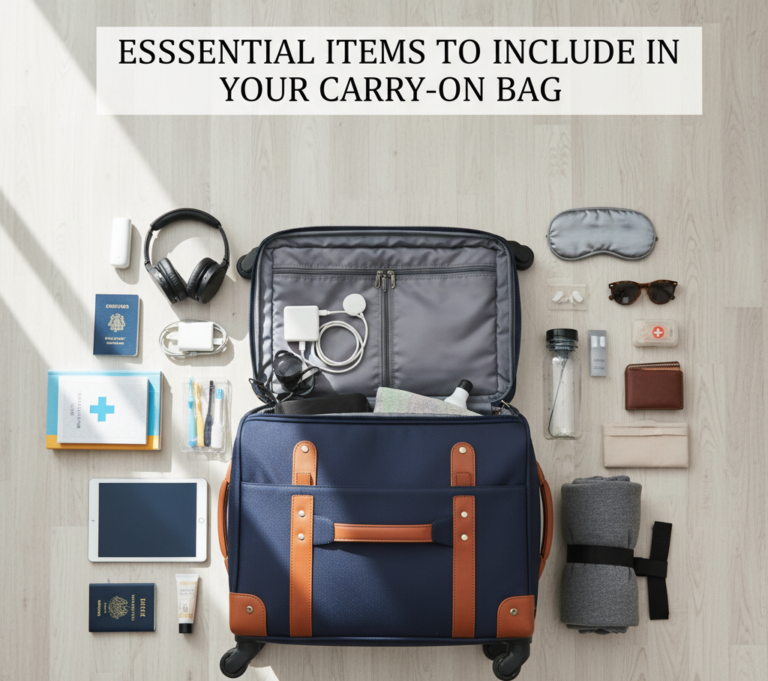
Travel Light, Travel Smart: 8 Essential Items to Include in Your Carry-On Bag
There are two types of travelers: those who breeze through the airport with confidence, and those who are frantically rearranging their luggage at the check-in counter. The difference isn’t experience; it’s strategy. The carry-on bag is your lifeline. It is your insurance policy against lost luggage, your comfort zone at 30,000 feet, and your mobile office.
Mastering the carry-on is a skill that separates the novice from the pro. It requires the same discipline found in the top 5 habits of highly effective people—being proactive, organized, and efficient. Whether you are embarking on a weekend getaway or using our ultimate packing list for a 10-day Europe trip, these 8 essential items must be in your bag.
Why Carry-On Only Travel Changes Everything
Before diving into the essential items, it is worth understanding why mastering the carry-on is one of the highest-return travel habits you can build. The decision to fly carry-on only is not about deprivation—it is about control, speed, and savings.
The average checked bag fee on a budget carrier runs $35–$70 each way. On a round trip, that is $70–$140 per person before the trip has even started. For a couple traveling together, checking two bags both ways can add $280 to the trip cost—enough to fund two nights in a quality hotel or four days of food and activities in an affordable European city. Over several trips per year, the savings compound dramatically.
Beyond money, carry-on travel fundamentally changes the airport experience. You skip the check-in queue entirely, proceed directly to security, board with confidence, and—most critically—walk off the plane and straight to the exit while other passengers wait 20–45 minutes at baggage claim. That time saving, across a full trip, can mean the difference between a relaxed arrival and a stressful scramble to make a connection.
There is also a psychological dimension. Checking luggage creates a dependency that carry-on travel eliminates. You stop worrying about whether your bag will arrive, whether it will be damaged, or whether the airline will lose it entirely. Airline baggage mishandling affects millions of bags annually—a risk that carry-on travelers never face.
Carry-On Size Rules: What You Need to Know Before You Pack
The single most common carry-on mistake is packing a bag that violates the airline’s size allowance. Rules vary significantly by carrier, and understanding them before you buy your bag—let alone before you pack—is non-negotiable.
| Airline Type | Typical Max Size (cm) | Typical Max Weight | Key Watch-Out |
|---|---|---|---|
| Major US Carriers | 56 × 36 × 23 cm | No weight limit (most) | Overhead bin space is first-come |
| European Budget (Ryanair) | 40 × 20 × 25 cm (free) | 10 kg (paid upgrade) | Strictest enforcement in Europe |
| European Budget (Wizz Air) | 40 × 30 × 20 cm (free) | 10 kg (paid upgrade) | Cabin bag fee if over-size at gate |
| Long-Haul International | 55 × 40 × 20 cm (typical) | 7–10 kg (most) | Weight limits strictly enforced |
| easyJet | 56 × 45 × 25 cm | 15 kg (large cabin bag) | Must fit overhead; smaller free bag allowed |
The practical implication: always check the specific airline’s carry-on policy for every leg of your trip, not just the outbound flight. Budget airlines in particular apply different rules than what you may be used to from full-service carriers, and the gate agents enforce them. A bag sizer at the gate is the final test—if your bag does not fit, you pay a gate-check fee that often exceeds the cost of pre-booking a checked bag.
Choosing the Right Carry-On Bag
Not all bags are created equal, and the shape of your bag matters as much as the size. Hard-shell spinners look impressive but sacrifice internal volume and do not compress to fit into tight overhead bins. Soft-sided bags—particularly those with a structured but slightly compressible exterior—are favored by experienced carry-on travelers because they can be coaxed into spaces that a rigid case cannot.
Backpack-style carry-ons have surged in popularity for good reason: they distribute weight across both shoulders, leave your hands free, and navigate cobblestoned streets or crowded transit systems far more comfortably than wheeled cases. The trade-off is that accessing items requires taking the bag off and opening it fully—packing cubes (discussed below) solve this problem entirely.
1. The Tech Command Center (Power & Connectivity)
In the modern age, a dead phone isn’t just an inconvenience; it’s a safety hazard. Your boarding pass, your hotel confirmation, and your map are all digital.
The Portable Power Bank
Never rely on the USB port at your seat—it is often broken or slow. You need a dedicated, high-capacity power bank.
- Why it’s essential: It keeps your digital life running. You need your phone to access the best productivity apps or check your trip planning checklist while on the go.
- Cable Management: Bring a multi-charging cable. Tangled wires are a recipe for stress.
Tech Packing: The Full Checklist
A power bank is the anchor of your tech carry-on setup, but it should not travel alone. Consider what else belongs in this category: your laptop or tablet (always carry-on, never checked—the physical shock of baggage handling can damage drives), all charging cables, a compact universal adapter if traveling internationally, wireless earbuds as a backup to over-ear headphones, and a small USB hub if you need to charge multiple devices simultaneously from a single hotel outlet.
Cable organization is chronically underestimated as a source of travel friction. A small cable roll or flat zippered pouch that keeps all cables and adapters in one place saves minutes at every hotel check-in, airport security checkpoint, and gate lounge. Minutes add up across a multi-day trip into meaningful time saved.
Airlines permit power banks in carry-on only—never in checked bags. Most airlines allow power banks up to 100Wh (watt-hours) without restriction; banks between 100–160Wh require airline approval. Check the label on your bank: capacity in mAh divided by 1000, multiplied by voltage (typically 3.7V), gives approximate watt-hours. A 20,000mAh bank at 3.7V is approximately 74Wh—comfortably within limits for all airlines.
2. The Comfort Bubble (Noise Cancellation)
Airplanes are loud, stressful environments. To arrive refreshed, you need to control your auditory environment.
Noise-Canceling Headphones
This is the single best investment for traveler sanity. Blocking out the engine drone and the crying baby allows you to create a sanctuary of focus or rest.
- Dual Purpose: These aren’t just for planes. They are essential for your home office setup when you return, helping you stay productive.
- The Strategy: Use the silence to disconnect or to listen to an audiobook from the top 10 books on personal finance. Turn travel time into learning time.
Maximizing In-Flight Rest with the Right Setup
Noise-canceling headphones are most effective when combined with a few complementary items that are easy to overlook. A travel neck pillow—ideally memory foam rather than the standard inflatable type, which forces an unnatural head position—makes a substantial difference in whether you wake up refreshed or stiff. An eye mask blocks the cabin’s ambient light and the screens of fellow passengers, which would otherwise disrupt natural melatonin production.
Compression socks, while unglamorous, are medically advisable on flights over three hours. Deep vein thrombosis (DVT) is a real risk on long-haul flights, and compression socks reduce this risk while also minimizing ankle swelling that makes post-flight walking uncomfortable. Wearing them on the flight and removing them upon arrival is a simple habit that professional frequent flyers consistently practice.
Earplugs as a backup to noise-canceling headphones are also worth packing. When you want to sleep but do not want to wear over-ear headphones, quality foam earplugs reduce ambient noise enough to significantly improve sleep quality. They weigh almost nothing and cost pennies.
3. The Hygiene Kit (Liquids Strategy)
The dry cabin air destroys your skin and dehydrates you. Your carry-on must include a tactical toiletry kit to combat this.
The 3-1-1 Bag (Upgraded)
Don’t just throw random bottles in a Ziploc. Curate a kit that keeps you fresh.
- Skincare: Decant your favorite products. Stick to the basics of the essential 4-step skincare routine (Cleanse, Moisturize, Protect).
- Sanitization: Hand sanitizer and wipes are non-negotiable. Wipe down your tray table immediately upon sitting.
- Hydration: Bring a heavy moisturizer or face mist to combat the arid cabin air, a key part of the ultimate self-care checklist.
The Complete 3-1-1 Strategy: What to Decant and What to Buy at Destination
The TSA’s 3-1-1 rule—containers of 3.4oz (100ml) or less, in one quart-sized clear bag, one bag per passenger—is well-known but frequently misapplied. Most travelers try to cram full-sized versions of their regular products into the allotted space and run out of room. The smarter approach is to audit each product’s actual daily use quantity and pack accordingly.
Solid alternatives to liquid products have improved dramatically in quality and now represent the cleanest carry-on hygiene solution. Solid shampoo bars replace 250ml shampoo bottles. Solid conditioner bars replace conditioner. Solid toothpaste tabs replace toothpaste tubes entirely. Solid sunscreen sticks are TSA-approved without size restrictions. Transitioning to solid formats for a two-week trip can free up your entire 3-1-1 bag allowance for the few products—prescription medications, specific skincare serums—that genuinely require liquid form.
Prescription medications should always travel in their original labeled containers. A doctor’s note for controlled substances or injectable medications (insulin pens, EpiPens) is advisable, particularly for international travel. These items are permitted in carry-on in quantities exceeding 3.4oz when properly documented.
4. The Entertainment Hub (Analog & Digital)
Flight entertainment systems fail. You must be self-sufficient.
E-Reader or Tablet
A Kindle or iPad saves weight compared to physical books. It allows you to carry hundreds of titles.
- Productivity: Use the flight to manage your life. Review your investment accounts or catch up on reading.
- Digital Detox: Conversely, use an e-reader (not a tablet) to avoid blue light and eye strain, aligning with the goal to reduce screen time while still being engaged.
Pre-Loading Your Entertainment: The Offline-First Approach
In-flight Wi-Fi is expensive, unreliable, and often too slow for streaming. The solution is comprehensive pre-flight download. Before any trip, execute the following: download offline maps for every destination city in Google Maps, download Spotify playlists and podcasts for offline listening, download Netflix shows or films on the app for offline viewing, sync your Kindle reading list, and download any work documents or reports you may want to review.
This pre-loading habit transforms flight time from dead time into productive or restorative time. A long-haul flight is, paradoxically, one of the best opportunities for deep reading—you are isolated, relatively comfortable, and have no legitimate alternative demands on your attention. Using that window to work through a book you have been meaning to read, or to catch up on industry research, is one of the underrated productivity advantages of frequent travel.
For those who prefer analog entertainment, a single physical book, a crossword or puzzle book, or a travel journal serve as reliable fallbacks that require no battery, no Wi-Fi, and no screen. Many experienced travelers find that the limited, single-purpose nature of a paperback—it only does one thing—is actually more conducive to deep reading than the distraction-laden surface of a tablet.
5. The “Lost Luggage” Insurance (Spare Clothes)
If you checked a bag, assume it will get lost. If it doesn’t, great. If it does, you need to be prepared.
One Full Change of Clothes
Always pack one outfit in your carry-on. Ideally, this includes:
- Fresh underwear and socks.
- A versatile t-shirt or top.
- A lightweight layer (like a merino wool sweater).
This ensures that even if you arrive in one of the cheapest European cities without your main bag, you can still go out to dinner without looking like you slept in a terminal. This level of preparedness is a hallmark of those who follow the ways to beat procrastination—they prepare for problems before they happen.
The Capsule Clothing Principle for Carry-On Travel
If you are traveling carry-on only for a multi-day trip, the clothing selection strategy becomes the most consequential packing decision you make. The capsule wardrobe approach—a small number of versatile, coordinating pieces that can be combined into multiple outfits—is the gold standard for efficient packing.
Merino wool is the material most consistently recommended by carry-on-only travelers for one specific reason: it is odor-resistant. A merino t-shirt can be worn three days in a row without washing and without developing the smell that synthetic or cotton fabrics would produce in the same timeframe. This property alone can halve the number of shirts you need to pack for any trip.
A practical capsule for a one-week trip might consist of three merino wool t-shirts, one long-sleeve merino shirt, one pair of travel-optimized pants (dark, quick-dry, minimal branding), one pair of shorts that doubles as swimwear, a packable down or synthetic insulation layer for cooler environments, and a single versatile pair of shoes that works for both walking and an evening out. Every item in this list coordinates with every other item, creating multiple outfit combinations from minimal pieces.
6. The Document Vault (Security)
Your wallet and passport are your most valuable assets. Treat them with the same security you apply to your digital life.
RFID Blocking Travel Wallet
Keep your physical cards safe from skimming and your passport accessible.
- Digital Backup: Just as you use password managers for your online accounts, keep digital scans of your passport and IDs in a secure cloud folder.
- Financial Cards: Ensure you are carrying the right cards, specifically the best travel rewards credit cards that offer no foreign transaction fees and lounge access.
The Complete Document Security System
Document security extends beyond the physical wallet. A complete pre-departure document preparation routine takes approximately 20 minutes and protects you against a scenario that ruins trips every day: the lost or stolen passport abroad.
Before departure, photograph every document you are carrying—passport photo page and visa stamps, travel insurance policy, credit cards (front and back), driver’s license, and your hotel confirmation pages. Store these photos in two places: a cloud storage folder accessible from any device, and a secure notes app protected by biometric login on your phone. If your physical wallet is stolen, you have immediate access to account numbers, emergency phone numbers, and identification documentation.
Many countries require you to carry identification at all times, but do not require it to be your original passport. Carrying a printed or digital copy of your passport photo page while leaving the original securely in your hotel room safe is standard advice from travel security professionals. The original passport only needs to be on your person at airports, during accommodation check-ins, and when specifically required by local law.
7. The Hydration Station
Buying water at the airport is a waste of money and plastic. It violates the principles of the zero-based budget.
Collapsible Water Bottle
Bring a bottle that can be rolled up when empty to save space. Fill it up after security. Staying hydrated helps prevent jet lag and keeps your energy high.
In-Flight Hydration: The Science Behind the Strategy
Aircraft cabins are pressurized to an altitude equivalent of roughly 2,400 meters above sea level, with humidity typically below 20%—drier than most desert environments. This combination causes measurable dehydration during flight at a rate that most passengers do not consciously register until they land feeling groggy, headachy, and stiff. Understanding this physiology motivates the hydration habit at a deeper level than just “drink more water.”
The recommendation for in-flight hydration is approximately 250ml (8oz) of water per hour of flight. On a transatlantic 8-hour flight, that means consuming two liters of water—a quantity that requires either buying multiple expensive bottles after security or carrying a refillable bottle. Most major airports have water refill stations beyond security; identifying these in your terminal before your gate is an easy habit to build.
Alcohol and caffeinated beverages are diuretics and accelerate dehydration. Limiting their in-flight consumption—or compensating by drinking additional water—is a simple intervention that meaningfully improves how you feel at landing. The free alcohol on business class is one of the worst things you can consume on a long-haul flight from a recovery standpoint, regardless of how appealing it seems.
Electrolyte tablets or powder sticks (available in single-serve packets) can be dissolved in your water bottle to replace mineral losses beyond what plain water restores. This is particularly valuable on flights longer than six hours and costs pennies per serving compared to sports drinks purchased at the airport.
8. The Snack Stash
Airport food is expensive and unhealthy. Relying on it is a rookie mistake.
High-Protein, Non-Perishable Snacks
Pack almonds, protein bars, or dried fruit. This prevents “hangry” decisions and keeps your spending in check.
- Financial Habit: Avoiding $15 airport sandwiches is a classic example of the 7 habits of people who are good with money. Small savings add up to big travel budgets.
- Preparation: Use your kitchen gadgets to prep snacks before you leave.
Snack Selection Strategy: What Actually Works in Transit
Not all snacks are equally suited to travel conditions. The ideal carry-on snack is calorie-dense, protein-rich, non-perishable, TSA-compliant, and capable of surviving in a bag at varying temperatures for 24+ hours without degrading. This narrows the field considerably from the full range of snacking options.
Nuts—almonds, cashews, walnuts—score highest on nearly all criteria. They are calorie-dense, high in protein and healthy fat, require no refrigeration, and have an indefinite shelf life in a sealed bag. Mixed nut and dried fruit combinations provide faster-digesting carbohydrates alongside the slower-burning fat and protein, creating more sustained energy without the sugar spike and crash of candy or pastries.
Protein bars vary enormously in quality. Bars with more than 20 grams of sugar are effectively candy bars with a protein veneer. Look for bars with at least 15 grams of protein, under 10 grams of sugar, and a short, recognizable ingredient list. Well-formulated bars from established brands provide a complete emergency meal substitute when airport delays extend past normal mealtimes.
Note that customs rules in many countries restrict bringing certain foods across borders. Fresh fruit, meat products, and some dairy items are prohibited entry in many destinations including the US, Australia, New Zealand, and parts of the EU. Commercially packaged, sealed snacks are almost universally permitted. If in doubt, consume snacks before landing or declare them on your customs form and be prepared to surrender them.
The Organization System: Packing Cubes and Why They Matter
The eight essential items above answer the question of what to pack. Packing cubes answer the equally important question of how to pack it. This category is perhaps the most transformative single upgrade available to travelers who have not yet adopted it.
Packing cubes are zippered rectangular fabric containers that fit inside your bag and divide its interior into organized compartments. Each cube is dedicated to a category—one for tops, one for bottoms, one for underwear and socks, one for tech accessories—creating a system where every item has a defined location and can be found without unpacking the entire bag.
The efficiency advantage is real and measurable. Without packing cubes, finding a specific item in a full carry-on typically requires removing multiple layers of clothing and creating a disordered pile that must then be repacked. With packing cubes, the target item is in its designated cube, which can be removed, accessed, and returned in under 30 seconds. Over a two-week trip involving dozens of bag accesses, this saves meaningful time and eliminates a significant source of daily travel friction.
Compression packing cubes—which have a second zip that compresses the contents, expelling air—can reduce clothing volume by 20–30%. This compression is particularly effective for bulkier items like sweaters, jeans, and jackets that typically consume disproportionate space. The saved volume can accommodate additional items or simply reduce the total bag weight.
📦 Recommended Packing Cube Configuration for a Carry-On
- Large cube: Tops and t-shirts (rolled vertically, ranger-roll style)
- Medium cube: Bottoms (pants, shorts)
- Small cube: Underwear and socks
- Small cube: Tech cables, adapters, power bank
- Toiletry bag: Separate hanging organizer for hygiene items
- Document pouch: Passport, wallet, insurance documents (accessed frequently—pack last, placed on top)
Navigating Airport Security Like a Pro
Packing the right items is only half the battle. Getting through airport security quickly and without drama is a skill that genuinely improves with understanding. Security screening theater is one of the most stressful parts of air travel for unprepared travelers and a minor inconvenience for those who have systemized their approach.
The Pre-Security Preparation Routine
The travelers who cause the longest delays at security checkpoints are consistently those who arrive unprepared and sort themselves out at the tray. The counter-approach is to prepare while still in the queue. Remove your laptop from your bag before reaching the belt. Move your phone, keys, watch, and belt to a front pocket or your jacket before the belt. Know where your liquids bag is and have it accessible for immediate removal. These actions take 45 seconds while waiting and save three minutes at the actual checkpoint.
TSA PreCheck (for US domestic travelers) and Global Entry (for international travelers returning to the US) are the highest-return travel investments available for frequent flyers. TSA PreCheck allows you to leave your shoes on, keep your laptop in your bag, and use a dedicated, shorter queue. Global Entry includes TSA PreCheck and also provides expedited re-entry through customs on international arrivals. Both programs require a background check and enrollment fee—often reimbursable through premium travel credit cards—and valid for five years.
European travelers can enroll in similar programs: the EU’s ETIAS (European Travel Information and Authorization System) simplifies entry into Schengen area countries, while individual country programs like the UK’s Registered Traveller scheme provide fast-track immigration access.
Items That Reliably Trigger Secondary Screening
Certain carry-on items consistently attract additional scrutiny that causes delays if you are not prepared. Knowing these in advance allows you to pack them accessibly or reconsider packing them in carry-on at all. Food items—particularly dense foods like nut butters, hummus, and soft cheeses—are frequently flagged as liquids under TSA interpretation. Medical devices, injectable medications, and insulin pumps may trigger additional screening but are always permitted with appropriate documentation. Wrapped gifts are opened by screeners if the contents cannot be clearly identified by X-ray; bring gifts unwrapped to avoid this.
Large electronics beyond laptops—hair straighteners, electric shavers, portable speakers—can sometimes appear ambiguous on X-ray. Packing them in a clear side pocket rather than buried in the center of a packed bag reduces the likelihood of your entire bag being hand-searched.
Wellness at 30,000 Feet: Arriving in Better Shape Than You Left
The ideal travel outcome is not just arriving at your destination—it is arriving feeling well, energized, and ready to engage with your trip immediately rather than spending the first day recovering. This goal is achievable with a small number of deliberate habits that experienced travelers practice consistently.
Movement and Circulation
Sitting immobile for four or more hours produces a predictable set of physical symptoms: stiffness, lower back pain, and reduced circulation in the legs. The intervention is simple: stand up and walk the length of the cabin at least once every ninety minutes. Perform seated stretches—ankle circles, neck rolls, forward bends—in your seat. These habits take under three minutes total per movement break and make a measurable difference in how you feel at landing.
An aisle seat, when available, removes the social friction of asking seat neighbors to let you out and makes movement breaks a genuinely zero-barrier activity. For long-haul flights where movement is most important, requesting an aisle seat during check-in or booking is a minor logistical effort with meaningful physical returns.
Sleep Strategy on Overnight Flights
On overnight transatlantic or transpacific flights, sleep is the highest-value activity you can engage in. Arriving in daylight hours having slept reduces jet lag significantly compared to arriving exhausted after watching films all night. The optimal setup: wear your noise-canceling headphones with a sleep-specific white noise or ambient sound track, use your eye mask, apply a light moisturizer to combat the dry cabin air, and take a small melatonin supplement (0.5–1mg, not the 5–10mg doses common in pharmacy products) approximately 30 minutes before your target sleep time aligned with the destination’s night.
Melatonin at low doses helps reset circadian rhythm without grogginess. Higher doses cause morning drowsiness and are generally counterproductive. Starting to shift your sleep schedule two to three days before a long eastbound flight—going to bed and waking up one hour earlier each day—progressively reduces the effective time zone gap and significantly eases arrival adjustment.
The Carry-On Toolkit: Gear That Lasts
Having the right gear makes packing these 8 items effortless. Here are the top-rated tools to organize your carry-on.

This is the engine of your Tech Command Center (Item 1). It has enough juice to charge an iPhone 5 times or an iPad twice. It is compact, durable, and airline-approved. Never be the person searching for an outlet at the gate again.
Check Price on Amazon
The gold standard for Item 2. These headphones feature industry-leading noise cancellation that silences jet engines. They are comfortable for long-haul flights and feature a 30-hour battery life. They are an investment in your peace of mind and productivity.
Check Price on Amazon
Stop using disposable plastic bags. This organizer makes Item 3 (Hygiene Kit) a breeze. It has transparent pockets so you can see your liquids, hangs up for easy access in small hotel bathrooms, and is water-resistant. It helps you maintain your morning routine no matter where you are in the world.
Check Price on AmazonCarry-On Packing by Trip Type: Adjusting the System
The eight essentials are universal, but the specific items within each category—and the priorities—shift based on your trip’s purpose. A business trip has different requirements than a beach holiday or a hiking adventure. Understanding these variations makes the packing system genuinely flexible rather than a rigid prescription.
The Business Travel Configuration
For business trips, the tech and document categories expand while clothing needs simplify. A dedicated laptop sleeve or compartment is non-negotiable. Business attire—typically two to three outfit iterations of dress shirt, trousers or skirt, and a blazer or jacket—demands wrinkle management that leisure travel does not. A portable clothing steamer (small, lightweight models exist specifically for travel) or the hotel shower steam method (hang clothes in the bathroom while running a hot shower for 10 minutes) handles wrinkles without ironing.
Business travelers should also pack a small, professional notebook and quality pen. Digital note-taking is efficient, but a physical notebook in a meeting signals presence and avoids the distraction stigma of a phone or laptop screen. The notebook also provides a record that does not depend on battery life or cloud sync.
The Adventure Travel Configuration
Hiking, cycling, diving, or other activity-based travel shifts priorities toward specialized gear and clothing. Quick-dry fabrics become essential rather than merely convenient. A small first aid kit—adhesive bandages, antiseptic wipes, blister treatment, ibuprofen, antihistamines, and any personal medications—replaces or supplements the standard toiletry kit. Activity-specific items like a compact headlamp, a lightweight packable rain jacket, and a dry bag for electronics near water are worth their weight many times over for the specific situations they address.
The Family and Group Travel Configuration
Traveling with children or a group introduces coordination challenges that solo and couple travel does not. Each person should be responsible for their own carry-on essentials, but shared supplies—first aid, snacks, entertainment for children—benefit from a designated “family bag” that one adult carries. Packing children’s entertainment (downloaded shows, activity books, small quiet toys) in an accessible front pocket rather than buried in the main compartment prevents mid-flight bag excavation in close quarters.
Sustainable Carry-On Packing: Lighter on the Planet
The overlap between efficient carry-on packing and sustainable travel is larger than most people realize. Many of the choices that save space and weight also reduce environmental impact. This alignment means that sustainable travel habits are not sacrifices—they are upgrades in both ethical and practical terms.
The collapsible water bottle is the clearest example: a single reusable bottle eliminates dozens of single-use plastic purchases across a two-week trip. The solid toiletry alternatives—shampoo bars, conditioner bars, solid toothpaste tabs—eliminate the plastic containers that single-use travel-size products create. Packing cubes, when made from quality materials, last for years and eliminate the need for the disposable plastic bags that most travelers use to separate clothing categories.
The merino wool clothing approach reduces washing frequency, which reduces both water and energy consumption during a trip. Choosing accommodation that offers laundry facilities rather than daily housekeeping reduces linen and towel washing. Using public transit rather than taxis, which naturally follows from the increased mobility that carry-on only travel enables, reduces transport emissions.
Each of these choices is individually small. Collectively, across multiple trips and many travelers, they represent a meaningful reduction in the environmental footprint of air travel beyond the flight itself—the one component of the trip that is hardest to reduce.
The Master Pre-Flight Carry-On Checklist
Use this checklist the evening before every trip to ensure nothing critical is left behind. The discipline of a consistent pre-flight audit—like a pilot’s preflight check—is what separates reliable travelers from those who have a new “I forgot…” story after every journey.
🧳 Tech & Power
- Power bank (fully charged, in carry-on only)
- Multi-charging cable (USB-C + Lightning)
- Universal adapter (if international)
- Laptop / tablet (fully charged, offline content downloaded)
- Earbuds and/or noise-canceling headphones
🛁 Hygiene & Comfort
- Toiletry bag with 3-1-1 liquids (or solid alternatives)
- Prescription medications in original labeled containers
- Hand sanitizer and sanitizing wipes
- Compression socks (wear on flight)
- Eye mask and earplugs
- Travel neck pillow
👗 Clothing
- One full change of clothes (even if checking a bag)
- Layering piece (sweater, packable jacket)
- Comfortable shoes suitable for the destination
📄 Documents & Finance
- Passport (valid for 6+ months beyond travel date)
- RFID blocking travel wallet with no-fee travel card
- Digital backups of all documents uploaded to cloud
- Travel insurance documents (digital + printed copy)
- Bank and card issuers notified of travel dates
💧 Food & Hydration
- Collapsible water bottle (empty for security, fill after)
- Electrolyte packets or tablets
- Protein bars (3–4 minimum for a long travel day)
- Mixed nuts or dried fruit in a sealed bag
Final Verdict: The Art of Readiness
Your carry-on bag is more than luggage; it is a mobile command center. By packing these 8 essential items, you transform yourself from a passive passenger into a proactive traveler. You are ready for delays, ready for work, and ready for adventure.
Start your next trip right. Audit your bag today, upgrade your essentials, and travel with the confidence of a pro.