5 Email Templates to Say “No” Professionally (Without Guilt)
Protect your time, set boundaries, and maintain your professional reputation. Here is exactly how to decline requests gracefully.
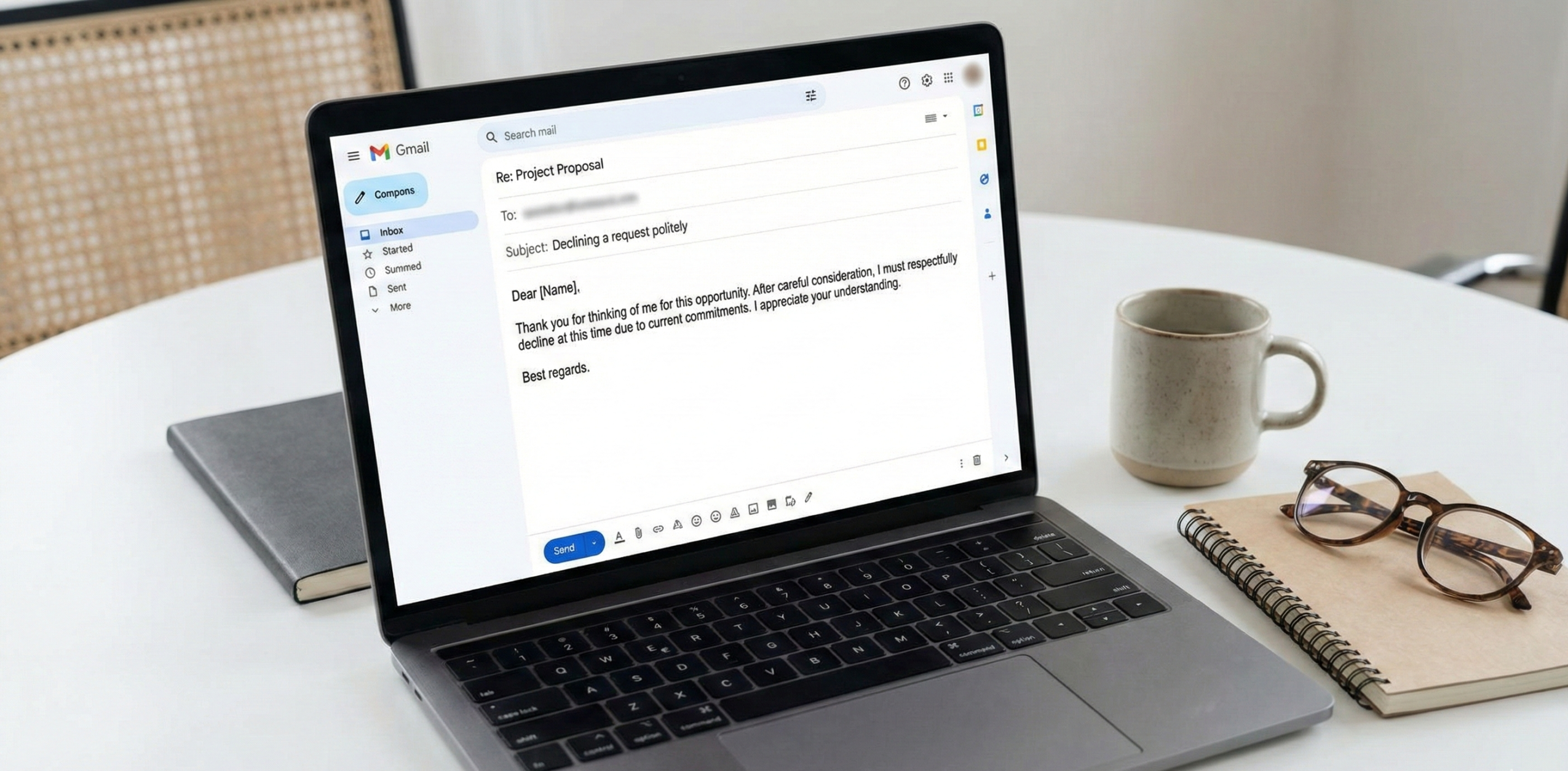
The Art of the Polite Refusal
We live in a culture that glorifies “hustle,” often making us feel like saying yes is the only path to success. However, the most successful people are not the ones who say yes to everything; they are the ones who say no to almost everything so they can focus on what truly matters.
Learning how to decline requests is a critical soft skill. It prevents burnout, reduces decision fatigue, and signals to others that your time is valuable. But the fear of appearing rude or unhelpful often stops us. If you struggle with this, you might also find our guide on how to build better communication skills incredibly useful.
Whether it is a request for a meeting, a new project with no budget, or an invitation to “pick your brain,” we have crafted 5 copy-paste email templates to help you stand your ground professionally.
The ability to turn down requests graciously is one of the most underrated professional skills. It is not about being difficult; it is about being deliberate. When you protect your time, you give your best to the work that genuinely deserves it.
The Psychology Behind Saying No
Before we dive into templates, it helps to understand why saying no feels so hard. This is not a personal failing — it is deeply rooted in psychology and social conditioning.
Why We Say Yes When We Mean No
Human beings are wired for social approval. From an evolutionary standpoint, being accepted by the group was tied to survival. Rejection — even minor social friction — triggers the same neural pathways as physical pain. This is why declining a request can feel genuinely threatening, even when the logical part of your brain knows it is the right decision.
In professional settings, this instinct is amplified by a fear of being seen as unhelpful, lazy, or not a “team player.” Many of us carry an internalized belief that our value at work is tied to how available and agreeable we are. If this resonates, you are far from alone.
The “Yes-Debt” Trap
Every time you say yes to something you genuinely cannot accommodate, you create what behavioral economists call a “yes-debt.” You have committed resources — time, energy, attention — that you do not have. Paying back this debt requires either delivering substandard work, sacrificing sleep and personal time, or letting people down anyway — just later and with more damage.
The irony is that a clear, timely “no” is almost always more professional and respectful than a slow, overwhelmed “yes.”
“A ‘no’ uttered from deepest conviction is better and greater than a ‘yes’ merely uttered to please, or what is worse, to avoid trouble.” — Mahatma Gandhi
Fawn Response in the Workplace
The fawn response — a trauma-informed concept referring to the tendency to placate others to avoid conflict — shows up frequently in workplace dynamics. People who have experienced difficult environments, whether in childhood or in previous toxic jobs, often default to excessive agreeableness as a protective mechanism. Recognizing this pattern in yourself is the first step to changing it.
Saying no professionally, and doing it repeatedly, is an act of retraining both your own nervous system and the expectations of those around you.
Social Proof and FOMO
Another force working against us is FOMO — the fear of missing out. When someone invites you to a project or event, there is a subtle implication that this opportunity is special, finite, and may not come again. This manufactured scarcity creates pressure to say yes immediately, even when reflection would reveal that the opportunity is not aligned with your goals.
High-performers have learned to pause before answering. They give themselves a window — even just a few hours — to evaluate a request objectively rather than reacting emotionally.
Before You Write: What to Ask Yourself
The best “no” emails are grounded in clarity — not just about your workload, but about your priorities. Before you open your drafts folder, run through this quick internal checklist.
-
1
Does this align with my current priorities?
If the request does not serve your primary goals this quarter, it is a strong candidate for a polite decline, regardless of how interesting it sounds.
-
2
Do I have the capacity, honestly?
Not just technically — emotionally and energetically too. Burnout is real, and taking on more when you are already stretched serves nobody well.
-
3
Am I the right person for this?
Could someone else do this better, faster, or with more enthusiasm? Redirecting a request to a more appropriate person is a professional act, not a cop-out.
-
4
What is the cost of saying yes?
Make the trade-off explicit. If you say yes to this, what are you automatically saying no to?
-
5
Is there a version of “yes” that works for me?
Sometimes the answer is not a hard no, but a conditional yes — a different scope, timeline, or involvement level that you can genuinely commit to.
💡 Quick Tip: If your gut reaction to a request is dread, that is information. Do not override it with obligation. Your intuition about your own capacity is usually accurate.
5 Scenarios and Exact Scripts to Use
Before you copy these, remember: brevity is kindness. You do not need to over-explain your reasons. A clear, firm, and polite “no” is better than a vague “maybe” that wastes everyone’s time.
1. The “Bandwidth” No (When You Are Too Busy)
Use this when you genuinely want to help but your schedule is packed. This connects deeply with the principles of time blocking — you cannot pour from an empty cup.
Subject: Re: Project X / Meeting Request
Hi [Name],
Thanks for thinking of me for this.
I’m currently heads-down on a few deadline-driven projects, so I don’t have the bandwidth to take this on right now. I want to make sure I’m not overcommitting so I can deliver high-quality work on my current priorities.
I hope you understand!
Best,
[Your Name]
When to use this template: Best suited for peer requests, cross-departmental asks, or anyone outside your direct reporting line. It is neutral, professional, and leaves no ambiguity.
Variations: If the person is likely to push back, you can add one concrete sentence: “My plate is full with [Project A] and [Project B] through the end of the month, so I genuinely cannot fit this in.” Specificity makes the refusal feel more credible and less like an excuse.
2. The “Not a Good Fit” No (Wrong Person/Scope)
Sometimes people ask you for things that are not in your job description. This is common when organizational boundaries are blurry or when colleagues default to whoever they know rather than whoever is best suited. For personal relationships, check our guide on setting boundaries with friends, but for work, use this:
Subject: Re: Assistance with [Topic]
Hi [Name],
Thanks for reaching out.
While I’m flattered you asked, this isn’t my area of expertise. I wouldn’t be the best person to help you achieve the results you’re looking for here.
[Optional: You might try reaching out to [Colleague Name], as they specialize in this.]
Good luck with the project!
Best,
[Your Name]
When to use this template: When someone asks you to weigh in on a topic, review a document, or contribute to a project that falls outside your actual domain. Also useful when someone is asking for advice that requires a licensed professional (lawyer, accountant, therapist).
Pro move: Pair this with a specific resource — a relevant internal document, tool, or team — rather than just pointing vaguely to another person. This shows you took the request seriously even if you cannot personally help.
3. The “Not Now” No (Deferral)
If you genuinely want to do it but just cannot do it today. This is great for managing your mental load without burning bridges. The key to making this template work is making it specific: vague deferrals are just slow rejections with extra steps.
Subject: Re: Invitation to [Event/Project]
Hi [Name],
This sounds like a great opportunity, and I’d love to be involved.
My schedule is fully booked for this quarter, so I can’t commit to this right now. Would you be open to reconnecting in [Month] when my calendar clears up?
Let me know if that works for you.
Thanks,
[Your Name]
When to use this template: Ideal for speaking invitations, committee memberships, advisory roles, or any recurring commitment where timing genuinely is the only barrier.
The trap to avoid: Do not use “not now” as a softer way of saying “never.” If you know you will not circle back in three months, a clean no today is far more respectful of the other person’s time and planning.
4. The “Alternative Solution” No (The Soft No)
You cannot do the work, but you can offer a resource. This is highly effective because you are still being genuinely helpful without overextending yourself. The alternative solution no is particularly powerful for consultants, senior professionals, and anyone fielding lots of “quick question” emails.
Subject: Re: Quick Question regarding [Topic]
Hi [Name],
Thanks for the email. I won’t be able to jump on a call to discuss this, but I have actually written a guide/documentation on this exact topic.
You can find the answers you need here: [Insert Link].
I hope that helps point you in the right direction!
Best,
[Your Name]
When to use this template: Perfect for the “can I pick your brain?” request, repetitive questions about processes you have already documented, or any situation where a resource can do what a meeting would.
Building your resource library: Consider creating a personal “no library” — a folder of links, docs, and templates you can reference in future declines. This turns each refusal into a scalable system over time.
5. The “Scope Creep” No (Protecting Your Value)
Essential for freelancers or employees asked to do unpaid extra work. Scope creep is one of the most financially damaging patterns for independent professionals, and addressing it head-on — professionally and without apology — is a career-defining skill. If you are wondering how to handle difficult conversations like this, read about stopping negative self-talk — you deserve to be paid for your time.
Subject: Re: Additional Request for [Project]
Hi [Name],
I’m happy to help with this additional request.
Since this falls outside the original scope of our agreement, I’ve attached an updated estimate that includes the extra hours required to complete this.
Let me know if you’d like to proceed with this addition, and I can send over the contract amendment.
Thanks,
[Your Name]
When to use this template: Any time a client or employer asks for something that was not in the original agreement — additional revisions, new deliverables, expanded research, extra meetings, or changes to an already-approved plan.
A note on tone: Notice this template does not say “I am sorry, but…” or “Unfortunately…” It is matter-of-fact, friendly, and treats the additional work as a natural, normal thing to price correctly. That tone is intentional. Apologizing for charging for your work signals that you do not fully value it yourself.
Master the Art of Essentialism

Struggling to prioritize? Essentialism by Greg McKeown is the ultimate guide to discerning what is absolutely essential, then eliminating everything that is not.
Check Price on AmazonWords to Avoid vs. Words That Work
The language you use when declining a request sends just as strong a signal as the decision itself. Certain phrases undermine your message before the recipient even finishes reading. Others reinforce your credibility and keep the relationship intact.
Why This Matters
Phrases like “I’m so sorry” or “I feel terrible” do several things you do not want: they signal that you are not fully confident in your decision, they invite negotiation, and they center the conversation on your emotions rather than the practical reality of the situation.
Contrast this with “Unfortunately, I am not able to…” which is matter-of-fact, warm enough to be polite, and leaves no linguistic hook for the other person to tug on. You are not sorry. You have made a considered decision. The word “unfortunately” acknowledges the inconvenience without turning it into a drama.
The same principle applies to over-explaining. The longer your explanation for why you cannot do something, the more it reads as defensiveness. A short, confident explanation is far more persuasive than a three-paragraph apology.
How to Calibrate Your Tone by Relationship
Not all “no” emails are created equal. The right tone depends heavily on your relationship with the person asking, the nature of the request, and your organizational culture. Here is a practical guide to calibrating your approach.
| Relationship | Recommended Tone | Key Principle |
|---|---|---|
| Direct Boss | Collaborative, transparent | Reframe as a prioritization question, not a flat refusal |
| Peer Colleague | Friendly, brief | No need to over-explain; brevity is respectful |
| Client (Freelancer) | Professional, confident | Treat it as a business decision, not a personal one |
| Senior Stakeholder | Respectful, solutions-focused | Offer an alternative or a clear timeline for re-engagement |
| External Contact | Polite, minimal | You owe them less context — keep it short |
| Job Recruiter | Warm, professional | Relationships matter — leave the door open graciously |
Declining Your Manager: A Special Case
Saying no to your manager is arguably the highest-stakes version of this skill. The key is to never frame it as a flat refusal — instead, make it a conversation about trade-offs and priorities.
For example: “I can absolutely take this on. I want to flag that if I do, I will need to push back the deadline on [Project A] by about two weeks. Does that work, or would you prefer I prioritize [Project A] first?” This reframes the conversation so your manager is making the prioritization call, not you. It is collaborative, honest, and puts the decision where it belongs.
⚠️ Caution: Never say “That’s not my job” directly to a manager, even if it is true. Instead, explain the capacity or scope issue professionally. “I want to make sure I can give this the attention it deserves — right now I’m at capacity with [X]. Would you like me to re-prioritize?” lands very differently.
What to Do When They Push Back
You sent the email. You declined politely. And then they replied asking again, or escalated, or reframed the request as smaller or more urgent. This is where many people capitulate — and it is exactly where you need to hold your ground.
The Broken Record Technique
One of the most effective tools for maintaining a boundary is the broken record technique: simply restate your position, calmly and consistently, without adding new justifications or engaging with their reframing.
For example:
- Their reply: “It will only take 20 minutes, I promise!”
- Your response: “I understand it feels quick — I genuinely do not have space in my schedule right now. I hope you are able to find the right person for this.”
Notice what you are not doing: debating the 20-minute estimate, explaining your calendar in detail, or apologizing again. You are simply restating the same decision in slightly different words.
Resetting Expectations After Capitulation
If you have a pattern of caving when pushed, the other person has learned that your “no” is just the start of a negotiation. Breaking this pattern requires one clear, firm response that does not leave a crack for further pressure.
A template for persistent follow-up:
Subject: Re: [Previous Thread]
Hi [Name],
As I mentioned, I’m not able to take this on at the moment. I hope you’re able to find a great solution — I know this is important to you.
Best,
[Your Name]
When to Escalate Internally
If someone repeatedly ignores your professional declinations — particularly if there is a power imbalance involved — it may be appropriate to involve your manager or HR. Document your refusals in writing (email is ideal for this reason) so you have a clear record. A professional “no” that is repeatedly overridden is a management issue, not a communication failure on your part.
Saying No Across Different Digital Channels
Not every decline happens over email. Increasingly, professional requests come through Slack, LinkedIn, text message, or even social media DMs. Each channel has its own norms, and adjusting your approach accordingly will make your response land better.
Best for formal or documented declines. Full sentences, professional salutation, and a clear subject line. Preserve the thread for reference.
💬 Slack / Teams
More casual. A shorter response is fine. “Hey, I can not take this on right now — I am heads-down on [X]. Hope you find the right person!” works perfectly.
Common for “pick your brain” or collaboration requests. Warm but brief. Always acknowledge the person’s work before declining to maintain the relationship.
📱 Text / WhatsApp
For professional contacts who text: keep it short and human. “Hey, appreciate you thinking of me — not going to be able to swing this one. Good luck with it!”
The “Seen and Not Replied” Problem
One of the worst habits in professional communication is leaving requests on read without responding. Even a brief, polite decline is infinitely better than silence. Ghosting a professional contact — even for an unwanted request — damages your reputation and creates unnecessary awkwardness in future interactions.
If you need time to think before responding, a holding reply works well: “Thanks for sending this over — I’ll get back to you by [date].” This buys you time without leaving the person in limbo.
Cultural Considerations When Saying No Professionally
If you work in a global organization or with international clients, understanding how different cultures approach refusal is critical. What reads as “appropriately direct” in one country can read as rude or even offensive in another — and what feels like excessive hedging to a Westerner may be the expected politeness norm elsewhere.
High-Context vs. Low-Context Communication
Anthropologists and communication researchers distinguish between high-context and low-context communication cultures. In low-context cultures — think the United States, Germany, Australia, the Netherlands — messages are meant to be taken at face value. Direct, explicit refusals are expected and respected.
In high-context cultures — Japan, China, South Korea, Brazil, many Middle Eastern countries — communication relies more heavily on subtext, relationship, and implied meaning. A direct “no” can feel jarring or disrespectful. Instead, professionals in these contexts may express refusal through indirection: “That might be difficult,” “Let me think about that,” or simply a prolonged silence.
Adapting Your Language for Global Teams
When declining across cultural lines, consider softening without losing clarity. Phrases like “I appreciate the opportunity” and “I want to make sure I can give this the attention it deserves, which I cannot currently do” communicate the same refusal while showing more relational warmth — which lands better in high-context settings.
Conversely, if you work in a fast-moving, low-context environment and you are too indirect, your message may not register as a “no” at all. This is particularly common when non-native English speakers communicate with native speakers in international settings. If clarity is your goal, err toward being explicit — politely, but unmistakably.
ℹ️ Note: When in doubt, match the register of the person’s original message. If they were formal, be formal. If they were casual and friendly, you can be warmer. The tone of their message tells you a lot about what they expect in return.
Special Case Scenarios: Saying No in Tricky Situations
Some declines are particularly emotionally charged or professionally complex. Here are templated approaches for situations that require extra care.
Declining a Job Offer Gracefully
Subject: Re: [Role] Offer — [Your Name]
Dear [Hiring Manager’s Name],
Thank you so much for offering me the [Position Title] role. After careful consideration, I’ve decided to decline the offer at this time. This was not an easy decision — I have great respect for the work your team is doing.
I hope our paths cross again in the future, and I wish you and the team all the best.
Warmly,
[Your Name]
Declining a Speaking or Panel Invitation
Subject: Re: Speaking Invitation — [Event Name]
Hi [Name],
Thank you so much for the invitation to speak at [Event Name]. It sounds like a wonderful event, and I’m genuinely flattered to be considered.
Unfortunately, I’m not available on that date / I’m not taking on speaking engagements at this time. I hope the event is a great success!
Best,
[Your Name]
Declining a Volunteer or Charity Request
Subject: Re: Volunteer Opportunity at [Organization]
Hi [Name],
Thank you for reaching out. The work [Organization] does is genuinely important, and I admire your mission.
I’m not in a position to volunteer my time at the moment, but I wanted to acknowledge your efforts and wish you all the best in finding the right people.
Kind regards,
[Your Name]
Declining a Social Event at Work
Declining social or optional work events requires a light touch — you want to be warm without over-explaining. A simple, friendly “I can not make this one but hope everyone has a great time!” is usually more than sufficient. You do not owe colleagues a detailed account of your personal schedule.
Declining a Request for a Reference or Recommendation
This is one of the most delicate declines in professional life. Agreeing to write a recommendation when you cannot do it enthusiastically is worse than declining — a lukewarm reference can actively harm the person’s chances.
Subject: Re: Reference Request
Hi [Name],
Thank you for thinking of me — I really appreciate your trust.
I want to be honest with you: I’m not sure I’m the best person to provide the strongest reference for this particular role, and you deserve someone who can advocate for you wholeheartedly.
I’d encourage you to consider [alternative contact] who has seen more of your work in [relevant area]. I’m rooting for you!
Warmly,
[Your Name]
The Mindset Shift That Makes Saying No Easy
The templates above will only work consistently if you also do the internal work to shift how you think about refusal. Without a genuine belief that your time is worth protecting, you will keep softening your nos until they become yeses, or you will feel chronic guilt even when you do say no.
From “Saying No” to “Saying Yes to Something Better”
Every no is a yes in disguise. When you decline a meeting that would not move the needle, you are saying yes to focused deep work. When you turn down a project outside your scope, you are saying yes to delivering excellence on the work that is already in your hands. Framing your refusals this way is not just a feel-good trick — it is an accurate description of the trade-off.
Your No Teaches People How to Treat You
There is a concept in behavioral psychology called operant conditioning: behaviors that are rewarded tend to be repeated. If you say yes every time someone pushes, you have inadvertently trained them that pushing works. Conversely, a consistent, professional “no” teaches people to respect your boundaries — and ironically, often earns you more respect in the process.
People who never say no are often seen as pushover, not team players. People who say no thoughtfully and professionally are seen as leaders — because they are modeling good judgment and self-management.
The “Hell Yes or No” Framework
Derek Sivers, entrepreneur and author, popularized a useful decision framework: if something is not a “hell yes,” it is a no. This might feel extreme in a professional setting — you cannot always be fully thrilled about every task — but the underlying principle is sound. When evaluating discretionary requests, ask yourself honestly: “Would I genuinely be glad I said yes to this in three months?” If the answer is not clearly affirmative, you have your answer.
“If it’s not a clear yes, then it’s a clear no.” — Derek Sivers
Dealing with the Guilt Afterward
Even when you know a decline was the right call, guilt can surface afterward — particularly if the person seemed disappointed or did not respond warmly. Here is what to remember: guilt, in this context, is not a signal that you did something wrong. It is a signal that you care about other people, which is a good thing. It does not mean you made the wrong decision.
Give yourself a set amount of time to feel uncomfortable about it — a few hours, even a day — and then redirect your energy to the work you protected. The discomfort fades. The time you saved is permanent.
- I said no because my current commitments deserve my full attention
- Protecting my time means delivering better results for everyone who depends on me
- Being consistently reliable is more valuable than being endlessly available
- A professional “no” is a sign of self-awareness, not selfishness
- My long-term reputation is built on quality, not quantity
Why You Need to Stop Saying “Yes” to Everything
Every time you say “yes” to a minor request, you are inadvertently saying “no” to something else — usually your own well-being or your high-priority goals. This constant context switching is a productivity killer.
⚠️ The Cost of “Yes”
- Decision Fatigue: See our report on how many decisions we make a day.
- Lower Quality Work: Rushing to finish tasks leads to errors.
- Resentment: You begin to dislike colleagues for “taking” your time.
- Invisible Overwhelm: You appear capable on the outside while quietly drowning.
- Stalled Goals: Your own projects perpetually sit at the bottom of the pile.
✅ The Power of “No”
- Respect: People respect clear, consistent boundaries.
- Focus: Enables highly effective habits.
- Clarity: Sets realistic expectations for your team.
- Integrity: You only commit to what you can deliver fully.
- Energy: More mental bandwidth for high-impact work.
The Hidden Cost of Context Switching
Research in cognitive psychology consistently shows that every time you switch tasks — even briefly — you pay a mental toll. The brain does not multitask; it toggles, and each toggle costs you. Accepting unnecessary requests fills your day with these micro-interruptions, each one requiring its own mental warm-up and wind-down.
Deep work — the kind that produces real results — requires extended, uninterrupted attention. You cannot do deep work if you are constantly fielding requests and jumping between tasks. Saying no is not just a boundary-setting exercise; it is a prerequisite for doing your best work.
The Availability Trap
Modern workplace culture has created what some organizational psychologists call the “availability trap” — the implicit expectation that you should be reachable and responsive at all times, on all channels. This norm has been amplified by remote work tools and always-on messaging apps.
Constant availability does not make you more productive. It makes you perpetually reactive, living in other people’s agendas rather than your own. Deliberate unavailability — protected focus blocks, delayed email responses, clear office hours — is a hallmark of the most effective professionals, not the least effective ones.
Pro Tip: Automate Your “No”
If you find yourself typing these emails repeatedly, stop. Use text expansion software or email templates. Tools like TextExpander or even the built-in “Templates” feature in Gmail can save you hours. For more on streamlining your workflow, check out our review of the 10 best AI tools to automate your daily tasks.
How to Set Up Email Templates in Gmail
- Open Gmail and go to Settings → See all settings
- Click the Advanced tab
- Enable Templates and save changes
- Compose a new email and click the three-dot menu → Templates → Save draft as template
- Name each template by scenario (e.g., “Bandwidth No,” “Scope Creep No”)
Building a Personal Decline System
Beyond individual templates, consider building a personal decline system — a set of criteria and resources that make each refusal faster and easier. This might include:
- A saved FAQ or internal documentation link you can share for common questions
- A “not taking on new [X] this quarter” autoresponder for specific request types
- A scheduled “reply day” once a week for non-urgent requests, so they do not interrupt your flow
- A calendar block each month to review which recurring commitments still deserve your yes
💡 Power Move: Create a single public-facing page that explains what kinds of requests you do and do not take on. Link to it in your email signature and social profiles. This prevents many unwanted asks before they reach your inbox at all.
Need to Block Out Distractions?
Focus on your “Yes” tasks with premium noise-canceling headphones. A must-have for deep work.
 Shop Headphones on Amazon
Frequently Asked Questions
Is it rude to say no without giving a reason?
Not necessarily. In a professional setting, “I don’t have the bandwidth” is a sufficient reason. Over-explaining can actually make you sound defensive or unsure. Keep it brief and polite. The more you justify, the more you invite negotiation.
How do I say no to my boss without getting fired?
Frame it as a prioritization question. Instead of just saying no, say: “I can do this task, but it will delay Project A. Which one would you prefer I prioritize right now?” This puts the decision back on them and demonstrates that you are thinking strategically, not being difficult.
What if they keep pushing after I say no?
Hold your boundary. You can reply with, “As I mentioned, I cannot take this on right now.” If you struggle with overthinking their reaction, read our guide on how to stop overthinking. Consistency is key — the moment you cave, you reset expectations and make future refusals harder.
Should I apologize when saying no?
Try to avoid “I’m sorry” if you haven’t done anything wrong. Protecting your time isn’t a mistake. Instead of “I’m sorry I can’t,” try “Unfortunately, I can’t.” It is a subtle but powerful shift in authority and conviction.
How do I say no professionally without sounding cold?
Warmth comes from acknowledgment, not agreement. Starting with “Thanks for thinking of me” or “I appreciate you reaching out” acknowledges the person before you decline. This small step makes the refusal feel human rather than dismissive, even if the rest of your message is brief and direct.
What is the best way to decline a meeting request?
Be specific about why a meeting is not the right format. “I do not think a full meeting is needed for this — could we sort it out over email or a quick message?” is both a decline and a practical alternative that many people will appreciate. If you genuinely cannot attend, a brief “I am not able to join for this one, but please send over notes afterward” is perfectly sufficient.
How do I decline extra work when my plate is full?
Make your current commitments visible. A response like “I am currently focused on [Project A] and [Project B] through [date], so I am not able to take on additional work without impacting the quality of those deliverables” is honest and professional. It also alerts your manager to your current workload, which is useful information for them to have.
Can saying no hurt my career?
Done badly, yes. Done well, almost never — and it can actively help your career. Professionals who say no thoughtfully are seen as people with good judgment and clear priorities. The risk to your career is far greater if you consistently over-commit and under-deliver than if you occasionally, professionally decline requests you cannot accommodate.
Final Thoughts: Your Time is Your Currency
Saying no is uncomfortable at first, especially if you are a recovering people-pleaser. However, it is an essential part of self-care for professionals.
By using these templates, you remove the emotion from the decision. You are not rejecting the person; you are simply managing your resources. The best professionals are not the ones who say yes the most — they are the ones who say yes well. That requires knowing when to say no.
Start small. Choose one request this week that you would normally say yes to out of obligation, and try one of these templates instead. Notice how the other person responds. Notice how you feel. Chances are, both will be better than you expect.
Over time, the habit compounds. You get better at it. People learn to respect your boundaries. And you start doing the kind of work — focused, purposeful, high-quality — that you actually want to be remembered for.
Protect Your Time. Do Your Best Work.
Save this page, share it with a colleague who needs it, and start using these templates today. Your inbox — and your sanity — will thank you.