
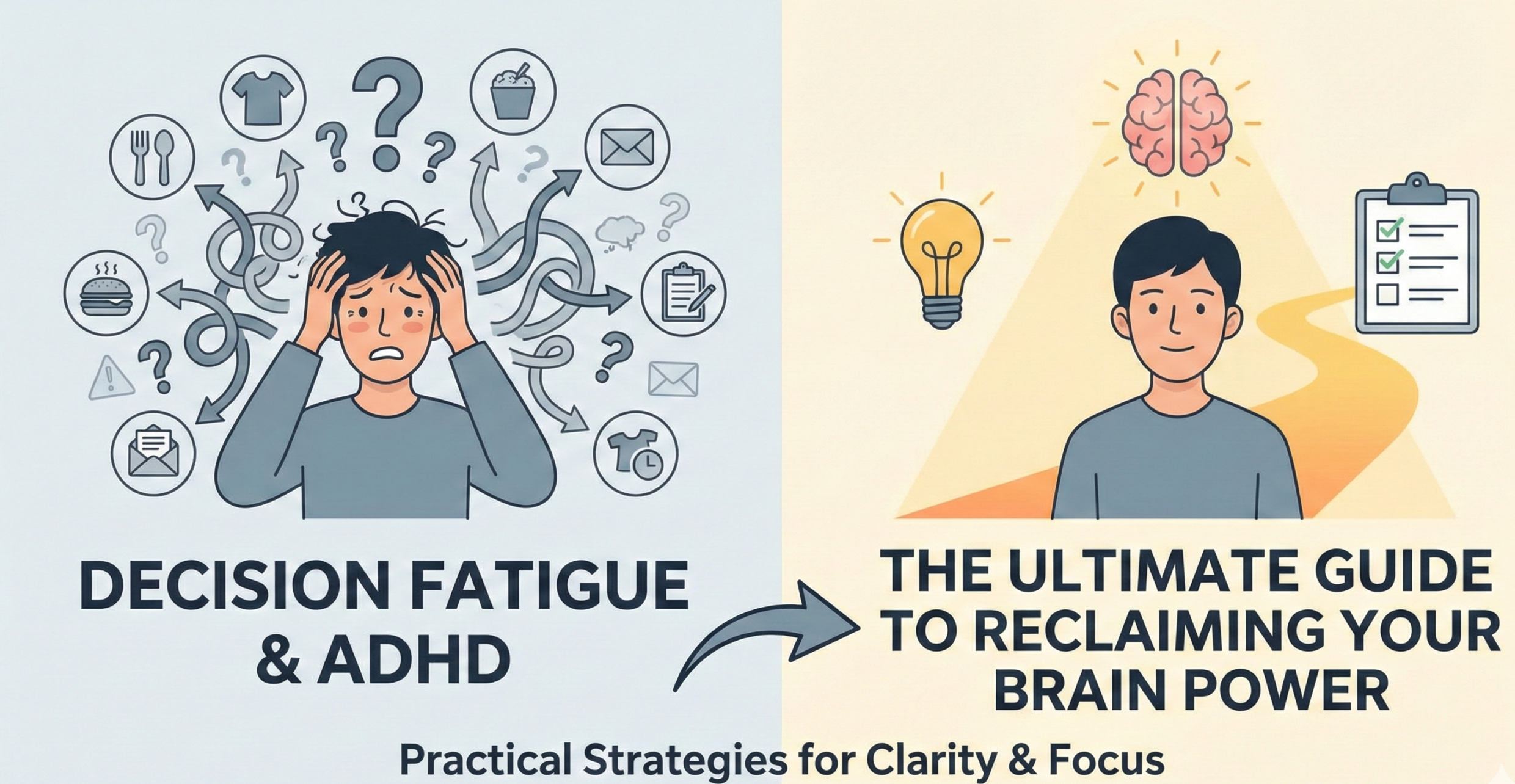
Decision Fatigue & ADHD: The Ultimate Guide to Reclaiming Your Brain Power
Why modern life is draining your willpower, how neurodivergence amplifies the struggle, and the evidence-backed system to stop overthinking before it costs you your day.
The Invisible Drain on Your Mental Battery
It is 4:00 PM. You have been sitting at your desk for hours. You realize you are hungry, but the simple question “What should I eat?” feels like an impossible calculus equation. You scroll through a delivery app for twenty minutes, unable to choose between Thai or Italian, until you eventually give up and eat a stale granola bar — or nothing at all.
This isn’t laziness. It isn’t a character flaw. It is a biological phenomenon known as decision fatigue — also called decision exhaustion or choice fatigue. In an era of infinite options, our brains are constantly bombarded with choices, from which email to answer first to which home office gadgets to buy. Every single one of these micro-choices chips away at a finite supply of mental energy.
For those navigating life with ADHD (Attention Deficit Hyperactivity Disorder), this struggle is amplified tenfold. The intersection of ADHD and decision-making creates a unique form of paralysis that can derail careers, damage relationships, and erode self-esteem. In this comprehensive guide, we dissect the anatomy of decision overload, explore the deep neuroscience of the ADHD connection, and equip you with a complete arsenal of evidence-based tools to simplify your life and protect your cognitive resources.
What Is Decision Fatigue? Defining the Phenomenon
To understand how to fight it, we must first define it precisely. Decision fatigue was popularized by social psychologist Roy F. Baumeister, and refers to the deteriorating quality of decisions made by an individual after a long session of decision-making. It is anchored in the concept of “ego depletion” — the idea that willpower and self-regulation draw from a limited mental resource that can be temporarily exhausted.
Decision Fatigue Defined
Decision fatigue is the state of mental exhaustion resulting from the cumulative burden of making choices throughout the day. Unlike physical fatigue, you may not feel your muscles ache, but your impulse control dissolves, your executive function falters, and the quality of your choices declines measurably.
The Two Primary Coping Mechanisms
When your brain’s fuel for decision-making runs low, it reliably resorts to one of two failure modes:
- Decision Avoidance (Procrastination): You simply stop making choices. You delay filing taxes, leave emails unread, or stick with the default option because change requires energy you don’t have. This “status quo bias” is a major reason people struggle with beating procrastination — they are not lazy, they are depleted.
- Impulse Action: Your brain shortcuts to the quickest dopamine hit. This is why candy bars line the checkout counter — supermarkets know that after 45 minutes of shopping decisions, your willpower is depleted and you will make impulsive purchases. The same mechanism fires online: late-night Amazon sessions, impulsive food orders, reactive emails sent in anger.
The modern digital landscape has catastrophically amplified decision overload. We make an estimated 35,000 decisions per day — a number that includes thousands of micro-choices invisible to conscious awareness, from which notification to acknowledge first to which thumbnail to click on a streaming platform. Our evolutionary hardware was never designed to process this volume.
Ego Depletion Theory: The Science & Its Complications
Baumeister’s original ego depletion model proposed a clean hydraulic metaphor: willpower as a fuel tank that empties with use and refills with rest and glucose. The model was intuitive, widely adopted, and influenced two decades of self-help literature. Then came the replication crisis.
In the mid-2010s, large pre-registered replication studies — most notably the 2016 multi-lab replication led by Martin Hagger — failed to reproduce many of the original ego depletion effects at statistically significant levels. This triggered considerable scientific debate. Was ego depletion a myth?
The Updated Model: Motivation, Not Fuel
The current scientific consensus — supported by researchers like Michael Inzlicht and Malte Friese — suggests that decision fatigue is real but mechanistically different from the original fuel-tank model. Rather than literal energy depletion, the brain undergoes a motivational shift: after sustained effort, the reward value of continued performance decreases relative to the reward value of rest or distraction. You don’t “run out” of willpower; you progressively choose to redirect attention. The practical implication is identical — performance degrades — but the remedy is different: motivation and meaning matter, not just glucose and rest.
What remains robustly supported regardless of the mechanism debate is the behavioral outcome: after sustained periods of decision-making, the quality, consistency, and care of subsequent decisions measurably declines. Judges grant fewer paroles as the day progresses. Physicians order more unnecessary tests as their shift lengthens. Students make more errors on afternoon exams than morning ones. The phenomenon is real; its precise mechanism continues to be refined.
Choice Paralysis vs. Decision Fatigue: An Important Distinction
These two terms are frequently conflated, but they describe different psychological phenomena with different causes and remedies. Understanding the distinction prevents applying the wrong solution to the wrong problem.
| Factor | Decision Fatigue | Choice Paralysis (Analysis Paralysis) |
|---|---|---|
| Primary Cause | Too many decisions over time (temporal accumulation) | Too many options at once (simultaneity of options) |
| Trigger | Progressive depletion across the day | Single high-stakes or high-complexity choice |
| Mental State | Exhaustion, apathy, impulsivity | Anxiety, over-analysis, perfectionism |
| Outcome | Poor impulsive choice or avoidance via default | No choice at all — endless deliberation |
| Remedy | Rest, routine, reducing decision volume | Constraining options, time limits, satisficing |
| ADHD amplification | Severely amplified — faster and deeper depletion | Severely amplified — every option feels equally valid |
Barry Schwartz, in his seminal work The Paradox of Choice, demonstrated that increasing the number of options does not increase satisfaction — it increases anxiety, regret, and decision difficulty. His famous jam study (Iyengar and Lepper) showed that shoppers were 10 times more likely to purchase jam when presented with 6 varieties versus 24. More options created less decision-making, not more. Abundance of choice is a psychological burden, not a gift.
“The secret to happiness is low expectations.”
— Barry Schwartz, The Paradox of ChoiceThe ADHD Factor: Why Making Decisions Feels Impossible
If neurotypical brains have a fuel tank for decisions, ADHD decision-making often feels like driving with a tank that is simultaneously leaky and unpredictably empty. Is indecisiveness a symptom of ADHD? Definitively yes. It is a hallmark of executive dysfunction — the class of cognitive difficulties that define the daily experience of living with ADHD.
The Neurology of ADHD Decision Fatigue
The prefrontal cortex (PFC) is the executive center of the brain — responsible for planning, prioritizing, working memory, and making choices. In ADHD brains, the PFC operates with reduced dopaminergic and noradrenergic tone, meaning the neurotransmitters that regulate focused, deliberate cognition are functionally underactive. When faced with a decision, this creates a specific pattern of failure:
Filter Failure
The neurotypical brain automatically suppresses irrelevant options. The ADHD brain considers every variable simultaneously — every past outcome, every tangential possibility — creating cognitive overwhelm from a choice that others find trivial.
Priority Blindness
Everything feels equally important. Without the natural gradient of urgency that the PFC provides, ADHD individuals cannot intuitively rank options by importance — all tasks feel like they have the same weight and the same deadline.
Time Blindness
Long-term consequences receive insufficient cognitive weighting. The “future self” feels abstract and distant, making decisions that require sacrificing present comfort for future benefit feel almost neurologically impossible without external scaffolding.
Rapid Depletion
Where neurotypical individuals experience gradual fatigue across a day, ADHD individuals often begin the day with a cognitive deficit and deplete far faster — particularly in unstructured environments that require constant self-regulation of attention.
| Feature | Neurotypical Brain | ADHD Brain |
|---|---|---|
| Filtering irrelevant options | Automatic — happens below conscious awareness | Impaired — requires deliberate effort to suppress |
| Prioritization | Intuitive ranking by importance and urgency | Priority blindness — everything registers equally |
| Time horizon weighting | Naturally considers long-term consequences | Present-focused — future consequences underweighted |
| Working memory during decision | Holds multiple options reliably | Options drop from working memory mid-decision |
| Fatigue onset pattern | Gradual depletion over hours | Rapid depletion, especially in unstructured contexts |
| Emotional regulation in decisions | Can suppress emotional responses to evaluate rationally | Emotional responses are intense and immediate (RSD) |
Recommended Read: Order from Chaos
For those with ADHD, understanding your brain’s unique organizational style is transformative. “Order from Chaos” by Jaclyn Paul offers practical strategies specifically designed for the ADHD experience of managing perpetual cognitive fatigue.
 Check Price on Amazon
Executive Function: The Architecture of Decision-Making
Executive function is not a single ability — it is an umbrella term for a family of high-level cognitive processes managed by the prefrontal cortex. Understanding which executive functions are involved in decision-making clarifies both why ADHD creates such significant decision difficulties and which interventions are most likely to help.
The Six Core Executive Functions in Decision-Making
- Working Memory: The ability to hold multiple pieces of information in mind simultaneously while processing them. Required for comparing options — “Option A has these advantages; Option B has these advantages; Option C has these advantages — now compare.” ADHD impairs working memory significantly, meaning options literally fall out of mental awareness mid-comparison.
- Cognitive Flexibility: The ability to shift between different rules, perspectives, or mental frameworks. Required for adapting your decision approach when new information changes the landscape. Rigidity in decision-making — getting “stuck” on one approach even when it clearly isn’t working — reflects impaired cognitive flexibility.
- Inhibitory Control: The ability to suppress automatic, impulsive responses and act based on deliberate reasoning. The brain’s “brake” on reactive behavior. When this is impaired, emotionally salient options are chosen over logically sound ones — the mechanism behind impulsive purchases and reactive decisions made in frustration.
- Planning and Organization: The ability to decompose a complex goal into sequential steps and organize them temporally. Required for decisions involving multiple stages — long-term purchases, career changes, complex negotiations. ADHD planning deficits manifest as an inability to visualize the decision path forward, leading to paralysis at the starting line.
- Emotional Regulation: The ability to manage emotional reactions during the decision process — specifically, to prevent fear, excitement, anxiety, or frustration from hijacking rational evaluation. In ADHD, emotional responses to choices are more intense and faster-onset, often overriding deliberate reasoning before it completes.
- Self-Monitoring: The ability to track your own mental state and performance in real time — noticing when you are fatigued, when a decision is being made impulsively, or when you are spiraling into analysis paralysis. This metacognitive awareness is foundational to decision self-regulation and is frequently impaired in both ADHD and decision fatigue states.
RSD and the Fear of Making the Wrong Choice
Rejection Sensitive Dysphoria (RSD) is a pattern of intense emotional pain triggered by the perception — real or imagined — of failure, criticism, or rejection. First described systematically by ADHD specialist Dr. William Dodson, RSD affects an estimated 99% of adults with ADHD and is now recognized as one of the most impairing features of the condition — yet it remains one of the least discussed.
In the context of decision-making, RSD creates a devastating loop: every significant choice carries the implied threat of making the “wrong” decision, which triggers fear of criticism from others (or from oneself), which activates the emotional pain response of RSD, which makes the choice feel high-stakes regardless of its actual importance, which triggers analysis paralysis. An ADHD person with RSD might spend four hours researching the best budget laptop not because the decision is genuinely complex, but because the emotional cost of choosing “wrong” feels unbearable.
RSD Is Not Perfectionism — It’s Pain
RSD is frequently misidentified as perfectionism or people-pleasing. The critical distinction is that perfectionism is driven by standards and aesthetics — “I want this to be good.” RSD is driven by anticipated pain — “I cannot tolerate the feeling if this goes wrong or if someone disapproves.” Understanding this distinction changes the intervention: cognitive reframing addresses perfectionism; emotional regulation and self-compassion practices address RSD.
The ADHD Perfectionism-Paralysis Loop
The combination of RSD and ADHD creates a specific paralysis pattern: the fear of wrong choice drives an excessive information-gathering phase (research spiral), which activates decision fatigue, which further impairs the decision-making capacity needed to exit the research spiral. The individual exhausts themselves gathering information and never arrives at a decision at all — or makes a desperate, low-quality choice at the end purely to escape the loop. Recognizing this pattern in yourself is the first step toward interrupting it deliberately.
Cognitive Load Theory: Why Your Brain Has a Bandwidth Problem
Cognitive Load Theory, developed by educational psychologist John Sweller, provides a powerful framework for understanding why decision fatigue accumulates and how to design your environment to prevent it. Sweller proposed that working memory has a strict bandwidth limit — it can actively process approximately 4–7 chunks of information at once. When this capacity is exceeded, performance degrades not gradually but suddenly.
Three types of cognitive load interact in any decision environment:
Intrinsic Load
The inherent complexity of the decision itself. Choosing a restaurant has low intrinsic load; choosing a mortgage product has high intrinsic load. This is largely fixed by the nature of the decision.
Extraneous Load
Cognitive burden added by poor decision environment design — too many irrelevant options, confusing interfaces, interruptions mid-process, or unclear framing. This is entirely controllable through environmental design.
Germane Load
Mental effort invested in building decision schemas — repeatable decision templates that reduce future cognitive cost. Good decisions made consciously and documented become heuristics that bypass future deliberation.
The practical insight of Cognitive Load Theory for decision fatigue management: ruthlessly eliminate extraneous load (simplify your decision environments), respect intrinsic load (schedule high-complexity decisions for peak mental energy), and build germane load (develop reusable decision rules that automate recurring choices). Together, these three principles form the foundation of a decision architecture that protects cognitive resources.
Dopamine, Serotonin & the Chemistry of Decision-Making
Decisions are not made in a vacuum of pure rationality — they are electrochemical events occurring in a brain shaped by neurotransmitter levels, hormonal states, blood glucose, sleep debt, and accumulated stress cortisol. Understanding the neurochemistry of decision-making explains why the same person can make brilliant strategic decisions at 9am and terrible impulsive ones at 10pm, and why ADHD medication meaningfully improves decision quality for many individuals.
Dopamine: The Option-Evaluation Neurotransmitter
Dopamine plays a central role in how the brain assigns value to different options during a decision. It is not merely the “pleasure chemical” of popular science — it is more precisely a prediction error signal that updates the relative value of choices based on expected versus actual outcomes. In ADHD brains, tonic dopamine levels in the prefrontal cortex are chronically lower than baseline, which impairs the clear value-differentiation between options that makes decisions feel resolvable. When options don’t clearly differ in perceived value, choice becomes arbitrary and exhausting.
This is why stimulant medications (which increase dopaminergic and noradrenergic tone in the PFC) improve decision quality and reduce analysis paralysis for many ADHD individuals — they restore the neurochemical signal-to-noise ratio that makes option evaluation tractable. Non-pharmacological methods that temporarily boost dopamine availability — exercise, novelty, specific music — can produce similar but shorter-lived effects.
Serotonin: The Patience and Delay-Tolerance Modulator
Serotonin modulates temporal discounting — the degree to which immediate rewards are preferred over delayed but larger rewards. Low serotonergic tone biases the brain toward impulsive, present-focused choices; it is one neurochemical mechanism behind ADHD time blindness and impulsive decision-making. Activities that support serotonin production — sun exposure, regular exercise, high-tryptophan foods, social connection — are therefore relevant not just to mood but to the quality of delayed-reward decisions made throughout the day.
Cortisol: The Stress-Decision Disruptor
Acute cortisol spikes — the stress hormone released during high-pressure situations — temporarily impair prefrontal cortex function and bias decision-making toward the amygdala’s fast, reactive processing mode. Under stress, choices become more risk-averse for potential losses and more risk-seeking for potential gains — a pattern that produces inconsistent and often regretted decisions. The cortisol mechanism is why decisions made during arguments, under deadline pressure, or in fear tend to feel different and worse the next morning. Scheduling high-stakes decisions away from high-stress periods is not just productivity advice; it is neuroscience.
The Hidden Costs of Decision Exhaustion
Fatigue and decision-making are cyclically linked. The more depleted you are, the worse your decisions; the harder you push through depletion to decide, the more depleted you become. This cycle impacts multiple domains of life in ways that are rarely traced back to their decision-fatigue origin.
1. Financial Health
When willpower is depleted, you are significantly less likely to honor financial commitments. Takeout instead of cooking, impulse purchases during end-of-day browsing, subscription services left uncancelled because cancellation requires a decision — these are the fingerprints of decision fatigue on a budget. Implementing a zero-based budget with maximum automation — direct debits, auto-invest rules, auto-savings transfers — removes these decisions from the depleted-willpower risk window entirely.
2. Professional Productivity and Leadership
In the workplace, decision fatigue manifests as inbox blindness: staring at emails without processing them, deferring strategic choices indefinitely, and delegating tasks poorly because delegation itself requires the decision of who is best suited. Leaders suffering from decision exhaustion make worse hiring decisions, worse resource allocation decisions, and disproportionately defer to whichever option is presented first (anchoring bias intensifies under fatigue). The most successful executives rigorously protect their peak decision-making hours from low-value choices. Productivity tools that offload task management and scheduling reduce the cognitive overhead of the workday significantly.
3. Medical and Legal Professional Burnout
The stakes of professional decision fatigue are particularly high in medicine, law, and emergency services. A now-classic study of Israeli parole judges found that prisoners appearing before the board in the morning received parole approximately 65% of the time; those appearing in the late afternoon received it less than 10% of the time. The judges were not being deliberately biased — they were defaulting to the safe, low-effort choice (denial) as their decision resources depleted. Similar patterns have been documented in emergency room diagnostic errors, surgical decision quality, and financial advisor recommendations made late in the trading day.
4. Emotional Wellbeing and Relationships
Perhaps the most insidious cost of decision exhaustion is its effect on interpersonal relationships. When your emotional regulation resources are depleted — as they always are at the end of a high-decision day — you become reactive, irritable, and short-tempered with the people closest to you. Your partner asks “What do you want for dinner?” and you snap. Your child asks you to help choose between two toys and you feel disproportionate frustration. This is not a relationship problem or a parenting problem; it is a cognitive resource management problem. Many relationship conflicts that appear in evenings or on highly unstructured weekends are actually decision fatigue manifesting as emotional dysregulation.
Sleep Deprivation & Decision Quality
Sleep deprivation is decision fatigue’s most powerful amplifier. The prefrontal cortex is the brain region most sensitive to sleep insufficiency — it effectively goes “offline” faster and more completely than other regions under sleep debt. A person operating on six hours of sleep (the national average in many developed countries) is making decisions from a cognitively impaired PFC while remaining largely unaware of that impairment — because the self-monitoring capacity required to detect cognitive degradation is housed in the very brain region that’s been compromised.
Research from the University of Washington found that leaders who slept poorly on a given night were rated by their teams the following day as significantly more abusive in tone, more erratic in decision-making, and less able to self-regulate — entirely consistent with PFC dysfunction. The same leaders, after a full night’s sleep, returned to normal ratings. Sleep is not a recovery tool; it is the foundational prerequisite for executive function.
Sleep Hygiene for Decision Makers
Protect sleep with the same seriousness as a client meeting: fixed sleep and wake times (±30 minutes, including weekends), no screens 60 minutes before bed, room temperature 65–68°F (18–20°C), and no caffeine after 2pm (caffeine has a 6-hour half-life, meaning a 3pm coffee still has half its stimulant effect at 9pm). For ADHD individuals, stimulant medication timing is critical — afternoon dosing can delay sleep onset by 60–90 minutes, which compounds decision fatigue the following day.
Decision Fatigue in Professional Life
The modern knowledge workplace is an almost perfectly designed decision fatigue machine: constant email and messaging demands, frequent context switching, back-to-back meetings that create decision demands in rapid succession, open-plan environments that generate constant low-level attentional disruption, and the expectation of real-time responsiveness that prevents any decision from being truly finished before the next one begins.
The Email Inbox as Decision Generator
Every email in your inbox represents a series of decisions: read it or defer? Respond now or later? Respond briefly or in full? Delegate or handle personally? Archive or keep? Research by McKinsey found that knowledge workers spend an average of 28% of their working week reading and responding to email. That is 11 hours per week, generating thousands of micro-decisions that consume cognitive resources better allocated to strategic thinking. Email batching — checking email at defined times (e.g., 9am, 1pm, 4:30pm) rather than continuously — can recover 60–90 minutes of high-quality cognitive time per day.
Meeting Design as Decision Architecture
Meetings without clear decision structures generate decision fatigue without producing decisions. Structuring meetings with pre-read materials, explicit decision frameworks (what options are on the table, what criteria matter, who has final authority), and time-boxed deliberation radically reduces the cognitive cost of group decision-making. Amazon’s famous “six-pager” narrative memo — sent before every significant meeting — is a decision architecture tool that ensures meeting time is spent deciding, not discovering options.
Decision Fatigue in Relationships & Parenting
The invisible labor of domestic and relational decision-making receives far less attention than its professional equivalent, despite generating a comparable or greater volume of daily decisions — particularly for primary caregivers. Meal planning, childcare logistics, household maintenance scheduling, social calendar coordination, medical appointments, school communications: the administrative load of managing a family generates hundreds of daily decisions that are largely invisible to those who don’t bear them.
The Mental Load Problem
The “mental load” — a term popularized by French cartoonist Emma Clémont and subsequently validated in organizational psychology research — describes the cognitive labor of tracking, planning, and anticipating domestic tasks. This mental load is a continuous decision stream that runs in parallel with professional work, leisure activities, and social engagement. For individuals carrying a disproportionate share of this load (statistically more common in women and in primary caregivers), the end-of-day decision fatigue is compounded by the invisible cognitive work performed outside formal working hours.
Distributing Decisions Equitably
The most effective domestic decision fatigue management is systemic rather than individual: distributing decision domains rather than individual tasks. Instead of asking “Who will handle dinner tonight?” (a daily decision), assign “Partner A owns all food decisions Monday through Wednesday; Partner B owns Thursday through Saturday; Sunday is shared.” This eliminates the daily renegotiation and the cognitive load of tracking whose turn it is.
Decision Fatigue and Parenting
Children are decision-demand generators. Every parenting interaction involves rapid micro-decisions: how to respond to a tantrum, whether to enforce a rule or exercise flexibility, what consequence is appropriate for a behavior, how to answer an unexpected question about the world. For parents with ADHD, this relentless decision stream on top of already-depleted executive function creates a particularly acute fatigue pattern. Structured predictable routines for children — consistent mealtimes, bedtime procedures, activity schedules — serve a dual purpose: they reduce the behavioral regulation demands on children and they reduce the decision demands on parents simultaneously.
Core Strategies to Overcome Decision Overload
You cannot eliminate decisions, but you can manage them systematically. The goal is to reduce the quantity of trivial decisions so you can focus your cognitive resources on the quality of important ones.
1. Automate and Delegate: The Steve Jobs Effect
Steve Jobs wore the same black turtleneck every day. Barack Obama wore only blue or gray suits during his presidency. Both cited the same reason: to eliminate one decision every single morning. The cognitive resources conserved were redirected toward decisions that actually shaped history. You can apply this principle at any scale:
- Meal planning: Decide on Sunday what you will eat all week. Use our guide on fresh vs frozen vegetables to simplify your grocery decisions. A fixed weekly meal template eliminates 21 daily food decisions in a single Sunday session.
- Capsule wardrobe: Reduce your clothing options to a curated set of pieces that all combine with each other. Every morning’s outfit decision collapses to “which combination of interchangeable pieces today?” rather than open-ended selection.
- Financial automation: Set bills and savings to auto-pay and auto-invest. Read about the types of investment accounts and configure automatic contributions. A fully automated financial system removes dozens of monthly decisions permanently.
- Morning script: Script the first 60–90 minutes of your day completely — from alarm to desk — so you make zero decisions during your high-value morning window. Check out these morning routine checklists to design yours.
2. Time Blocking and Peak Energy Scheduling
Schedule your most difficult, decision-heavy tasks for your peak energy window — typically the first 2–3 hours of the working day for most people, though some are natural evening cognitive performers. Never leave high-stakes decisions to chance encounters with your schedule. If you need help building this system, read our complete guide to time blocking.
3. The “Satisficing” Framework
Nobel laureate Herbert Simon coined the term “satisficing” — a portmanteau of “satisfying” and “sufficing” — to describe the strategy of choosing the first option that meets a defined minimum standard, rather than searching for the optimal choice. Satisficers consistently report higher life satisfaction than “maximizers” (people who persist in searching for the best possible option), despite maximizers often obtaining objectively better outcomes. The psychological cost of maximizing — the time spent searching, the anticipated regret, the comparison with unchosen alternatives — outweighs the marginal benefit of the superior option. When a choice is not genuinely high-stakes, satisfice deliberately.
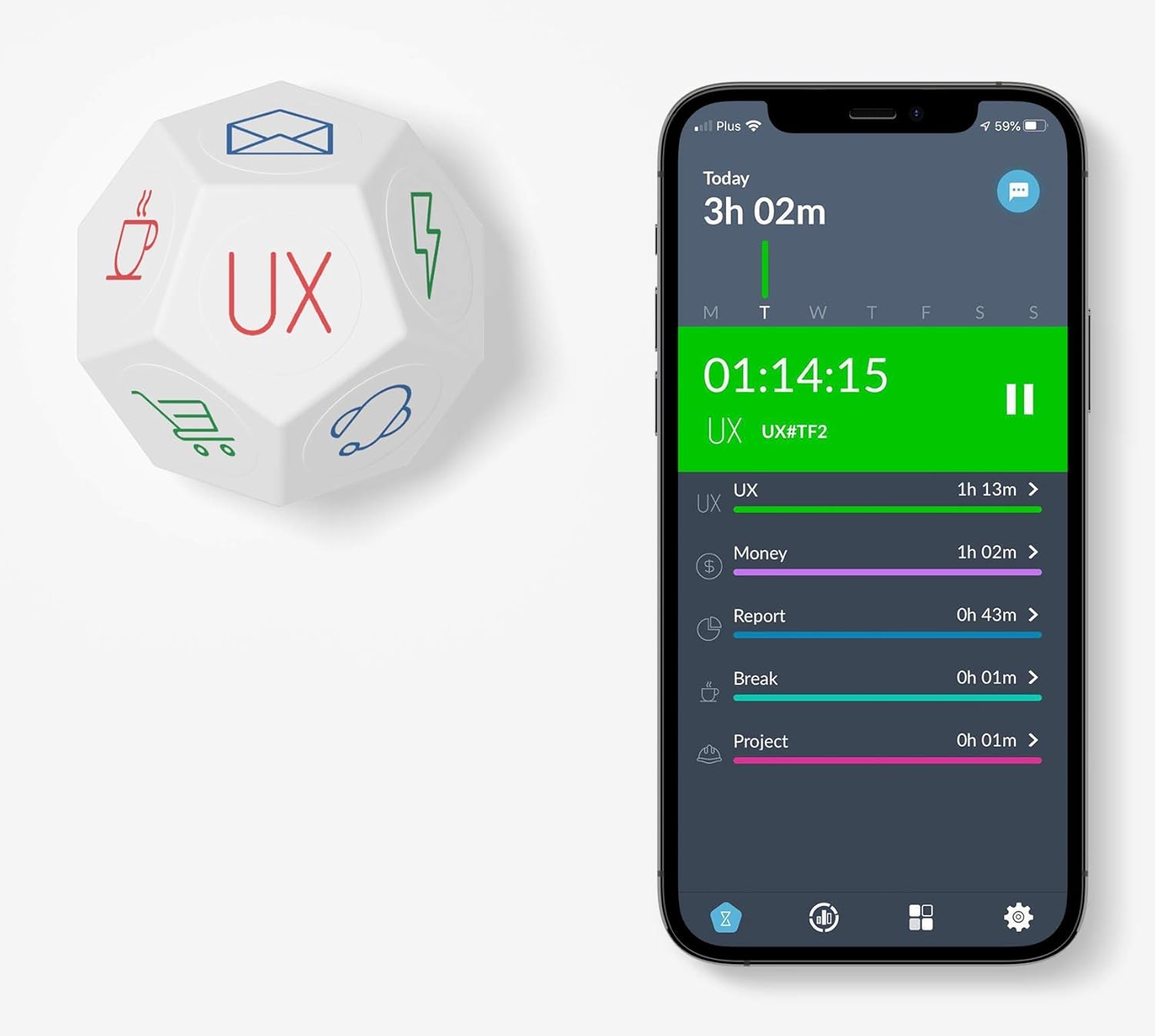
Tool for Focus: TimeFlip 2
For those with ADHD who struggle to switch tasks or decide what to do next, this physical time-tracking device gamifies the transition between work blocks — dramatically reducing the friction of starting and the paralysis of “what now?”
 Check Price on Amazon
ADHD-Specific Decision Frameworks
Generic productivity advice often fails people with ADHD because it assumes executive functions that ADHD specifically impairs — the ability to initiate tasks, hold multiple options in working memory, delay gratification, and self-monitor cognitive state. The strategies in this section are specifically designed for ADHD decision architecture.
The “Good Enough” Decision Rule
ADHD perfectionism-paralysis requires an explicit philosophical counter-stance. Explicitly adopting the rule “I will choose the first option that passes a defined minimum threshold and stop deliberating” short-circuits the research spiral that RSD fuels. Write the rule down. Post it where you make decisions. “Good enough is the goal. Perfect is the enemy.”
Externalize the Decision Process
ADHD working memory impairment means that decision options stored only in mental space are unreliable — they fade, mutate, and create cognitive load through the effort of maintenance. Externalize every significant decision onto paper or a digital tool: write the options, write the criteria, write the weights. The act of externalizing transforms a diffuse cognitive burden into a concrete, manipulable problem. Many ADHD individuals report that seeing a decision written out resolves it in minutes when internal deliberation had stretched for days.
The “Coin Flip Reveal” Technique
For decisions that feel genuinely equivalent, flip a coin. The value of this technique is not in the random outcome — it is in your emotional response to it. The moment the coin lands, you will feel either relief or immediate resistance. That gut response reveals your actual preference, which was always present but buried under the noise of deliberation. Once you know your preference, the decision is made — you simply need to give yourself permission to honor it.
Time-Constrained Deliberation Windows
Allocate a specific, fixed amount of time for each decision category — and treat that time boundary as binding. “I will spend 15 minutes maximum on this decision, then commit to whatever I have concluded.” Using a physical timer (a classic Pomodoro timer is ideal) makes the boundary concrete and removes the open-ended deliberation that ADHD analysis paralysis thrives in. When the timer ends, you decide with available information. Perfectionism says “I need more data.” Wisdom says “I have enough.”
Two-Minute Decision Rule
If a decision can be made in under two minutes, make it now. Do not defer it to a “decision queue” where it will consume background working memory as an open loop.
Decision Batching
Group similar decisions and make them in a single focused session. All weekly meal decisions on Sunday. All email responses twice daily. All project prioritization on Monday morning.
Default Options
Create explicit default answers for recurring decisions: default dinner when uninspired, default response for common email types, default next action for stalled projects.
The “Future You” Test
Ask: “Will future me be glad I made this choice, or is this present-me trying to avoid discomfort?” Externalizes the time-blindness problem by concretizing the future self.
10/10/10 Framework
Ask: How will I feel about this decision in 10 minutes? 10 months? 10 years? Forces temporal perspective into decisions dominated by immediate emotional weight.
If–Then Planning & Implementation Intentions
Implementation intentions — “If X happens, then I will do Y” — are one of the most robustly supported behavioral interventions in psychology, with meta-analyses across hundreds of studies showing consistent and significant increases in goal completion. Developed by Peter Gollwitzer, the mechanism is elegant: by pre-deciding your response to anticipated situations, you offload the in-the-moment decision to a pre-committed rule that fires automatically, bypassing the need for depleted executive function.
For decision fatigue and ADHD management specifically, if-then planning works by:
- Eliminating reactive decisions: “If it is 5pm and my shutdown ritual has not started, then I will immediately close all browser tabs and begin the ritual, regardless of what is left unfinished.” Pre-deciding this removes the daily negotiation about when to stop working.
- Handling distraction impulses: “If I feel the urge to check social media during a deep work block, then I will write the urge down on my distraction notepad and return to the task.” Captures the impulse without acting on it and without requiring willpower to suppress it.
- Managing emotional decisions: “If I am about to send an angry email, then I will save it as a draft and read it again in the morning before sending.” Removes the immediate emotional hijacking of email communication.
- Initiating avoided tasks: “If it is 9am on Monday, then I will open the project file before I open my email client.” The if-then rule converts a behavioral intention into an automatic trigger that doesn’t require morning willpower to initiate.
The format is strict: a specific situation trigger (If) linked to a specific, concrete behavior (Then). Vague if-then plans — “If I feel stressed, then I will try to relax” — are significantly less effective than specific ones — “If I feel overwhelmed, then I will do 5 minutes of box breathing before responding to anyone.”
Ulysses Contracts & Precommitment Devices
In Homer’s Odyssey, Ulysses (Odysseus) needed to sail past the Sirens — mythological creatures whose song was so irresistible that sailors who heard it steered their ships onto the rocks. His solution was precommitment: he ordered his crew to tie him to the mast and block their own ears with wax, so that neither his commands given under the influence of the Siren song nor his crew’s potential distraction could alter their course. He made a binding agreement with his future, weaker-willed self.
A Ulysses Contract is any precommitment device that constrains a future decision in advance, when your current self has better judgment than your anticipated future self will. For decision fatigue and ADHD management:
- Freedom or Cold Turkey blocks: Scheduling website blocks in advance, when you are calm and intentional, that cannot be easily overridden when the depleted, distracted version of you wants to scroll at 2pm.
- Pre-logged sleep time: Setting your device’s downtime feature to lock non-essential apps from 10pm automatically — before the tired, undisciplined version of you decides “just 20 more minutes” of scrolling.
- Pre-committed financial rules: Auto-investing the day salary arrives so the money is gone before depleted-willpower you has the chance to redirect it toward impulse purchases.
- Social precommitments: Telling a friend or accountability partner your commitment — creating social cost for not following through, which makes the future temptation to abandon the commitment more expensive.
Decide for Your Future Self While Your Present Self Is Capable
The Ulysses Contract works because the self that creates it has better executive function than the self that will encounter the temptation. Morning-you is always a better decision-maker than evening-you. Rested-you is always more rational than stressed-you. Build your systems when you are at your best, so they operate when you are at your worst.
Environmental Design to Reduce Daily Decisions
The most sustainable decision fatigue management strategy is not behavioral — it is architectural. By deliberately designing your physical and digital environment to make good choices the default and effortful choices the exception, you reduce cognitive load without requiring any willpower at the point of decision. This is the principle behind everything from cafeteria food layout research to Apple’s one-click purchase design.
The Default Effect
Defaults are among the most powerful behavioral levers available to decision architects. Organ donation rates in countries with opt-out defaults (everyone is a donor unless they choose otherwise) are over 90%; opt-in countries average below 20%. The same choice — donate or not — produces radically different outcomes based purely on which option requires the active decision. In your personal environment, deliberately setting pro-wellbeing defaults exploits this mechanism for your own benefit:
- Default your phone’s Do Not Disturb schedule to activate automatically — make distraction the opt-in, not focus.
- Place healthy food at eye level in your refrigerator; move snacks to the back and bottom — default the healthy choice.
- Leave your workout clothes out the night before — default the exercise choice by eliminating the friction of preparation.
- Set up your browser with a task management homepage — default to work when you open a new tab.
- Have a standard morning breakfast you make by default — eliminate the morning food decision entirely.
- Pre-set your work playlist to begin automatically when your calendar shows a deep work block.
Friction-Based Decision Architecture
Complementary to the default effect is deliberate friction — making undesirable choices harder to execute. If your phone needs to be in another room to be used, the friction of walking to retrieve it makes impulsive checking far less likely. If social media apps are deleted from your phone and accessible only via browser (with an extra login step), the friction reduces habitual checking by 50–70% for most people. Log out of streaming services and entertainment apps between uses — the extra login step creates just enough friction to interrupt the automatic “mindless open” behavior that burns evening hours.
The Decision Journal Method
Venture capitalist and Farnam Street founder Shane Parrish popularized the decision journal as a tool for improving long-term decision quality. The premise is that most people never build accurate mental models of their own decision-making because they never systematically track the inputs, processes, and outcomes of significant decisions. Without this feedback loop, you make the same cognitive errors repeatedly without awareness.
How to Keep a Decision Journal
For any significant decision, record at the time of decision:
- The decision context. What is the choice? What are the options? What information do you have? What information are you missing?
- Your mental and physical state. How much sleep did you have? What time of day is it? Are you hungry, stressed, or emotionally activated? This data lets you later identify the conditions under which your decisions are systematically better or worse.
- Your prediction. What do you expect will happen if you make this choice? What are you most uncertain about? What would change your mind?
- The decision itself. What did you choose, and what was the final reasoning?
- Review at a later date. After sufficient time has passed to observe outcomes (weeks to months depending on the decision type), return and record what actually happened. Compare to your prediction. Where were you wrong? What did you systematically underestimate or overestimate?
The decision journal is particularly valuable for ADHD individuals who experience time blindness — the absence of a felt sense of the past and future. Making decisions visible and traceable in a physical record creates the external memory system that ADHD working memory cannot reliably provide, while building genuine insight into your personal decision patterns over time.
Mental Shortcuts: Using Heuristics Wisely
Heuristics are cognitive shortcuts — simplified decision rules that bypass full analysis to produce “good enough” decisions quickly. Nobel laureate Daniel Kahneman’s framework of System 1 (fast, automatic, intuitive) and System 2 (slow, deliberate, analytical) thinking describes how heuristics operate: they are System 1 shortcuts that solve problems without taxing the limited bandwidth of System 2.
Used wisely, heuristics are not a failure of rigorous thinking — they are a cognitive economy essential to navigating a high-decision environment without constant depletion. The problem is not heuristics themselves but uncritical heuristic application to high-stakes decisions that warrant deliberate analysis. The skill is matching the cognitive investment to the actual stakes of the choice.
Practical Heuristics for Daily Decisions
“Good enough” Threshold
Define minimum criteria before evaluating options. Choose the first option that meets them. Stop. This is satisficing — Simon’s Nobel-winning insight about sustainable decision-making.
The 2-Year Rule
“Will this matter in 2 years?” If no, make a fast decision and move on. Reserve analytical energy for decisions with genuine long-term consequences.
Expert Delegation
Identify the most knowledgeable person in the relevant domain and ask what they would choose. Borrow their decision schema rather than building your own from scratch.
The “Tell a Friend” Test
Explain your decision to an imaginary skeptical friend. If you feel defensive or need to rationalize extensively, reconsider. If you can explain it simply, trust it.
Regret Minimization
Jeff Bezos’s framework: imagine yourself at 80 looking back. Which choice would you regret not making? This bypasses present-tense anxiety and anchors in long-term values.
Digital Minimalism as Decision Reduction
Your smartphone is a decision-fatigue machine. Every notification is a demand for a decision: read now or later? Reply or ignore? Share or discard? Research now or continue working? Cal Newport’s concept of digital minimalism — deliberately curating your digital life to include only tools that provide net value above their attention cost — is directly relevant to managing daily decision load.
The average smartphone user receives 46 push notifications per day and unlocks their phone 96 times. Each unlock is triggered by either a notification (someone else’s decision injected into your attention) or an impulse (your own brain generating a decision demand in the form of a checking urge). Cumulatively, this represents hundreds of daily micro-decisions consuming cognitive resources that should be available for higher-value choices.
Our guide on 7 smartphone settings to change immediately is an excellent starting point. Beyond settings changes, a comprehensive digital minimalism protocol for decision fatigue management includes:
- Notification audit: Turn off all notifications except calls and calendar alerts. Every other notification is discretionary — it can wait for your scheduled email/app check windows.
- App removal: Delete any app you access more than three times per day impulsively rather than intentionally. Move remaining social apps to a second-page folder that requires deliberate navigation — eliminating the automatic thumb-muscle-memory reflex.
- Email schedule: Close email entirely between designated processing windows. An autoresponder setting expectations (“I check email at 9am, 1pm, and 4:30pm”) manages external expectations and removes the ambient anxiety of an always-open inbox.
- Single-purpose devices: Designating your phone as a communication device (calls, messages) and your computer as a work device — with entertainment restricted to a separate device like a tablet — uses physical friction to reduce cross-contamination of work and leisure contexts.
Body Doubling for ADHD Decision Blocks
Body doubling — working in the ambient presence of another person — is one of the most effective and underutilized strategies in the ADHD toolkit. The mechanism is not social pressure or accountability (though these contribute); it is the regulation effect of ambient social presence on the ADHD dopaminergic system. A working partner’s presence appears to stabilize the ADHD brain’s arousal and focus regulation in ways that solo work cannot replicate.
For decisions specifically, body doubling reduces decision paralysis by externalizing the decision context — the presence of another person makes it socially awkward to spend 45 minutes frozen in a decision loop, creating gentle social pressure to initiate action. Virtual body doubling services like Focusmate pair you with a stranger via video call for structured work sessions. At the start, you each declare what you intend to accomplish — which itself is a micro-decision that starts the cognitive chain of action. The check-in at the end creates a mild accountability arc that ADHD executive function struggles to generate internally.
The “Phone a Friend” Decision Protocol
For ADHD decision paralysis specifically, calling or voice-messaging a trusted friend and explaining the decision out loud is remarkably effective. The act of articulating the decision to another person engages verbal working memory in a way that internal deliberation doesn’t, and the friend’s perspective often illuminates an obvious path invisible from inside the paralysis loop. The social modality also activates the ADHD brain’s interest-based nervous system in a way that solo deliberation cannot.
Mindfulness & Decision Clarity
Mindfulness — the practice of intentional, non-judgmental attention to present-moment experience — has accumulated substantial research support as an intervention for decision quality. A 2014 study published in Psychological Science found that a brief 15-minute mindfulness session significantly reduced sunk-cost bias (the tendency to persist in a failing course of action due to prior investment) in decision-making, suggesting that mindfulness interrupts the automatic cognitive patterns that corrupt decision quality.
For stress-driven decision fatigue specifically, mindfulness practice reduces cortisol reactivity — blunting the acute stress response that hijacks prefrontal cortex function during high-pressure choices. Regular mindfulness practitioners make more consistent decisions across depleted and non-depleted states, suggesting that the practice builds a degree of executive function resilience against cognitive fatigue.
Unsure which mindfulness app is right for your neurodivergent brain? We compared Headspace vs Calm vs Insight Timer in detail to help you choose the platform that fits your attention style and budget. For ADHD specifically, shorter more frequent sessions (5–10 minutes, 2–3 times daily) tend to be more sustainable than the 20–30 minute single sessions recommended in traditional mindfulness literature.
Recovery: Refilling the Tank
Sometimes prevention has already failed — you are depleted, the decisions are bad, and pushing through will only deepen the damage. Active recovery from decision exhaustion requires more than passive rest; it requires specific activities that restore executive function capacity.
Nutrition: What Actually Helps
While Baumeister’s original glucose model has been partially revised, the brain’s dependence on stable blood glucose for sustained executive function is not controversial. A hungry or blood-sugar-crashed brain makes reliably worse decisions. The practical guidance: eat before making important decisions, favor protein and complex carbohydrates over refined sugar (which causes the glucose spike-and-crash pattern), and maintain hydration (mild dehydration — just 1–2% below optimal — measurably impairs attention and decision accuracy). Consider the protein source options explored in our guide on whey protein vs plant protein for sustained energy without the blood sugar volatility.
Movement as Executive Function Reset
Acute aerobic exercise — even a 10-minute brisk walk — produces measurable improvements in prefrontal cortex blood flow and executive function performance that persist for 30–90 minutes post-exercise. This is not motivational framing; it is neurobiology. The catecholamine release from exercise directly improves the dopaminergic and noradrenergic tone in the PFC that ADHD chronically underperforms on. A strategic walk at the midday slump is a genuine cognitive intervention.
Sensory Reduction for ADHD Recovery
For ADHD brains, sensory input is a continuous source of low-level decision demand — every sight, sound, and notification creates a micro-arousal that requires suppression. Periods of deliberate sensory reduction — a quiet room, noise-canceling headphones with no audio, eyes closed, no screens — provide a rare window of genuine cognitive rest. Even 10 minutes of sensory reduction can meaningfully restore executive function in an ADHD brain habituated to constant stimulation. Combine this with a self-care checklist that prioritizes these recovery windows as non-negotiable daily infrastructure.
Tools to Offload Decisions: Analog vs. Digital
One of the most effective strategies for combating ADHD decision fatigue is externalizing executive function — moving the cognitive work of tracking, planning, and prioritizing from your brain into a reliable external system. But which tool is right for your neurodivergent brain?
| Feature | Paper Planner (e.g., Panda Planner) | Digital App (e.g., Notion/Todoist) | Hybrid System |
|---|---|---|---|
| Distraction Level | Very low — no notifications | High — same device as email/social | Low (paper for daily, digital for storage) |
| Memory Encoding | High — handwriting strengthens retention | Low — typing bypasses deep encoding | High for key items (written) + searchable |
| Flexibility | Low — hard to reorganize | Very high — drag, sort, filter | Moderate |
| ADHD Visibility | High — always physically open and visible | Low — out of sight means out of mind | High (paper dashboard visible) |
| Long-term storage | Poor — physical volume, not searchable | Excellent — searchable, backed up | Excellent (digital archive) |
| Best for ADHD | Daily planning and focus sessions | Project management, reference | Recommended for most ADHD adults |
Password management is another underrated decision-reduction tool. A password manager eliminates the dozens of “do I remember this password?” micro-decisions per week that generate friction and focus breaks. Check our review of 5 free password managers — for many people, this single change removes one of the most consistently annoying daily friction sources entirely.
Frequently Asked Questions
Is indecisiveness a symptom of ADHD?
Yes, chronic indecisiveness is a core symptom of ADHD, stemming from executive dysfunction — specifically impairments in working memory, inhibitory control, cognitive flexibility, and emotional regulation. ADHD also commonly involves Rejection Sensitive Dysphoria (RSD), which adds an intense fear-of-wrong-choice layer that dramatically worsens decision paralysis. The indecisiveness is not laziness or lack of motivation; it is a neurological difference in how the prefrontal cortex processes and evaluates options under the dopamine and norepinephrine deficits characteristic of ADHD.
How does decision fatigue differ from burnout?
Decision fatigue is a temporary, same-day depletion — caused by accumulated decision-making within a single day and resolved with rest, food, and fewer demands. Burnout is a chronic syndrome of emotional, physical, and mental exhaustion from prolonged stress, requiring weeks to months of significant lifestyle change to recover. Decision fatigue that occurs daily without sufficient recovery is a common contributing cause of burnout — the two conditions exist on a continuum of escalating severity.
Can decision fatigue cause physical symptoms?
Yes. While primarily cognitive, decision fatigue activates the stress response, which manifests physically as tension headaches, eye strain, digestive disruption, muscle tension, and generalized lethargy as the body attempts to conserve energy. For ADHD individuals, physical symptoms can be more pronounced due to higher baseline cortisol levels associated with chronic executive dysfunction strain and the greater cognitive effort required to navigate daily functioning.
What is the fastest way to recover from decision fatigue?
The most effective acute recovery sequence: stop making all decisions immediately, eat something with complex carbohydrates and protein, take a 10-minute brisk walk (aerobic movement restores prefrontal cortex blood flow within minutes), then do 5–10 minutes of sensory reduction — quiet, no screens, eyes closed. For ADHD specifically, adding a brief body doubling session or calling an accountability partner can help re-establish executive function momentum after the recovery period.
How can ADHD medication help with decision-making?
Stimulant medications increase dopaminergic and noradrenergic availability in the prefrontal cortex — directly addressing the neurotransmitter deficits that impair ADHD decision-making. Most users report clearer option differentiation (reduced priority blindness), better impulse suppression, improved working memory during deliberation, and reduced emotional flooding during high-stakes choices. Non-stimulant options (atomoxetine, guanfacine) achieve similar improvements via different mechanisms with different side-effect profiles. Medication is most effective when combined with behavioral strategies — neither approach alone is as powerful as both together.
What is Rejection Sensitive Dysphoria and how does it affect decisions?
RSD is a pattern of intense emotional pain triggered by perceived failure, criticism, or rejection — present in an estimated 99% of adults with ADHD. In decisions, RSD makes every significant choice feel emotionally high-stakes regardless of actual importance, because choosing “wrong” threatens to trigger the RSD pain response. This drives endless research spirals and analysis paralysis. The key insight: RSD is addressed through emotional regulation and self-compassion — not through gathering more information to guarantee a perfect outcome, which is the intuitive but counterproductive ADHD response.
What are the best tools for reducing daily decision load with ADHD?
The most effective ADHD decision-load tools: a physical planner kept open and visible on your desk (out of sight = out of mind for ADHD); a visual timer for time-bounded decision sessions; if-then planning cards for anticipated scenarios; pre-scheduled website blockers (Freedom, Cold Turkey) activated in advance rather than in the moment; a body doubling partner or Focusmate for paralysis situations; and a simplified meal template eliminating daily food decisions. Start with one category — whichever friction point costs the most daily mental energy — rather than implementing all simultaneously.
How does sleep affect ADHD decision-making specifically?
Sleep deprivation has an amplified effect on ADHD decision quality because it directly impairs the prefrontal cortex — already the brain region most functionally challenged in ADHD. Even one night of insufficient sleep can eliminate the executive function benefit provided by ADHD medication. ADHD individuals are also disproportionately likely to experience delayed sleep phase disorder and difficulty with sleep initiation, creating chronic sleep debt that persistently undermines daily decision quality. Protecting sleep is, for ADHD adults, the highest-leverage intervention available — above any app, strategy, or habit change.
Conclusion: Reclaiming Your Willpower
Decision fatigue is the silent disruptor of productivity and wellbeing. Whether you are dealing with ADHD decision-making struggles, the structural overload of modern professional life, or the invisible mental load of family management, the solution lies in intentionality applied at the system level — not in superhuman willpower applied at the moment of decision.
The strategies in this guide operate across three levels: the neuroscientific (understanding how your brain actually works under cognitive load), the behavioral (if-then planning, Ulysses contracts, decision journals), and the architectural (environmental design, digital minimalism, default optimization). Lasting change requires all three — understanding why your current decision environment is failing you, building behavioral protocols that operate when executive function is depleted, and redesigning your environment so the good choice is always the easy choice.
Start where the friction is greatest. If morning paralysis costs you the most time, design a morning script. If evenings are where decisions go wrong, build Ulysses contracts before 6pm. If ADHD analysis paralysis is your primary challenge, adopt satisficing explicitly and practice the coin-flip reveal until it becomes a reflex. By conserving cognitive energy on trivial choices, you free yourself for the decisions that actually determine the direction of your life — like renting vs buying a house, planning meaningful experiences with our trip planning checklist, or building long-term wealth through understanding your investment options.
Your cognitive bandwidth is finite and precious. Stop spending it on the treadmill of triviality. For more on building the behavioral foundation beneath good decision-making, don’t miss our deep dive on the habits of highly effective people.
Save Your Decisions for What Matters
Bookmark this guide, identify your single highest-cost daily decision friction point, and implement one strategy from this article this week. The compound effect of reduced decision load accumulates faster than almost any other productivity investment.