
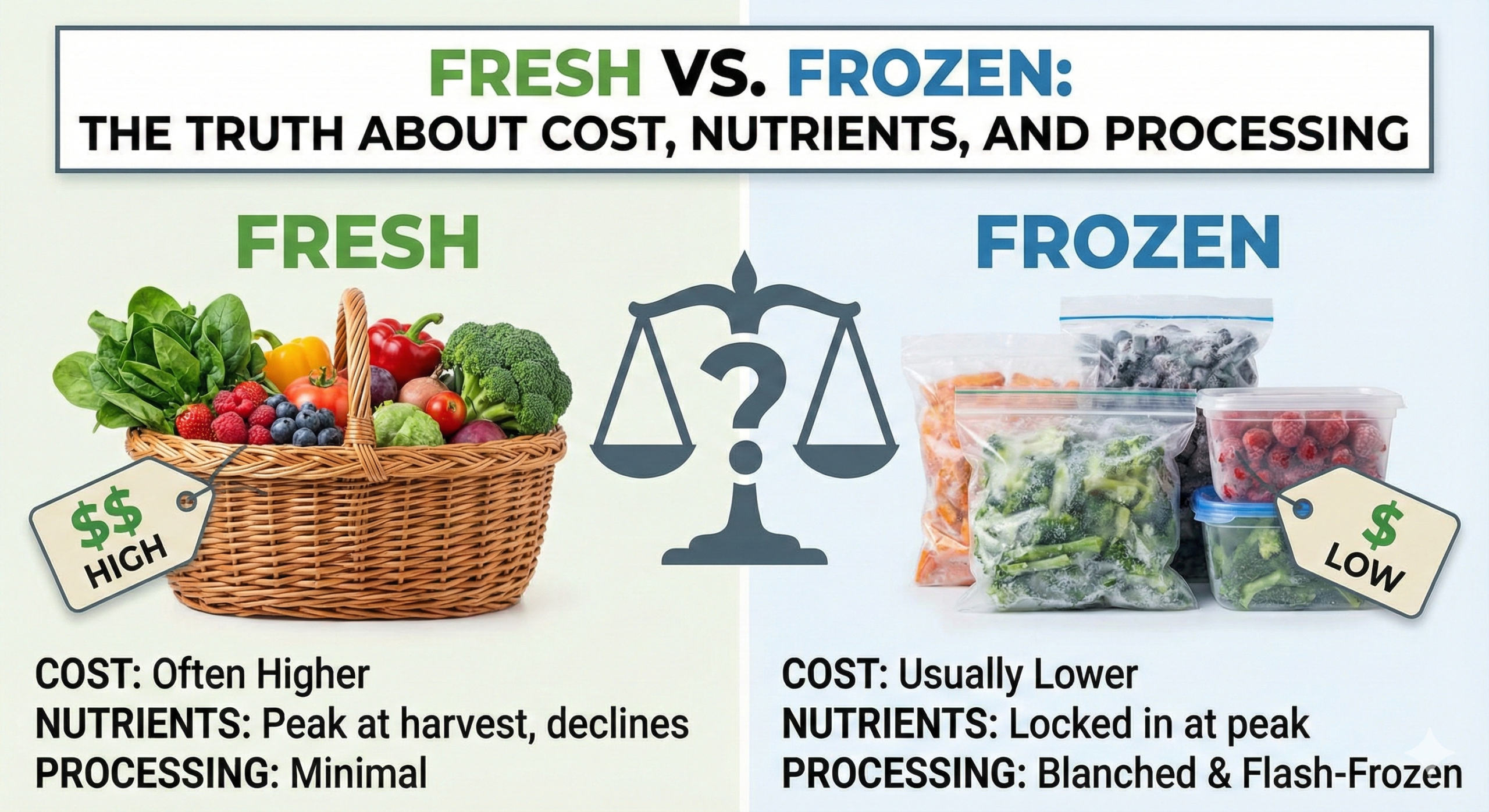
Fresh vs. Frozen Vegetables & Fruits: The Truth About Cost, Nutrients, and Processing
We have all been there. You start the week with good intentions, filling your cart with vibrant bell peppers, glossy spinach, and glistening berries. You feel like the picture of health. But by Friday, that spinach has collapsed into a slimy green sludge in the crisper drawer, and the berries have grown a fine white coat of mold.
This common kitchen tragedy leads many of us to ask: is there a better way?
The debate of frozen vegetables vs fresh is about more than just taste—it is about your budget, your time, your nutrition, and increasingly, your environmental footprint. Are frozen vegetables cheaper than fresh in the long run? Are frozen veggies as healthy as fresh, or does the freezing process destroy the vitamins? And are frozen vegetables processed food? What about canned—the forgotten third option?
In this comprehensive guide, we thaw out the facts, vegetable by vegetable, cooking method by cooking method. Whether you are making quick and healthy weeknight dinners or prepping a morning smoothie, this is the definitive resource you need.
At a Glance: The Full Comparison Matrix
Before diving into the details, here is the complete breakdown across every dimension that matters to a modern home cook.
| Feature | Fresh Produce | Frozen Produce | Canned Produce |
|---|---|---|---|
| Cost Efficiency | Variable — high waste risk | High — zero waste, long shelf life | Highest — cheapest per serving |
| Nutrient Density | Declines rapidly in transit/storage | Locked in at peak ripeness | Good; some loss from heat processing |
| Texture | Crisp, firm, crunchy | Softer after cooking | Soft; best in soups/stews |
| Prep Time | High — washing, peeling, chopping | Low — pre-washed, pre-cut | Lowest — open and use |
| Seasonality | Limited — expensive off-season | Year-round at consistent price | Year-round |
| Shelf Life | 3–10 days (refrigerated) | 8–12 months (frozen) | 2–5 years (pantry) |
| Sodium Content | None | Usually none (plain bags) | Often high — rinse before use |
| Pesticide Residue | Highest in conventional | Lower — washing before freezing | Lower — processing reduces residue |
| Environmental Impact | Low if local; high if imported | Low — less food waste | Moderate — tin production impact |
| Flavor (peak season) | Best — unmatched when local | Very good — peak-ripeness harvest | Altered — metallic notes possible |
| Variety Available | Widest — exotic and specialty | Good — standard vegetables | Moderate |
| Organic Options | Widely available | Widely available | Available but limited |
Round 1: The Real Financial Breakdown
One of the most pressing questions for households managing food budgets is this: are frozen vegetables cheaper than fresh? The answer requires looking beyond the price tag on the shelf and examining the full cost of ownership.
The Sticker Price vs. True Cost Per Serving
If you compare price-per-pound at the store, in-season fresh produce often wins. A bag of fresh broccoli crowns in peak harvest is typically cheaper by weight than a bag of frozen florets. But this comparison is incomplete. The “edible portion” correction changes the math dramatically.
| Vegetable | Fresh — Avg Price/lb | Edible % | True Cost/lb eaten | Frozen — Avg Price/lb | Winner |
|---|---|---|---|---|---|
| Broccoli | $1.80 | 61% | $2.95 | $2.00 | ❄️ Frozen |
| Spinach | $3.00 | 95% | $3.16 | $2.50 | ❄️ Frozen |
| Peas | $2.50 | 40% | $6.25 | $1.80 | ❄️ Frozen |
| Corn | $0.50/ear | 27% | $1.85 | $1.50 | ❄️ Frozen |
| Green Beans | $2.00 | 88% | $2.27 | $2.20 | 🌿 Fresh (in season) |
| Strawberries | $4.00 | 94% | $4.26 | $2.80 | ❄️ Frozen |
| Blueberries | $5.00 | 97% | $5.15 | $3.20 | ❄️ Frozen |
| Carrots | $1.00 | 82% | $1.22 | $1.60 | 🌿 Fresh |
The Hidden Cost of Spoilage
The single biggest factor making fresh vegetables expensive in practice is spoilage. Research consistently shows that the average household discards approximately 30% of the fresh produce purchased each week. If you throw away one third of your fresh spinach, the effective cost of that spinach increases by 43%. Frozen produce eliminates this variable entirely. You pour out precisely what you need, seal the bag, and return it to the freezer. Nothing is wasted.
Seasonal Price Volatility
Fresh produce prices fluctuate dramatically with seasons, weather events, transportation disruptions, and fuel costs. A carton of strawberries in December can cost triple what it costs in June. Frozen produce is immune to seasonal price spikes. The price of a frozen pea is the same in January as it is in July, because the peas were frozen at the optimal harvest period and the supply is managed accordingly. For households trying to eat well on a consistent budget, frozen produce’s price stability is a significant practical advantage.
If you are trying to minimize food waste for budget and environmental reasons—perhaps using one of our recommended top 5 kitchen gadgets like a vacuum sealer—you can extend the life of fresh produce meaningfully. But frozen remains the gold standard of cost consistency.

Save Your Fresh Veggies: FoodSaver PowerVac
If you prefer fresh but hate waste, vacuum sealing is the solution. Keep produce fresh up to 5× longer in the fridge or freezer.
Check Price on AmazonRound 2: The Nutritional Showdown
There is a persistent and stubborn myth that “fresh is always more nutritious.” The science is considerably more complicated—and in many cases, favors frozen produce in ways that genuinely surprise people.
The Journey of “Fresh” Produce
The spinach labelled “fresh” in your supermarket was likely harvested 5–10 days ago. During transportation and storage, it was exposed to light, heat, oxygen, and mechanical stress. Vegetables begin losing nutrients immediately after harvest. Water-soluble vitamins—particularly Vitamin C, folate, and the B vitamins—are the most vulnerable, degrading at rates that depend on temperature, light exposure, and time.
This is crucial for anyone focused on nutrient density—whether you are comparing whey protein vs plant protein sources or trying to maximize the micronutrient return from your food budget.
The spinach you bought “fresh” on Sunday may be nutritionally inferior to frozen spinach blanched and frozen the same day it was harvested.
The Science of Flash Freezing and Blanching
Understanding how frozen vegetables are produced transforms the way you think about them. The process is more sophisticated than most consumers realize, and each step has measurable nutritional consequences.
Step 1: Harvest at Peak Ripeness
Vegetables destined for freezing are typically harvested at a stage of ripeness specifically optimized for nutritional content—not for travel durability. Fresh supermarket produce is frequently picked under-ripe to survive the distribution journey without bruising. Frozen produce does not have this constraint. It can be harvested at the nutritional peak because it moves from field to freezer within hours.
Step 2: Washing and Pre-Processing
After harvest, produce is rapidly washed, sorted, and cut. This washing step also removes a significant proportion of pesticide surface residues—an important consideration we will discuss in the organic section below. Pre-cutting ensures uniform pieces that freeze and cook evenly, and removes inedible portions (corn husks, pea pods, broccoli stalks) so that 100% of what you purchase is edible.
Step 3: Blanching
Blanching is the step that most commonly raises questions about nutrient retention. Before freezing, most vegetables are briefly immersed in boiling water or subjected to steam for 1–5 minutes. The purpose is enzymatic deactivation—specifically, destroying the enzymes that would otherwise continue degrading the vegetable’s color, flavor, and nutritional content even at freezer temperatures.
What blanching actually destroys: Blanching causes a loss of water-soluble vitamins—primarily Vitamin C (10–25% loss) and some B vitamins. However, it also deactivates the enzymes that would cause far larger nutritional losses over subsequent months of frozen storage. Fat-soluble vitamins (A, D, E, K), minerals (potassium, magnesium, iron), fiber, and most antioxidants are largely unaffected by blanching.
Step 4: IQF — Individually Quick Frozen Technology
Modern frozen vegetable production uses Individually Quick Frozen (IQF) technology rather than simply packing vegetables into a bag and freezing the block. In IQF processing, individual pieces move along a high-speed conveyor through an extremely cold air blast—typically -40°F to -60°F (-40°C to -51°C). Each piece freezes individually within minutes.
The critical advantage of IQF is the formation of very small ice crystals within the vegetable cells, rather than the large crystals that form in slow domestic freezing. Smaller ice crystals cause less mechanical damage to cell walls, which results in better texture retention after thawing and cooking. Premium IQF frozen vegetables are noticeably less mushy than vegetables frozen slowly in a home freezer.
Step 5: Packaging and Cold Chain
After freezing, vegetables are packaged in oxygen-barrier bags and maintained in a continuous cold chain from factory to your freezer. As long as the cold chain is not broken (a bag that thaws and refreezes shows ice crystalization and freezer burn), the nutritional content remains essentially static from the point of freezing onward.
Nutrient Retention: Fresh vs. Frozen by Vegetable
The nutritional picture is not uniform across all vegetables. Some retain their nutritional content exceptionally well through freezing; others show meaningful losses from blanching. Here is a practical breakdown:
| Vegetable | Key Nutrient | Fresh After 7 Days | Frozen After Blanching | Winner |
|---|---|---|---|---|
| Spinach | Folate | ~47% retained | ~80% retained | ❄️ Frozen |
| Broccoli | Vitamin C | ~56% retained | ~70% retained | ❄️ Frozen |
| Peas | Vitamin C | ~60% retained | ~65% retained | ≈ Equal |
| Corn | Lutein / Zeaxanthin | ~75% retained | ~85% retained | ❄️ Frozen |
| Blueberries | Anthocyanins | ~80% retained | ~84% retained | ❄️ Frozen |
| Green Beans | Vitamin C | ~80% retained | ~75% retained | 🌿 Fresh |
| Carrots | Beta-carotene | ~95% retained | ~90% retained | 🌿 Fresh (slight edge) |
| Edamame | Protein / Isoflavones | ~85% retained | ~90% retained | ❄️ Frozen |
The key insight: Frozen wins nutritionally for the most perishable, high-water-content vegetables (leafy greens, peas, berries). Fresh wins or ties for hardier vegetables like carrots and green beans that lose fewer nutrients in transit and storage.
Round 3: The “Processed Food” Label
One of the most common and most damaging misconceptions in nutrition is treating “processed” as a monolithic category of harmful foods. The reality requires important distinctions.
What “Processed” Actually Means
According to the USDA’s definition, any food that has been altered from its natural raw state is “processed.” This means that washing strawberries technically makes them processed. Chopping broccoli makes it processed. Freezing peas makes them processed. By this definition, virtually everything you eat outside of freshly picked raw produce is processed.
The relevant distinction is between minimal processing (which preserves or even enhances nutritional value) and ultra-processing (which typically degrades nutritional quality by removing fiber, adding refined sugars, excess sodium, and chemical preservatives). The NOVA food classification system provides a more useful framework:
| NOVA Class | Description | Examples | Fresh or Frozen Veg? |
|---|---|---|---|
| Class 1 | Unprocessed / minimally processed | Fresh produce, frozen plain vegetables | ✓ Both qualify |
| Class 2 | Processed culinary ingredients | Salt, oils, sugar | — |
| Class 3 | Processed foods | Canned vegetables (with salt), cheese | Canned may qualify |
| Class 4 | Ultra-processed foods | Frozen meals, sauced frozen veggies | ⚠️ Sauced varieties only |
The Sauce Warning: Where Frozen Goes Wrong
Plain frozen vegetables—those with a single ingredient on the label matching the vegetable’s name—are firmly in the “minimally processed, nutritionally excellent” category. The problem arises with flavored and sauced varieties. “Broccoli in Cheese Sauce,” “Glazed Carrots with Butter,” or “Edamame in Teriyaki” transform a nutritious vegetable into an ultra-processed product with added sodium, saturated fat, sugar, and often preservatives and artificial flavors.
The rule is simple: if the ingredient list contains more than the name of the vegetable (and perhaps water, which is used in some freezing processes), put it back on the shelf. Choosing clean frozen vegetables aligns with the same philosophy as following an essential skincare routine—removing unnecessary additives to get the genuine benefit of the core ingredient.
Round 4: Texture and Culinary Uses
This is the area where fresh produce holds its strongest advantage, and where frozen produce has genuine, unavoidable limitations. Understanding the mechanical reason for this difference helps you make smarter decisions about which form to buy for each intended use.
Why Frozen Vegetables Get Mushy: The Cell Wall Explanation
Plant cells contain water vacuoles. When water freezes, it expands by approximately 9% in volume. This expansion causes ice crystals to puncture the surrounding cell membranes. When the vegetable thaws, the structural integrity of its cell walls is compromised, and the released water gives the vegetable its characteristic soft, sometimes mushy texture. No amount of cooking technique fully compensates for this structural change at the cellular level.
However, the degree of textural loss varies significantly by vegetable. Peas and corn maintain good texture after freezing. Leafy greens collapse entirely—but since frozen spinach is almost exclusively used in cooked applications (soups, smoothies, pasta), this is rarely a practical problem. Whole tomatoes fall apart completely when frozen, which is why frozen tomatoes are sold diced or pureed rather than whole.
Best Produce Choice by Cooking Method
The optimal choice between fresh and frozen shifts dramatically depending on how you intend to cook the vegetable. Here is a practical method-by-method guide:
Raw Salads
Fresh only. Frozen lettuce, cucumbers, and tomatoes are completely unsuitable — the textural collapse is total and irreversible.
High-Heat Roasting
Fresh is strongly preferred. Frozen vegetables release excess water in the oven, steaming rather than roasting. You get soft, pale vegetables instead of caramelized, crispy ones. If using frozen, spread in a single layer and roast at very high heat (425°F+) without thawing first.
Stir-Frying
Fresh preferred for texture but frozen works well for peas, edamame, corn, and broccoli when added in the last 2–3 minutes of cooking. Key: use from frozen, never thaw first, and use very high heat.
Soups & Stews
Frozen wins. The textural difference is completely unnoticeable in liquid, and frozen vegetables often have superior flavor consistency. Add them in the last 5–10 minutes to prevent overcooking.
Smoothies
Frozen wins decisively. Frozen fruit chills and thickens the smoothie without diluting flavor with ice. Frozen spinach integrates invisibly. Fresh fruit in smoothies produces a thinner, less satisfying result.
Steaming
Both work well. Fresh produces slightly better texture. Frozen is more convenient. Steam from frozen without thawing and reduce time by about 30% compared to fresh.
Casseroles & Bakes
Frozen is ideal. The extended cooking time in a casserole means fresh vegetables can overcook and become mushy anyway — frozen vegetables start at a textural disadvantage that the long cooking time equalizes.
Air Fryer
Fresh is better for crispiness. Frozen can work if tossed in very small amounts of oil and cooked at high heat without thawing. Shake basket frequently. Broccoli and green beans perform reasonably well from frozen.
Meal Prep
Frozen wins for convenience. Pre-portioned, pre-washed, and consistent throughout the week. Ideal for batch cooking grains, proteins, and sauces alongside frozen vegetables.
Using frozen fruit for smoothies is one of the most practical kitchen hacks for busy mornings—saving both preparation time and money while delivering superior texture to blended drinks. This time savings creates room for practices that support your overall wellbeing, like the mindfulness routines covered in our review of Headspace vs Calm vs Insight Timer.

The Smoothie Essential: Ninja Professional Blender
Frozen fruit demands a powerful motor. The Ninja crushes through frozen berries and ice in seconds for perfectly smooth textures every time.
Check Price on AmazonVegetable-by-Vegetable Buying Guide
The fresh vs. frozen question does not have a single answer for all produce. Here is a definitive per-vegetable recommendation based on nutritional science, cost analysis, and culinary performance.
Broccoli
Frozen florets are more economical (no stalk waste), retain more Vitamin C than week-old fresh, and work perfectly in everything except roasting. Buy fresh only if roasting same day.
Spinach
Fresh spinach has excellent nutrition for raw salads, but for cooked applications (curries, pasta, eggs), frozen spinach is far superior in cost, convenience, and nutritional retention after storage.
Peas
Fresh peas are expensive and time-consuming to shell. The window of peak freshness is extremely short. Frozen peas harvested at the peak of the season are genuinely superior to “fresh” supermarket peas in most cases.
Corn
Fresh corn on the cob in peak summer is exceptional and should be enjoyed. For cooking in dishes, frozen corn kernels are identical nutritionally, cheaper, and infinitely more convenient.
Bell Peppers
Frozen bell pepper strips work in stir-fries and fajitas but completely collapse in texture. For raw applications, stuffed peppers, or any recipe where structure matters, always buy fresh.
Carrots
One of the few vegetables where fresh is both cheaper and nutritionally competitive. Carrots store well in the fridge for 2–3 weeks. Frozen carrots become very soft. Buy fresh bags for cost and versatility.
Strawberries
Unless buying in peak season locally, frozen strawberries are far cheaper and more flavorful than out-of-season fresh. Essential for smoothies and baking. Non-negotiable freezer staple.
Blueberries
Among the best-value frozen items available. Retain anthocyanin antioxidants extremely well. Lower price, consistent supply. Keep fresh for snacking; use frozen for everything cooked or blended.
Edamame
Fresh shelled edamame is extremely hard to find and expensive. Frozen edamame is actually the “natural” format for this product in most markets. Nutritionally excellent, very affordable.
Lettuce / Salad Leaves
Never buy frozen. Lettuce is 95% water and fully collapses upon freezing. There is no frozen alternative for fresh salad greens. This is the one category where frozen simply does not exist.
Tomatoes
Fresh for salads, sandwiches, and anything raw. Canned or frozen (diced) for sauces, soups, and cooked dishes — they are identical in nutritional value and often cheaper and more flavorful than out-of-season fresh.
Garlic & Onions
Fresh garlic and onions store for weeks at room temperature, are very cheap by weight, and deliver far superior flavor compounds to frozen alternatives. No reason to ever buy these frozen.
Seasonality: When to Buy Fresh, When to Buy Frozen
The single most powerful decision framework for produce buying is seasonal alignment. Buying fresh produce in its natural season gives you peak flavor, peak nutrition, and lowest price. Buying it out of season means paying premium prices for produce harvested under-ripe, shipped from distant growing regions, and significantly depleted in the nutritional content it would have had at local peak season.
🌱 Spring — Buy Fresh
- Asparagus
- Peas and snap peas
- Artichokes
- Spinach and arugula
- Spring onions
- Radishes and turnips
- Strawberries (late spring)
☀️ Summer — Buy Fresh
- Corn on the cob
- Tomatoes and bell peppers
- Zucchini and cucumbers
- Blueberries and peaches
- Green beans
- Eggplant
- Fresh herbs (basil, cilantro)
🍂 Autumn — Either
- Winter squash and pumpkin (fresh)
- Apples and pears (fresh)
- Broccoli and cauliflower (fresh)
- Berries — buy frozen now; season ending
- Kale and Brussels sprouts (fresh)
- Root vegetables (fresh — store well)
❄️ Winter — Buy Frozen
- Berries of all kinds
- Peas, corn, and edamame
- Broccoli and spinach
- Mango and tropical fruits
- Green beans
- Butternut squash (cubed)
The Local Farmers Market Advantage
There is an important distinction within “fresh” produce that supermarket comparisons often miss: locally grown, recently harvested produce from farmers markets or community-supported agriculture (CSA) boxes bears virtually no resemblance to the nutritional profile of supermarket fresh produce that has spent a week in a distribution chain.
Truly local, same-week-harvested produce can legitimately claim better nutrition than frozen alternatives—because the transit-and-storage vitamin losses that drive frozen’s nutritional advantage simply do not apply. If you have reliable access to a local farmers market, buying fresh there during the growing season is the optimal nutritional choice. For everything else, frozen is the smarter option.
The Third Option: Canned Vegetables
Canned vegetables are the most overlooked and underrated produce option in most kitchens. Branded as inferior by both the fresh-food purists and the frozen-food advocates, canned vegetables deserve a more nuanced assessment.
How Canning Affects Nutrition
Like freezing, canning involves heat processing that causes some vitamin losses—primarily Vitamin C (15–35% loss) and some heat-sensitive B vitamins. However, many nutrients are remarkably stable through canning. Lycopene in canned tomatoes is actually more bioavailable after heat processing than in raw tomatoes, because the heat breaks down cell walls that would otherwise limit absorption. Canned beans, lentils, and chickpeas retain their protein, fiber, iron, and most minerals completely intact.
The Sodium Problem
The primary nutritional concern with canned vegetables is sodium content. Many standard canned vegetables contain 250–400mg of sodium per serving as a preservative. This is not inherent to the canning process—it is a flavoring decision. The solution is simple: choose low-sodium or no-salt-added canned vegetables, or rinse regular canned vegetables under running water before use, which removes 30–40% of the added sodium.
When Canned Beats Both Fresh and Frozen
For pantry reliability, canned vegetables are unmatched. A shelf life of 2–5 years means you always have vegetables available regardless of freezer space, power outages, or supply disruptions. For specific applications—tomato sauce, chili, bean-based dishes, soups—canned produce delivers identical or superior results at the lowest possible cost. A can of chickpeas, kidney beans, or black beans provides high-quality plant protein and fiber at roughly $0.50 per can—cheaper than any fresh, frozen, or dried alternative on a cost-per-serving basis.
Frozen vs. Fresh for Weight Loss and Meal Prep
For anyone using diet as a weight management tool, frozen vegetables offer structural advantages that fresh produce cannot match—particularly for those following a meal prep approach to nutrition.
The Portion Control Advantage
Frozen vegetables enable precise portion control in a way that fresh produce does not. You can measure exactly 100g of frozen broccoli, track its calories and macros accurately, and use the remainder of the bag later in the week. With fresh broccoli, variation in head size, stalk proportion, and prep loss makes accurate portioning more difficult. For anyone tracking macros seriously—a practice paired well with monitoring protein intake via sources like whey or plant protein—frozen vegetables simplify the tracking process.
The Volume Eating Strategy
Frozen vegetables are among the highest-volume, lowest-calorie foods available. A 400g bag of frozen mixed vegetables contains approximately 100–150 calories while providing substantial fiber, micronutrients, and physical volume that signals fullness. For anyone using a high-volume eating approach to weight management, keeping multiple bags of frozen vegetables on hand removes the friction between intention and execution. When hunger strikes and you are tired, reaching for a frozen bag and a microwave requires essentially no effort or planning.
Meal Prep Dominance
Frozen vegetables are purpose-built for meal prep. They require no washing, no chopping, no peeling, and no concern about spoilage between prep day and consumption day. A weekly meal prep session using frozen vegetables takes a fraction of the time of the same session using fresh vegetables requiring preparation. For busy professionals trying to eat well without spending hours in the kitchen, frozen vegetables are the single most practical nutritional tool available.
Keeping your freezer stocked with frozen vegetables reduces the time you spend shopping and prepping—freeing time for intentional screen-time reduction as explored in our guide on 10 simple ways to reduce screen time every day.
Freezer Burn: Causes, Prevention, and Safety
Freezer burn is one of the most misunderstood phenomena in home food storage, and it creates unnecessary food waste due to confusion about whether affected food is safe to eat.
What Freezer Burn Actually Is
Freezer burn is not bacterial contamination. It is a dehydration and oxidation phenomenon that occurs when moisture migrates from the surface of frozen food into the surrounding cold dry air of the freezer. The affected areas appear grayish-white, dry, and papery. In frozen vegetables, ice crystal formation on the surface followed by sublimation creates this characteristic appearance.
Is Freezer-Burned Food Safe?
Yes—completely. Freezer-burned food is safe to eat. The USDA confirms that freezer burn affects only texture and flavor, not safety. Severely freezer-burned areas of a vegetable may be tough, dry, and bland, but they are not harmful. You can cut away the most affected portions or simply use the vegetables in heavily seasoned cooked dishes where the textural changes are unnoticeable.
How to Prevent Freezer Burn
- Minimize air exposure: After opening a frozen bag, remove as much air as possible before resealing—press the bag flat or use a binder clip to keep it tightly closed.
- Use airtight freezer bags: Standard thin plastic bags allow more moisture transfer than heavy-duty freezer bags or vacuum-sealed bags.
- Maintain consistent freezer temperature: Fluctuating temperatures (caused by frequent door opening or power interruptions) accelerate ice crystal formation. Keep your freezer at 0°F (-18°C) or below.
- Use within the recommended window: Most frozen vegetables are best within 8–12 months, though they remain safe beyond that period. Quality degrades with time even in a sealed container.
- Don’t refreeze thawed vegetables: If vegetables have fully thawed, cook them immediately rather than refreezing, as repeated freeze-thaw cycles dramatically accelerate ice crystal damage and quality loss.
How You Defrost Matters: A Practical Science Guide
The method by which you defrost frozen vegetables has measurable effects on the final texture, safety, and nutritional retention of the cooked result.
Cooking From Frozen (Best Practice)
For the vast majority of frozen vegetables, the optimal approach is cooking directly from frozen without any thawing step. Adding frozen vegetables directly to hot pans, boiling water, soups, or ovens minimizes the time spent in the temperature danger zone (40°F–140°F / 4°C–60°C) where bacterial growth is possible, and limits the textural damage from prolonged thawing. It is also the most time-efficient approach.
Refrigerator Thawing (When Needed)
When a recipe specifically requires thawed vegetables—smoothies, cold dips, certain salad toppings—thaw them in the refrigerator overnight. This keeps the temperature consistently cold throughout the thawing process, preventing any portion of the vegetable from entering the bacterial growth zone.
Counter Thawing (Avoid)
Thawing frozen vegetables on the kitchen counter at room temperature is not recommended. While brief counter thawing (under 30 minutes) is generally low-risk for vegetables, it creates unnecessary bacterial risk for longer periods, particularly in warm kitchens. For vegetables that will be cooked immediately afterward, this risk is low. For vegetables intended to be eaten without cooking (like in a smoothie), always thaw in the refrigerator or use a microwave defrost setting.
Microwave tip: When defrosting in the microwave, use the defrost setting (50% power) in 1-minute intervals and stir between cycles. Full-power microwaving causes the outer layers to begin cooking while the interior remains frozen, creating uneven texture that is worse than direct cooking from frozen.
Organic Frozen vs. Conventional Fresh: The Pesticide Question
The question of organic versus conventional produce adds another layer of complexity to the fresh vs. frozen debate—one that has real public health implications for certain produce categories.
Pesticide Retention in Fresh vs. Frozen
Frozen vegetables undergo washing before processing, which removes a proportion of pesticide surface residues. While washing does not eliminate systemic pesticides absorbed into the vegetable tissue, it meaningfully reduces the surface residue load compared to unwashed fresh produce. This partially closes the pesticide gap between conventional fresh and organic fresh produce for some categories.
The Environmental Working Group’s Dirty Dozen
For the produce categories that consistently show the highest pesticide loads in USDA testing—strawberries, spinach, kale, peaches, pears, nectarines, apples, grapes, bell peppers, cherries, blueberries, and green beans—buying organic is meaningfully beneficial. The good news: organic frozen versions of many of these high-residue vegetables are widely available and often priced within a reasonable premium of conventional frozen options.
The Clean Fifteen: When Conventional Is Fine
For produce with naturally low pesticide loads—avocados, sweet corn, pineapples, onions, papayas, frozen sweet peas, eggplant, asparagus, broccoli, cabbage, kiwi, cauliflower, mushrooms, honeydew, and cantaloupes—the additional cost of organic is not justified by meaningful pesticide reduction. Buying conventional fresh or frozen for these items is entirely reasonable from a safety perspective.
The Best Value Play: Organic Frozen
Organic frozen vegetables represent one of the best nutrition-per-dollar investments available in the supermarket. They carry the pesticide reduction benefits of organic certification, the nutritional retention advantages of frozen processing, the cost efficiency of bulk harvest, and the convenience of no-prep cooking. For high-pesticide categories like spinach, strawberries, and blueberries, organic frozen is our top recommendation.
Environmental Impact and Food Miles
The environmental footprint of your produce choices is increasingly relevant as food systems become a significant focus of climate and sustainability discussions. Neither fresh nor frozen has a universally lower environmental impact—the answer depends on where the food was grown and how it was transported.
The Food Miles Myth
Transportation distance (food miles) contributes surprisingly little to the total environmental footprint of food—typically around 10% of total greenhouse gas emissions for most produce categories. Production methods and land use decisions account for the majority. This means a locally grown conventional tomato and an imported organic tomato may have similar total carbon footprints, despite very different transportation distances.
Where Frozen Wins Environmentally
The environmental advantage of frozen produce lies primarily in waste reduction. Food waste is an enormously significant contributor to greenhouse gas emissions—wasted food produces methane as it decomposes in landfills, and all the resources (water, land, energy, transportation) used to produce it are wasted alongside it. Since frozen produce generates essentially zero household spoilage waste, its overall environmental footprint per gram of vegetable actually consumed is frequently lower than fresh produce when spoilage losses are factored in.
The Local Fresh Advantage
Locally grown, in-season fresh produce from nearby farms has the lowest total environmental footprint when purchased and consumed without waste. The problem is that “local” and “in-season” applies for only a portion of the calendar in most climates—and out-of-season produce shipped thousands of miles by air freight has among the highest environmental footprints of any food category. If you are exploring broader plant-based living and its environmental implications, our comparison of soy vs oat vs almond milk covers similar environmental trade-offs in plant-based beverages.
Pros, Cons & Final Verdict
Fresh
- ✓ Superior texture for raw eating and roasting
- ✓ Peak flavor when locally sourced and in season
- ✓ Wider variety — exotic and specialty items
- ✓ No blanching — retains all heat-sensitive vitamins
- ✓ Farmers market finds are nutritionally optimal
- ✗ Up to 30% spoilage waste average household
- ✗ Nutrient decline during transport and storage
- ✗ Seasonal price spikes can be extreme
- ✗ Requires preparation — washing, peeling, chopping
- ✗ Higher pesticide surface residue (unwashed)
Frozen
- ✓ Harvested at nutritional peak — superior to old fresh
- ✓ Zero waste — use only what you need
- ✓ Consistent pricing year-round
- ✓ Pre-washed, pre-cut — minimal prep time
- ✓ 8–12 month shelf life eliminates urgency
- ✓ Ideal for smoothies, soups, stews, meal prep
- ✗ Textural collapse — unsuitable for salads
- ✗ Blanching reduces some water-soluble vitamins
- ✗ Limited variety — mostly standard vegetables
- ✗ Sauced varieties hide ultra-processed ingredients
- ✗ Freezer burn degrades quality over long storage
Buy Fresh When:
You are eating produce raw in salads, slaws, or as snacks. You are roasting vegetables as a side dish and want caramelized, crispy results. You are buying produce currently in season and locally sourced—this is peak nutrition, peak flavor, and often peak value. Fresh also wins for flavoring ingredients like garlic, onions, and fresh herbs, where the volatile aromatic compounds that drive flavor are too fragile to survive freezing.
Buy Frozen When:
You are making smoothies, soups, stews, curries, casseroles, pasta sauces, or plant-based blended drinks. Frozen is also the superior choice for busy professionals and parents who benefit from removing the friction of produce preparation from weeknight cooking. It is a core strategy for eating well without extensive planning or kitchen time.
The smartest approach: strategic combination. Fill your fruit bowl with fresh apples, bananas, and whatever is in season locally. Keep your freezer stocked with frozen berries, spinach, peas, corn, edamame, and broccoli. This ensures you always have nutritious, ready-to-cook vegetables available regardless of shopping schedule, season, or energy level—without the guilt and expense of watching fresh produce spoil.

Organize Your Prep: Rubbermaid Brilliance
Whether portioning frozen vegetables or storing fresh cut fruit, these airtight containers keep food visible, fresh, and organized throughout the week.
Check Price on AmazonFrequently Asked Questions
Are frozen vegetables considered processed food?
Technically yes — they are minimally processed through blanching and freezing. However, plain frozen vegetables (single ingredient) are classified as NOVA Group 1 foods — unprocessed or minimally processed — and are not in the same category as ultra-processed foods. They contain no additives, preservatives, or refined ingredients. The only exception is frozen vegetables with added sauces, which can qualify as ultra-processed.
Are frozen vegetables cheaper than fresh?
Generally yes, when total cost is calculated correctly. While fresh produce may show a lower sticker price per pound, frozen vegetables have no waste (100% edible), no seasonal price spikes, and no spoilage loss. When accounting for the 30% waste rate of an average household and the edible portion yield of fresh vegetables, frozen produce is typically 20–40% cheaper per gram of actually eaten vegetable.
Do frozen vegetables lose nutrients?
Blanching causes a 10–25% loss of Vitamin C and some B vitamins. However, the remaining nutrients are locked in at the point of freezing — minerals, fiber, fat-soluble vitamins, and most antioxidants are essentially unaffected. Critically, fresh vegetables can lose 40–50% of heat-sensitive vitamins during a week of supermarket transit and home refrigerator storage — often more than frozen vegetables lose in the entire processing and storage chain.
Is frozen fruit healthy for smoothies?
Frozen fruit is ideal for smoothies — arguably better than fresh. It is harvested at peak ripeness, retaining maximum antioxidant and vitamin content. It chills and thickens the smoothie without diluting flavor with ice cubes. Frozen blueberries, strawberries, mango, and banana are nutritionally equivalent or superior to fresh supermarket equivalents that have traveled long distances post-harvest.
Which vegetables are better to buy frozen?
Peas, corn, edamame, spinach, broccoli, and all berries are the top candidates for buying frozen. These vegetables freeze exceptionally well, are primarily used in cooked applications where textural differences are negligible, retain excellent nutrition through freezing, and are significantly cheaper frozen than fresh in most seasons. Carrots, green beans, and garlic are better purchased fresh due to their long natural shelf life and better frozen texture performance.
Can I eat frozen vegetables raw?
Most commercial frozen vegetables are blanched before freezing, which kills the majority of surface bacteria. However, the USDA and food safety authorities recommend cooking frozen vegetables before eating as a general safety guideline, as freezing does not eliminate all potential pathogens. For cold applications like smoothies, frozen fruit is generally safe because its acidity and the blending environment pose minimal risk. Frozen vegetables added to smoothies (like spinach) are also commonly consumed without cooking with low risk.
Why are frozen vegetables mushy after cooking?
Water expands approximately 9% when frozen. This expansion creates ice crystals that physically rupture cell walls within the vegetable. When the vegetable thaws and is cooked, the compromised cell structure collapses and releases the water, producing the characteristic soft texture. The degree varies — peas and corn hold up well; leafy greens and tomatoes collapse completely. IQF (individually quick frozen) technology reduces but cannot eliminate this cellular damage.
Is freezer-burned food safe to eat?
Yes, completely safe. Freezer burn is a dehydration and oxidation phenomenon, not bacterial contamination. The USDA confirms that freezer-burned food presents no safety risk — only quality degradation in the form of dry, tough, bland areas. These sections can be trimmed away or used in heavily seasoned dishes where the textural impact is unnoticeable.
Does freezing destroy fiber?
No. Dietary fiber is a structural carbohydrate that is not affected by the freezing process. Frozen vegetables and fruits retain 100% of their fiber content. The blanching process also does not significantly affect fiber levels. Frozen vegetables are an excellent source of dietary fiber, equivalent to their fresh counterparts.
Is it better to buy organic frozen or conventional fresh?
For high-pesticide crops (strawberries, spinach, blueberries, peas), organic frozen is a compelling option that combines the pesticide reduction of organic certification with the nutritional retention and cost-efficiency advantages of frozen processing. For low-pesticide crops (corn, peas, broccoli, avocado), conventional fresh or frozen is fine and the organic premium is not justified by meaningful safety improvement.
How long do frozen vegetables last?
Most plain frozen vegetables maintain peak quality for 8–12 months at 0°F (-18°C) or below. They remain safe to eat indefinitely as long as they have been kept continuously frozen, but quality (flavor, texture, color) degrades beyond 12 months. Opened bags should be tightly resealed to minimize air exposure and prevent freezer burn. Maintaining consistent freezer temperature is more important than the specific date for preserving quality.
Conclusion
Do not let food snobbery hurt your wallet or your health. Fresh, frozen, and canned vegetables are all legitimate, nutritious choices—and the best kitchen strategy uses all three strategically rather than treating this as an ideological commitment to one camp.
Fresh produce at its best—local, in season, eaten within days of harvest—is genuinely extraordinary. But supermarket “fresh” produce that spent ten days in transit and another three in your refrigerator is frequently nutritionally inferior to the frozen bag beside it in your freezer, and considerably more expensive when waste is factored in honestly.
Build a kitchen that uses both: fresh apples, bananas, and whatever the season offers for raw eating, and a freezer stocked with spinach, peas, berries, broccoli, and corn for everything cooked. Add a strategic selection of canned beans, tomatoes, and legumes for pantry reliability. Together, these three formats ensure that no matter your schedule, budget, or what the supermarket has on offer this week, you never have an excuse to skip your vegetables.
Stock Your Kitchen for Success
Get the storage and prep tools you need to keep both your fresh and frozen produce at their best.
Shop Kitchen Storage & Prep Essentials