
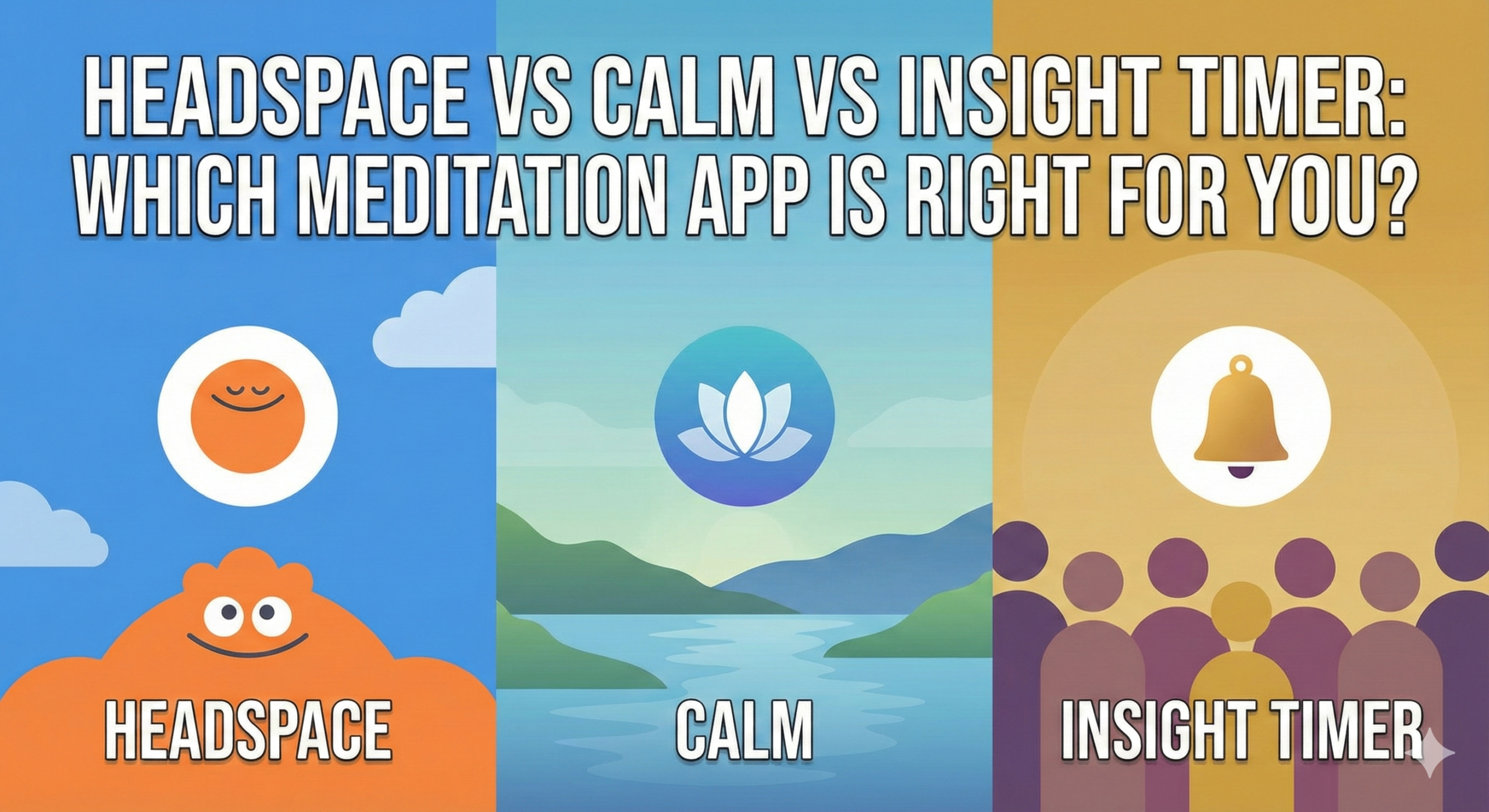
Headspace vs Calm vs Insight Timer: The Ultimate Battle for Your Peace of Mind
By The Wellness Editorial Team
Silence has become a luxury good. In a world where our attention spans are being auctioned off to the highest bidder, the quest for mental clarity has shifted from Himalayan caves to the App Store. If you are feeling the burnout, you aren’t alone. But when you finally decide to download a meditation app, you hit a new wall of anxiety: Which one do I choose?
The “Big Three”—Headspace, Calm, and Insight Timer—dominate the market. They account for the vast majority of user downloads and revenue in the digital wellness space. Yet, despite their shared goal of making you happier, they are radically different products.
Headspace is the friendly teacher; Calm is the soothing retreat; Insight Timer is the bustling community center. Choosing the wrong one can feel like buying a gym membership you never use—it just adds to the guilt.
In this comprehensive guide, we are stripping away the marketing fluff. We have tested these apps for hundreds of hours, slept to their stories, and meditated through their courses. Here is the definitive breakdown of Headspace vs Calm vs Insight Timer to help you decide which subscription deserves your money and your mind.
The “Too Long; Didn’t Read” Comparison
If you are in a rush and just want the specs, here is how the three giants stack up against each other.
| Feature | Headspace | Calm | Insight Timer |
|---|---|---|---|
| Best For | Beginners needing structure & education | Sleep, anxiety relief, & aesthetics | Variety seekers & budget-conscious users |
| Primary Vibe | Clinical, animated, educational | Cinematic, celebrity-led, soothing | Community-driven, diverse, open-platform |
| Free Version | Very limited (Basic course only) | Limited (Some timer/music features) | Best in class (100k+ free tracks) |
| Content Format | Linear courses, animations | Masterclasses, Sleep Stories | User-uploaded tracks, Live Yoga |
| Price (Approx) | $12.99/mo or $69.99/yr | $14.99/mo or $69.99/yr | $9.99/mo or $59.99/yr (Member Plus) |
1. Headspace: The Gym for Your Mind
Headspace was arguably the app that mainstreamed meditation. Co-founded by Andy Puddicombe, a former Buddhist monk, the app treats meditation less like a mystical practice and more like a trainable skill. It cuts through the “woo-woo” with science-backed techniques and charming animations.
The Philosophy and User Experience
Headspace is structured. If you thrive on gamification and checklists, this is your home. The app is famous for its “Basics” course, which hand-holds you through the mechanics of meditation—scanning the body, noting thoughts, and visualization.
The interface is bright, cartoony, and approachable. It doesn’t take itself too seriously. The primary focus here is education. You aren’t just listening to a track; you are learning how to meditate so you can eventually do it without the app.
Key Features
- The Wake Up: Daily short videos to start your day with mindfulness.
- SOS Sessions: Quick 3-minute tracks for moments of panic or sudden stress.
- Focus Music: Curated playlists designed by heavyweights like John Legend to help deep work.
- Sleepcasts: Audio experiences that change slightly every night so your brain doesn’t memorize them.
For professionals trying to disconnect, Headspace offers a clear off-ramp from the digital chaos. In fact, if you are looking for 10 simple ways to reduce screen time every day, using Headspace’s audio-only mode after the initial setup is a great strategy.
✅ The Pros
- Best for beginners: Teaches the fundamental techniques perfectly.
- Structured paths: Linear progression keeps you motivated.
- Kid-friendly: Excellent section for children (“Headspace for Kids”).
- Scientific approach: Heavily cited in clinical studies.
❌ The Cons
- Repetitive voice: If you don’t like Andy’s voice (or the few others), you’re stuck.
- Pricey: The free tier is essentially a trial; you must pay to unlock value.
- Less variety: Content is created in-house, limiting diversity.

Support Your Practice: Retrospec Solana Yoga Mat
A structured practice requires a dedicated space. This extra thick mat provides the comfort needed for the seated sessions Headspace recommends.
Check Price on Amazon2. Calm: The Digital Spa
If Headspace is a classroom, Calm is a retreat in Bali. Upon opening the app, you are greeted not by menus, but by the sound of rainfall, crickets, or a crackling fire. It is immediately visceral.
The Philosophy and User Experience
Calm focuses heavily on relaxation and sleep rather than strict mindfulness education. It’s less about “training” your brain and more about “soothing” it. The aesthetic is stunning, featuring moving landscapes and cinematic photography.
This approach aligns perfectly with a holistic lifestyle. Just as you might follow the ultimate self-care checklist for busy professionals, opening Calm feels like checking off the “mental relaxation” box with style.
Key Features
- Sleep Stories: Bedtime stories for adults read by celebrities like Matthew McConaughey, Harry Styles, and Cillian Murphy.
- The Daily Calm: A fresh 10-minute meditation released every day, usually focusing on a specific theme like gratitude or patience.
- Masterclasses: Audio courses taught by experts on topics like “Radical Self-Compassion.”
- Soundscapes: High-fidelity nature sounds that can play in the background while you work.
✅ The Pros
- Unbeatable Sleep Content: The Sleep Stories are the gold standard in the industry.
- Celebrity Talent: High production value with voices you know and love.
- Beautiful UI: The app itself induces a state of calm.
- Music Library: Exclusive tracks from artists like Disney Piano and Moby.
❌ The Cons
- Less instructional: Not the best if you strictly want to learn how to meditate.
- Navigation: Can sometimes prioritize “content” over “practice.”
- Pop-ups: Aggressive upsells on the free version.

Enhance the Immersion: Sony WH-1000XM5 Noise Canceling Headphones
Calm’s 3D soundscapes and Matthew McConaughey’s voice deserve the best audio hardware. Block out the world completely.
Check Price on Amazon3. Insight Timer: The YouTube of Meditation
Insight Timer is the rebel of the group. While Headspace and Calm are “walled gardens” with proprietary content, Insight Timer is an open platform. It hosts over 100,000 free meditations from thousands of teachers worldwide.
The Philosophy and User Experience
Variety is the spice of life, and Insight Timer is the entire spice bazaar. You can find Vipassana, MBSR, Christian prayer, Kundalini yoga, and sound baths all in one place. It creates a routine that feels personal.
Think of it like building a physical habit; you wouldn’t skip the essential 4-step skincare routine checklist just because you’re bored. Insight Timer prevents boredom by offering infinite variations of practice, ensuring you stick to your mental hygiene routine.
Key Features
- The Timer: The most customizable timer on the market. You choose the duration, the interval bells, and the ambient background noise.
- Live Events: Real-time yoga and meditation sessions where you can interact with teachers.
- Circles: Community groups based on interests (e.g., “Anxiety Support,” “Lucid Dreaming”).
- Courses (Paid): While tracks are free, structured courses usually require the Member Plus subscription.
✅ The Pros
- Incredible Free Value: You can use this app for years without paying a cent.
- Infinite Variety: Teachers from every tradition and culture.
- Community: See who else is meditating with you in real-time.
- Customization: Build your own practice parameters.
❌ The Cons
- Analysis Paralysis: Too many choices can be overwhelming for beginners.
- Quality Control: Audio quality varies since anyone can upload content.
- Cluttered Interface: The app is dense and can be hard to navigate.

Bring the Sound Home: Tibetan Singing Bowl Set
Inspired by the diverse sound baths on Insight Timer? Add a physical sound healing element to your home practice.
Check Price on AmazonHead-to-Head Comparisons
Round 1: For Sleep
Winner: Calm.
While Headspace has “Sleepcasts” and Insight Timer has thousands of Yoga Nidra tracks, Calm owns this category. The sheer production quality of their Sleep Stories and the star power behind them creates a Pavlovian response. You hear the intro music, and your body knows it is time to shut down. It is the mental equivalent of a warm bath.
Round 2: For Learning Meditation
Winner: Headspace.
If you don’t know what you are doing, Insight Timer is confusing and Calm is too passive. Headspace’s structured 10-day introductory courses are pedagogical masterpieces. They use analogies (like the “blue sky” metaphor) that stick with you for years.
Round 3: For Lifestyle Integration
Winner: Insight Timer.
Wellness isn’t just sitting on a cushion; it’s how you cook, eat, and work. Insight Timer has tracks for specific activities—even cooking. It pairs beautifully with a mindful lifestyle. For example, while you are browsing top 5 kitchen gadgets that are actually worth the money, you can listen to a “Mindful Eating” lecture on Insight Timer to ensure those gadgets are used for nourishing your body, not just rushing dinner.
Round 4: Value for Money
Winner: Insight Timer.
There is no contest here. Headspace and Calm essentially require a subscription to be useful. Insight Timer offers 80% of its value for free. If you are on a budget or resent the subscription economy, Insight Timer is the only logical choice.
Final Verdict: Which One Should You Download?
Ultimately, the “best” app is the one you actually use. However, based on our testing, here is our specific recommendation for different types of users:
Choose Headspace if:
You are Type A, appreciate structure, or are a complete skeptic regarding meditation. You want a scientific, secular approach that explains why you are doing what you are doing. It is also the best choice if you are trying to help your children develop mindfulness skills.
Choose Calm if:
Your primary issue is anxiety or insomnia. If you want an app that feels like a warm hug and looks like a piece of art, this is it. It’s perfect for the user who wants to press “play” and be passively relaxed without having to “do the work.”
Choose Insight Timer if:
You are an explorer. You want to try breathwork one day, Christian contemplation the next, and a sound bath the day after. It is also the right pick if you have a specific teacher you follow (like Tara Brach or Jack Kornfield) or if you want to integrate mindfulness into daily chores, like cooking one of these 7 quick and healthy weeknight dinner ideas while listening to a gratitude track.

Set the Mood: ASAKUKI Premium Essential Oil Diffuser
No matter which app you choose, scent is a powerful anchor for mindfulness. Lavender for sleep, Eucalyptus for focus.
Check Price on AmazonFrequently Asked Questions (FAQ)
Can I use these apps offline?
Yes, all three apps allow paid subscribers to download tracks for offline listening. This is essential for travel or meditating in “airplane mode” to avoid distractions.
Do Headspace, Calm, or Insight Timer offer student discounts?
Yes. Headspace offers a significant student plan (often around $9.99/year). Calm sometimes partners with “Amazon Prime Student” or offers discounts. Insight Timer’s core features are free, so a discount is less necessary, but they do offer student pricing for Member Plus occasionally.
Which app is better for anxiety: Calm or Headspace?
It depends on your coping mechanism. Headspace is better for managing anxiety through cognitive reframing (changing how you think). Calm is better for immediate physiological symptom relief (calming the body down through sound and soothing voice).
Is Insight Timer truly free?
Yes. Unlike the others, Insight Timer’s library of 100,000+ tracks is completely free. The paid subscription (“Member Plus”) is strictly for offline downloads, high-quality audio, and structured multi-day courses.
Can I connect these apps to Apple Health or Google Fit?
Yes, all three integrate with Apple Health and Google Fit to track your “Mindful Minutes,” allowing you to see your meditation stats alongside your physical activity.
Which app has the best variety of meditation lengths?
Insight Timer. Because it is user-generated, you can find a 1-minute meditation or a 90-minute one. Headspace and Calm generally stick to standard lengths (5, 10, 15, 20 minutes).
Are there religious connotations in these apps?
Headspace and Calm are entirely secular. Insight Timer is an open platform, so while it has secular content, you can also find Christian, Buddhist, Hindu, and New Age religious content if you search for it.
Which app is best for kids?
Headspace generally wins here with its specific “Headspace for Kids” section categorized by age groups (5 and under, 6-8, 9-12), utilizing their engaging animations.
Conclusion
The battle of Headspace vs Calm vs Insight Timer doesn’t have a single winner because they are solving different problems.
If you want a university education in your own mind, buy Headspace. If you want a digital sanctuary to escape the world and sleep better, buy Calm. If you want a global community and unlimited variety for free, download Insight Timer.
The most important step is simply beginning. Mental health is a compound interest game; a small investment of 10 minutes today pays dividends ten years from now. Pick the interface that appeals to you most and start your streak today.