Renting vs. Buying a House: Pros and Cons for Your Wallet
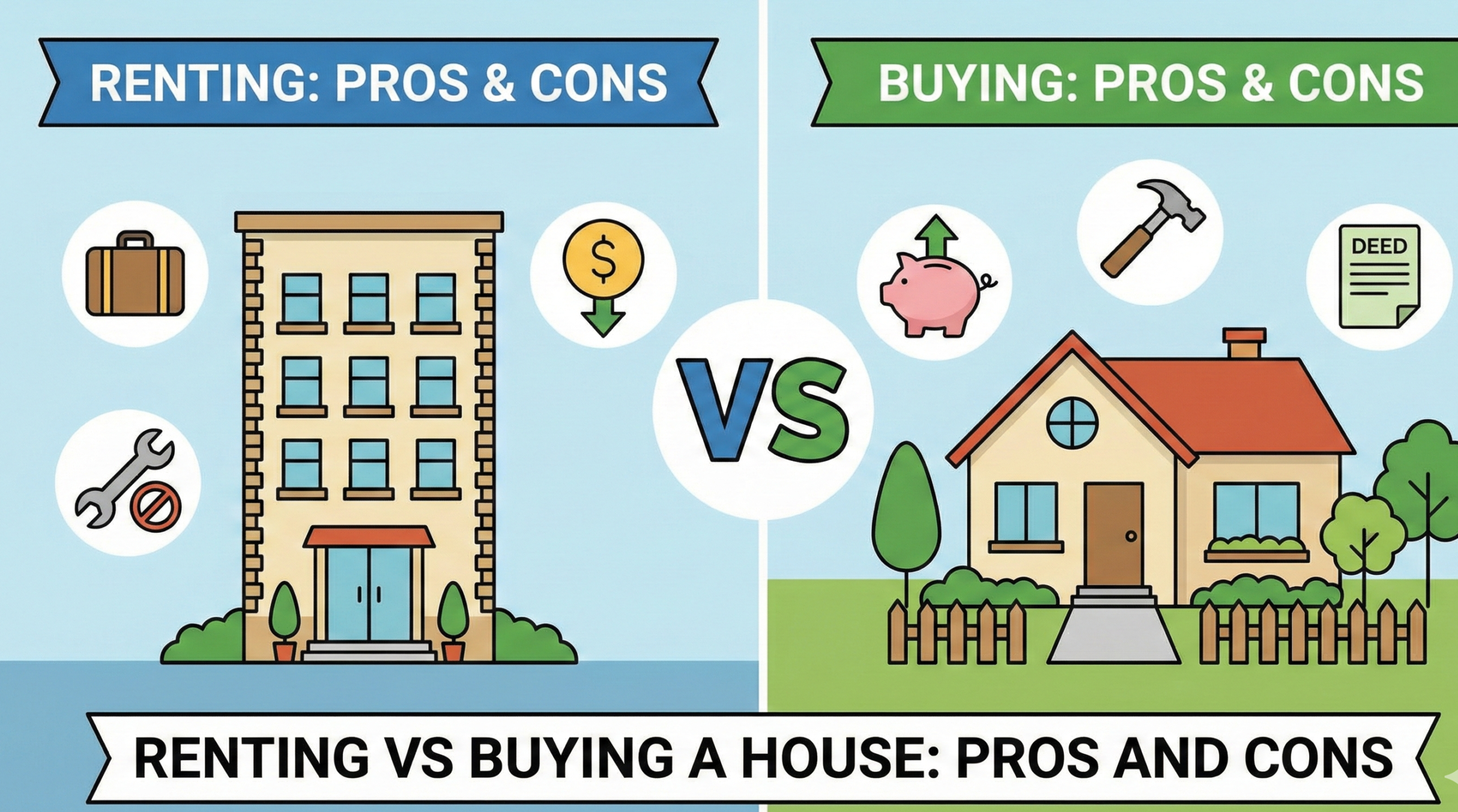
For decades, the “American Dream” has been synonymous with a white picket fence and a 30-year mortgage. But in today’s volatile economic landscape, is buying a home really the golden ticket to wealth it once was?
The debate of renting vs. buying a house is the single largest financial decision most people will ever make. It is not just about money; it is about lifestyle, mobility, and risk tolerance. Cultural pressure often screams “Buy!”, labeling renting as “throwing money away.” However, financial experts know the truth is far more nuanced. Rent is not wasted money—it is a fee paid for a roof over your head and the flexibility to move without selling an illiquid asset.
Conversely, homeownership offers stability, the potential for appreciation, and the freedom to paint your walls whatever color you like. But it also comes with property taxes, insurance premiums, and the dreaded “unexpected repair” bill. In this guide, we strip away the emotional marketing and look at the hard numbers. Whether you are looking to build equity or maintain freedom, we will help you decide which path aligns with your financial future.
At a Glance: The Core Differences
Before analyzing the deep financial implications, here is a high-level breakdown of how owning compares to renting across key categories.
| Feature | Buying (Homeownership) | Renting (Leasing) |
|---|---|---|
| Upfront Cost | High (Down payment, closing costs, inspection) | Low (Security deposit, first month’s rent) |
| Monthly Cost | Mortgage + Taxes + Insurance + Maintenance | Fixed Rent + Utilities (Usually lower initially) |
| Maintenance | 100% Your Responsibility | Landlord’s Responsibility |
| Mobility | Low (Selling takes months and costs fees) | High (Move when lease ends) |
| Financial Gain | Equity building + Potential Appreciation | None (unless investing the savings elsewhere) |
| Customization | Total Freedom | Limited (No holes in walls, usually) |
1. The Financial Reality: Equity vs. Flexibility
The math behind buying versus renting is more complicated than simply comparing a mortgage payment to a rent check.
The Hidden Costs of Buying
When you buy, your mortgage principal and interest are just the beginning. You must account for the “unrecoverable costs” of homeownership: property taxes, homeowners insurance, HOA fees, and maintenance. A good rule of thumb is to budget 1% of the home’s value annually for repairs.
Before committing to a mortgage, it is vital to have your finances in absolute order. We highly recommend using a structured approach. Check out our guide on 5 simple steps to create a zero-based budget checklist to see if you can truly afford the hidden costs of owning.
The “Rent is Wasted Money” Myth
Rent is not wasted; it buys you shelter and transfers financial risk to the landlord. If the furnace breaks, you don’t pay. If the housing market crashes, you don’t lose equity. The financial secret to renting is what you do with the surplus. Because renting often requires less upfront capital, you can invest the difference in the stock market.
To make renting a smart financial move, you must be disciplined about investing. If you aren’t sure where to start, read about the 4 types of investment accounts explained to grow your wealth without a deed.

Master Your Money Mindset
Ramit Sethi’s bestseller challenges the myth that buying is always better. A must-read for anyone torn between a mortgage and a lease.
Check Price on Amazon2. Barrier to Entry: Credit and Down Payments
Buying a house requires passing a financial stress test. Renting is generally much easier to qualify for.
The Mortgage Hurdle
To get a favorable interest rate, you generally need a credit score above 720. A lower score can cost you tens of thousands of dollars over the life of a loan. Furthermore, saving for a 20% down payment to avoid Private Mortgage Insurance (PMI) is a massive hurdle for many.
If you are eyeing a purchase but your score is lagging, don’t rush. Take a few months to fix it. Here is a must-do list on how to improve your credit score fast before you apply for pre-approval.
Renting Requirements
Landlords will check your credit and income (usually requiring 3x the monthly rent in gross income), but the scrutiny is far less intense than a bank underwriting a 30-year loan.
3. Lifestyle: The DIY vs. The “Call the Super”
Do you own a drill? Do you want to own a drill? Your desire to perform manual labor should heavily influence your decision.
The Owner’s Burden
When you own a home, weekends are often consumed by lawn care, gutter cleaning, and painting. You are the facility manager. This requires a specific mindset and discipline. It aligns with one of the 7 habits of people who are good with money: being proactive rather than reactive with asset maintenance.
The Renter’s Freedom
Renters have the luxury of time. When the faucet leaks, you make a call. When you get a job offer in a new city, you break the lease (for a fee) or wait it out, and you move. You are not tethered to a specific location by an illiquid asset that takes 60–90 days to sell.

Essential for Homeowners
If you decide to buy, you become the handyman. This 100-piece tool kit covers 90% of the household repairs you will encounter in year one.
Check Price on Amazon4. Summary: Pros and Cons
Let’s break it down into a clear comparison to see where the value lies for your specific situation.
✅ Buying Pros
- Equity: Every payment brings you closer to 100% ownership.
- Appreciation: Real estate generally increases in value over time.
- Stability: No landlord can raise your rent or evict you (if you pay).
- Tax Benefits: Mortgage interest and property tax deductions (for some).
- Pride: A sense of community and ownership.
❌ Buying Cons
- Upfront Costs: Down payment and closing costs are substantial.
- Maintenance: Repairs are expensive and unpredictable.
- Illiquidity: Your money is tied up in the house.
- Market Risk: Values can drop, leaving you “underwater.”
✅ Renting Pros
- Flexibility: Easy to relocate for career or travel.
- Predictability: Fixed monthly costs with no surprise repair bills.
- Liquidity: Keep your cash in savings or stocks, not in walls.
- Amenities: Access to pools/gyms you couldn’t afford to build yourself.
❌ Renting Cons
- No Equity: You leave with nothing when you move out.
- Rent Hikes: Landlords can increase prices annually.
- Restrictions: Rules on pets, decor, and renovations.
- Instability: The landlord could sell the property, forcing you to move.
5. Education Before Action
Whether you choose to sign a lease or a mortgage deed, the worst thing you can do is go in uneducated. Real estate is a high-stakes game.
We recommend immersing yourself in financial literacy before signing. Start by reading the top 10 books on personal finance you need to read. Many of these classics, like The Total Money Makeover or Rich Dad Poor Dad, offer conflicting but valuable perspectives on homeownership that will help you form your own opinion.
6. The True Cost of Buying: Every Dollar You Will Spend
One of the most dangerous mistakes first-time homebuyers make is calculating only the down payment and monthly mortgage payment. The true cost of buying a home is substantially higher, and failing to account for these costs can derail your finances within the first year of ownership. Here is the complete financial picture for a median-priced U.S. home at $420,000 in 2025.
Upfront Costs at Closing
| Cost Item | Typical Range | On $420K Home | Notes |
|---|---|---|---|
| Down Payment (20%) | 3.5%–20%+ | $84,000 | 20% avoids PMI; lower down payments available |
| Closing Costs | 2%–5% of loan | $6,720–$16,800 | Loan origination, title insurance, escrow fees |
| Home Inspection | $300–$600 | ~$450 | Non-negotiable; uncovers hidden issues |
| Appraisal Fee | $400–$700 | ~$550 | Required by lender to confirm property value |
| Moving Costs | $1,000–$5,000 | ~$2,500 | Local vs. long-distance moving varies significantly |
| Initial Repairs/Updates | $0–$20,000+ | $5,000–$15,000 | Nearly all homes require immediate attention post-purchase |
| Total Upfront Estimate | $99,000–$119,000 | Cash required before moving in |
Ongoing Annual Costs of Homeownership
Once you are in the home, the expenses do not stop. The following are the recurring annual costs that buyers routinely underestimate when calculating whether they can “afford” a home.
| Annual Cost | Typical Range | On $420K Home |
|---|---|---|
| Property Taxes | 0.5%–2.5% of value/year | $2,100–$10,500 |
| Homeowners Insurance | 0.5%–1% of value/year | $2,100–$4,200 |
| Maintenance & Repairs (1% Rule) | 1%–2% of value/year | $4,200–$8,400 |
| PMI (if <20% down) | 0.5%–1.5% of loan/year | $1,680–$5,040 |
| HOA Fees (if applicable) | $0–$600+/month | $0–$7,200 |
| Total Annual Overhead (est.) | $8,400–$30,340 |
⚠️ The 1% Maintenance Rule: Set aside 1% of your home’s purchase price every year specifically for maintenance and repairs. For a $420,000 home, that is $4,200 per year, or $350 per month. This fund is not optional—it is a financial necessity. The average homeowner spends between $9,000 and $13,000 on home maintenance annually according to the American Housing Survey. Budget conservatively.
The True Cost of Selling: What Nobody Tells You
One of the most overlooked aspects of homeownership is the cost of eventually selling. When you sell, you do not walk away with the full sale price. The following deductions apply to most U.S. home sales:
- Realtor Commissions: Typically 5%–6% of the sale price split between buyer’s and seller’s agents. On a $500,000 home, this is $25,000–$30,000 out of your proceeds. The NAR settlement in 2024 changed how commissions work, so confirm current practices in your market.
- Seller Concessions: In buyer’s markets, sellers often contribute to the buyer’s closing costs. This typically reduces net proceeds by 1%–3%.
- Capital Gains Tax: If your home appreciated beyond the exclusion limit ($250,000 for single filers, $500,000 for married joint filers), you owe federal capital gains tax on the excess gain.
- Pre-Sale Repairs and Staging: Most sellers invest $5,000–$20,000 in pre-sale improvements, painting, and professional staging to maximize their sale price.
The bottom line: selling a home typically costs 8%–10% of the sale price in total transaction costs. This is a major reason why the “you must stay 7+ years to make buying worthwhile” advice exists—you need sufficient time for appreciation to overcome these transaction costs.
7. The Price-to-Rent Ratio and the 5% Rule: Your Financial Decision Tools
Rather than relying on gut instinct or cultural pressure, use these two proven financial frameworks to determine whether buying or renting makes mathematical sense in your specific market.
The Price-to-Rent Ratio Explained
The price-to-rent (P/R) ratio is a simple calculation that compares the cost of buying a property to the cost of renting a comparable one in the same market. It is calculated by dividing the median home price by the median annual rent for a comparable property.
Formula: Price-to-Rent Ratio = Home Purchase Price ÷ Annual Rent
Example: A home that costs $400,000 to buy and rents for $2,000/month ($24,000/year) has a P/R ratio of 400,000 ÷ 24,000 = 16.7.
📊 Interpreting the P/R Ratio
- Below 15: Buying is strongly favored. The cost of purchasing is low relative to the rental alternative. Common in LCOL (low cost of living) cities like Cleveland, Detroit, Memphis.
- 15–20: Neutral zone. Either option can work depending on personal circumstances, time horizon, and investment discipline.
- Above 20: Renting is strongly favored mathematically. The purchase price is high relative to rentable value. Common in HCOL cities like San Francisco (P/R ~40+), New York, Seattle, LA.
🏙️ P/R Ratios: U.S. Cities 2025
- San Francisco, CA: ~40–50 (Rent wins clearly)
- New York City, NY: ~35–45 (Rent wins clearly)
- Seattle, WA: ~28–35 (Lean toward renting)
- Austin, TX: ~22–28 (Neutral, slightly rent)
- Atlanta, GA: ~16–20 (Neutral)
- Memphis, TN: ~10–13 (Buy wins clearly)
- Cleveland, OH: ~8–12 (Buy wins clearly)
The 5% Rule: Ben Felix’s Framework
Financial advisor Ben Felix popularized the “5% Rule” as a practical way to compare the unrecoverable costs of owning versus renting. The rule proposes that the true annual cost of owning a home—expressed as a percentage of the home’s value—is approximately 5%, composed of three parts:
- Property Tax: ~1% of home value annually
- Maintenance Cost: ~1% of home value annually
- Cost of Capital (Opportunity Cost): ~3% of home value annually (the return you forgo by having your down payment in a house instead of invested)
To apply the rule: multiply the home’s price by 5% and divide by 12 to get the monthly “break-even rent.” If your actual monthly rent is less than this number, renting is the better financial choice. If your rent is more than this number, buying is favored.
Example: A $400,000 home × 5% = $20,000/year ÷ 12 = $1,667/month. If comparable apartments in your area rent for $2,200/month, buying is likely the better financial decision. If they rent for $1,400/month, renting is clearly cheaper.
💡 Break-Even Point: For most home purchases at current interest rate levels (6.5–7%), the break-even period—the number of years you must stay before buying outperforms renting—is approximately 5–8 years. Below that horizon, the transaction costs of buying and selling make renting financially superior regardless of appreciation. Always run your specific numbers with a rent vs. buy calculator before deciding.
8. Mortgage Types Explained: Which Loan Is Right for You?
If you decide to buy, choosing the right mortgage product is as important as choosing the right home. The wrong mortgage structure can cost you tens of thousands of dollars over the life of the loan or leave you financially exposed to interest rate increases. Here is a clear breakdown of every major mortgage type available to U.S. homebuyers in 2025.
30-Year Fixed Rate
The most popular U.S. mortgage. Fixed interest rate for 360 months. Highest total interest paid but lowest monthly payment. Provides complete payment certainty.
Best For: Long-term stability, tight monthly budgets15-Year Fixed Rate
Same fixed-rate structure but half the term. Higher monthly payments but significantly lower total interest paid. Builds equity twice as fast. Typical rate 0.5–0.75% lower than 30-year.
Best For: High earners wanting to pay off fast5/1 ARM
Adjustable-Rate Mortgage: fixed rate for first 5 years, then adjusts annually based on market index. Lower initial rate than fixed mortgages. Can increase significantly after year 5.
Best For: Buyers planning to sell or refinance before year 5FHA Loan
Government-backed loan insured by the Federal Housing Administration. Requires as little as 3.5% down with a credit score of 580+. Requires mortgage insurance premium (MIP) for the loan’s life if less than 10% down.
Best For: First-time buyers with limited savings or creditVA Loan
Available exclusively to veterans, active-duty service members, and eligible surviving spouses. Zero down payment required. No PMI. Competitive rates. Funded by the Department of Veterans Affairs.
Best For: Military veterans and service membersUSDA Loan
U.S. Department of Agriculture loan for rural and suburban home purchases. Zero down payment for eligible areas and income levels. Requires USDA guarantee fee instead of PMI.
Best For: Low-to-moderate income buyers in rural areasConventional Loan (3% Down)
Non-government-backed loans with as little as 3% down for qualifying buyers. Requires PMI until 20% equity is reached. More flexible than FHA in terms of property types accepted.
Best For: Buyers with good credit but limited down paymentJumbo Loan
Conventional loans above the conforming loan limit ($766,550 in most U.S. markets in 2025, higher in HCOL areas). Stricter qualification requirements: typically 680+ credit score and larger reserves required.
Best For: High-value property purchases in HCOL marketsThe 28/36 Rule: How Much House Can You Afford?
The 28/36 rule is the most widely used affordability guideline in mortgage lending. It states that your housing costs should not exceed 28% of your gross monthly income, and your total debt payments (housing + car + student loans + credit cards) should not exceed 36% of gross monthly income.
28/36 Rule in Practice: $100,000 Annual Income
For a household earning $100,000 annually ($8,333/month gross), the 28/36 rule recommends:
Note: At a 7% mortgage rate in 2025, a $100K income household can afford approximately $290,000–$320,000 in home purchase price at 20% down while staying within the 28% guideline. This is significantly below the median U.S. home price of $420,000, which explains why homeownership has become more challenging for average earners in the current rate environment.
9. Renting as a Wealth Strategy: Investing the Difference
The most sophisticated argument for renting is not that it is cheaper month-to-month—sometimes it is not—but that it frees up capital that, if invested wisely, can outperform real estate over long time horizons. This is the core thesis of the “rent and invest” strategy, popularized by economists and financial advisors who challenge the conventional homeownership narrative.
The Opportunity Cost of the Down Payment
A $84,000 down payment (20% on a $420,000 home) invested in a diversified stock index fund tracking the S&P 500 would, at the historical average annual return of approximately 10% (7% after inflation), grow to approximately $580,000 after 20 years. The S&P 500’s average annual return over any 20-year rolling period in U.S. history has been positive in 100% of cases. Real estate appreciation, while generally positive, averages approximately 3–4% annually nationally—roughly in line with inflation. The difference in compound growth between these two assets over 20+ year periods is substantial.
When “Invest the Difference” Actually Works
The critical caveat of the rent-and-invest strategy is that it requires extraordinary financial discipline that most people struggle to maintain. The “difference” between your rent and a theoretical mortgage payment must actually be invested—not spent on lifestyle inflation—every single month for decades. Research by behavioral economists suggests that most renters do not, in practice, invest the difference consistently.
For the strategy to outperform buying, three conditions must all be true simultaneously:
- Your rent must be meaningfully lower than the total cost of owning (including opportunity cost of down payment)
- You must consistently invest the entire monthly savings in a diversified portfolio
- You must maintain this discipline for the full time horizon without lifestyle creep consuming the surplus
If all three conditions are met, renting and investing can produce a higher net worth than buying in high-cost markets. If any one condition fails—particularly condition 3—homeownership’s forced savings mechanism (your equity grows whether you are financially disciplined or not) often produces better real-world outcomes for average households.
Real Estate as an Inflation Hedge
One underappreciated advantage of buying over renting is real estate’s function as an inflation hedge. A fixed-rate mortgage locks in your primary housing cost permanently. As inflation rises over time, your mortgage payment stays the same in nominal dollars while rents typically rise 3–5% annually. Over a 20–30 year horizon, this can produce significant relative savings. A household with a $2,000 fixed mortgage payment in 2025 will still pay $2,000 in 2045—but a renter paying $2,000 today might pay $3,600 or more for comparable housing in 2045 if rent increases at 3% annually.
10. First-Time Homebuyer Programs: Free Money You Might Be Leaving Behind
One of the most overlooked dimensions of the rent vs. buy decision is the availability of first-time homebuyer assistance programs that can dramatically reduce the upfront barrier to purchasing. Many buyers who assume they cannot afford to buy do not realize they qualify for substantial financial assistance. These programs collectively provide tens of thousands of dollars in grants, low-interest loans, and tax credits to eligible buyers each year.
Federal First-Time Homebuyer Programs
- FHA Loan (3.5% Down): The Federal Housing Administration’s loan program reduces the down payment barrier to just 3.5% for buyers with a 580+ credit score. For a $300,000 home, that is $10,500 instead of $60,000.
- USDA Rural Development Loan: Zero down payment for eligible rural and suburban areas. Many suburbs of major cities qualify. Income limits apply (typically up to 115% of area median income).
- VA Home Loan: Zero down payment, no PMI, and competitive rates for military veterans and service members. One of the most valuable financial benefits available to U.S. veterans.
- HUD Good Neighbor Next Door: 50% discount on HUD homes in “revitalization areas” for teachers, firefighters, EMTs, and law enforcement officers. Requires a 36-month occupancy commitment.
State and Local First-Time Buyer Assistance
Every U.S. state has at least one first-time homebuyer assistance program, and most have several. These programs are administered through state housing finance agencies (HFAs) and typically offer one or more of the following:
- Down Payment Assistance (DPA) Grants: Non-repayable grants covering 2%–5% of the purchase price. Not loans—free money for qualifying buyers.
- Second Mortgage DPA: Low- or zero-interest second mortgage covering the down payment, deferred until the home is sold or refinanced.
- Mortgage Credit Certificates (MCCs): Federal tax credits worth 20%–30% of annual mortgage interest, reducing your actual tax bill (not just your deduction) for as long as you own the home.
💡 How to Find Programs: Visit HUD.gov’s state housing resource directory or your state’s HFA website to find currently available programs. Income and purchase price limits apply. Most programs require completion of an approved homebuyer education course, which itself is valuable preparation for the responsibilities of ownership.
11. Renters’ Rights and Renters Insurance: Protecting Yourself as a Tenant
Choosing to rent is not choosing to be vulnerable. Understanding your rights as a tenant and protecting yourself with renters insurance gives you the stability and security that too many renters forgo—often to their financial detriment.
Key Renters’ Rights All Tenants Should Know
Tenant protections vary significantly by state and city, with some jurisdictions (California, New York, Oregon) having some of the strongest renter protections in the country and others having minimal state-level protections. The following rights exist in some form in most U.S. states:
🔑 Habitability Rights
Landlords are legally required to maintain properties in a habitable condition—functioning plumbing and heating, weather-tight roof and walls, working electrical systems, and freedom from pest infestations. When landlords fail to make required repairs after proper notice, tenants in most states may “repair and deduct” (hire a contractor and deduct costs from rent) or withhold rent into escrow.
📋 Lease and Rent Protections
In cities with rent control or rent stabilization (New York City, San Francisco, Los Angeles, Portland, and others), landlords cannot raise rent above a legally established percentage annually. Where rent control exists, it provides the payment predictability that is otherwise a major advantage of buying. Check local ordinances before assuming your rent can be raised without limit.
💰 Security Deposit Rules
Most states cap security deposits at 1–2 months’ rent and require landlords to return the deposit (with itemized deductions for actual damages) within 14–30 days of move-out. Improper withholding of deposits is a legal violation that can result in penalties of 2–3× the deposit amount plus attorney fees in many states. Document your unit’s condition at move-in and move-out with dated photographs.
🚫 Anti-Discrimination Protections
The Fair Housing Act prohibits housing discrimination based on race, color, national origin, religion, sex, familial status, and disability at the federal level. Many states and cities add additional protected categories including source of income, sexual orientation, gender identity, and age. If you believe you have been discriminated against, file a complaint with HUD or your state’s fair housing authority.
Renters Insurance: The Most Underutilized Financial Protection Available
Only approximately 57% of renters in the United States carry renters insurance, despite the average policy costing just $15–$20 per month. This means nearly half of all renters—tens of millions of households—have no protection against the financial consequences of apartment fires, burglaries, water damage, and personal liability claims.
Renters insurance covers three categories of loss that can be financially devastating without it:
- Personal Property: Replaces or reimburses stolen or damaged belongings—electronics, furniture, clothing, jewelry—anywhere in the world. A single burglary or apartment fire can result in $10,000–$30,000 in losses uninsured.
- Personal Liability: Covers legal defense and judgment costs if someone is injured in your apartment or if you accidentally damage someone else’s property. Legal defense alone can cost $50,000–$100,000 without coverage.
- Additional Living Expenses: Covers hotel bills and meals if your apartment becomes uninhabitable due to a covered event (fire, flood, storm) while repairs are made.
At $180–$240 per year for a typical policy, renters insurance is arguably the highest-value insurance product available to any consumer. It is non-negotiable financial protection for anyone who rents.
12. House Hacking: Living for Free While Building Equity
House hacking is one of the most powerful wealth-building strategies available to first-time buyers—and one of the least understood outside of real estate investing circles. It is the practice of purchasing a multi-unit property, living in one unit, and renting out the remaining units to generate rental income that offsets or eliminates your monthly housing costs.
How House Hacking Works
The most common house hacking vehicle is a duplex, triplex, or quadplex (2–4 unit property). Properties with 1–4 units qualify for residential mortgage financing—meaning you can use standard FHA loans (3.5% down) or conventional loans rather than more expensive commercial financing. This makes the strategy accessible to buyers who could not otherwise afford investment real estate.
Example: You purchase a duplex for $380,000 using an FHA loan at 3.5% down ($13,300 upfront). Your mortgage payment (principal, interest, taxes, insurance) totals $2,400/month. You live in one unit and rent the other for $1,800/month. Your net housing cost is $600/month—less than most studio apartment rentals in the same market. Meanwhile, you are building equity in a $380,000 asset that is being partially funded by your tenant.
House Hacking Strategies Beyond Multi-Family
- Single-Family with ADU (Accessory Dwelling Unit): Purchase a single-family home with a basement apartment, garage conversion, or backyard cottage and rent the secondary unit. Increasingly common in cities like Denver, Seattle, and Portland.
- Room Rental: Purchase a single-family home with multiple bedrooms and rent individual rooms to housemates. Less private but highest income density per square foot.
- Short-Term Rental (STR): Rent a bedroom or secondary unit on Airbnb while living in the primary space. Higher income potential but more management intensive and subject to local STR regulations.
Tax Advantages of House Hacking
House hacking is not just a monthly cash flow strategy—it also creates meaningful tax advantages. When you rent a portion of your home, you can deduct a proportional share of mortgage interest, property taxes, insurance, utilities, and depreciation from your rental income. A duplex where you occupy one unit and rent the other allows you to deduct 50% of these expenses against your rental income, significantly reducing your tax liability.
13. Renting vs. Buying by Life Stage: What Makes Sense at Every Age
The right answer to the rent vs. buy question is not static—it evolves as your life circumstances change. Here is how the calculus shifts across different life stages.
20s: Recent Graduate
Student debt, career uncertainty, frequent city changes, and limited savings make renting the logical default. Use this decade to build credit, fund your emergency fund, and contribute to retirement accounts. The flexibility to chase career opportunities without a property anchor is worth more than equity in your 20s.
Verdict: RentLate 20s–Early 30s: Settling Down
Geographic stability, stronger income, debt paydown progress, and potential partnership make this the natural window for first-time buying for many people. If you have 7+ year horizon in a market with a P/R ratio below 20 and meet the 28/36 rule, buying becomes increasingly compelling.
Verdict: Analyze Your Market30s–40s: Family Formation
School districts, neighborhood stability, outdoor space, and the need for customization (baby-proofing, renovations) push strongly toward buying for families with the financial capacity. The forced savings of equity accumulation during peak earning years is especially valuable.
Verdict: Strong Buy Case40s–50s: Peak Earnings
Most homeowners in this stage are in the sweet spot: significant equity built, mortgage near payoff horizon, and appreciation compounding. Those who rented through their 30s should seriously evaluate buying now if geographic stability is established. The remaining mortgage term is shorter, making the math more favorable.
Verdict: Buy If Stable60s: Pre-Retirement
Many homeowners in this stage own their home outright or near-outright, providing zero housing cost in retirement (property taxes and insurance only). Those still renting face rising rents on fixed incomes. If financially feasible, this is a critical decade to either pay down a mortgage aggressively or purchase for long-term cost stability.
Verdict: Buy for StabilityRetirement
Downsizing owned homes can unlock significant equity to fund retirement. Some retirees strategically sell their home, invest the equity, and rent in a lower-cost or more amenity-rich location—particularly in senior living communities where maintenance is handled and community amenities exist.
Verdict: Depends on Equity14. Buying in High-Cost vs. Low-Cost Cities: Why Location Changes Everything
The single largest variable in the rent vs. buy calculation is geography. The same income that makes homeownership entirely feasible in Memphis or Pittsburgh makes it mathematically near-impossible in San Francisco or Manhattan. Understanding how your specific city affects the calculation is essential before making any decision.
High-Cost of Living (HCOL) Cities: The Case for Renting
In cities like San Francisco, New York, Seattle, Boston, and Los Angeles, median home prices are $800,000–$1,500,000+. At these price points, the 28/36 rule requires an annual household income of $200,000–$400,000+ just to qualify for a mortgage with 20% down at current rates. The vast majority of residents in these markets earn below this threshold, making buying mathematically inaccessible without substantial family wealth, windfall income (stock options, inheritance), or many years of aggressive saving.
In HCOL cities, the P/R ratio typically exceeds 30–40, meaning renting and investing the difference becomes not just a viable alternative but often the superior financial strategy. Many of the world’s wealthiest individuals—including prominent tech executives and finance professionals in these cities—rent strategically because the opportunity cost of their capital is higher deployed in investments than in real estate at these valuations.
Low-Cost of Living (LCOL) Cities: The Case for Buying
In cities like Cleveland, Memphis, Detroit, Indianapolis, Pittsburgh, and Kansas City, median home prices of $150,000–$250,000 create a fundamentally different calculation. The P/R ratio in these markets is often 10–15, meaning the cost of owning is at or below the cost of renting comparable properties. A household earning $65,000–$80,000 can comfortably meet the 28/36 rule at these price points.
In LCOL markets, the historical argument for buying as a forced savings and wealth-building mechanism is at its strongest. Equity in a modest home in a stable LCOL market, accumulated over 20–30 years, has produced significant multi-generational wealth for middle-class American families. The primary risk in these markets is local economic decline reducing property values—less of a concern in cities with diversified economies.
15. Final Verdict: Which Should You Choose?
There is no universal “right” answer, but there is a right answer for you right now.
Choose to RENT If:
- You plan to stay in the area for less than 5 years.
- You are working on paying off high-interest debt (credit cards, student loans).
- You do not have an emergency fund or a 20% down payment saved.
- You value career mobility and travel over stability.
- You live in a HCOL city with a P/R ratio above 25.
- Your rent is less than 5% of a comparable home’s value per year (5% Rule).
- You have high-return investment opportunities that outperform real estate appreciation in your market.
Choose to BUY If:
- You plan to stay in the home for 7+ years.
- You have a stable income, good credit (720+), and a healthy emergency fund.
- You want the freedom to renovate and modify your living space.
- You want to lock in your monthly housing costs long term.
- You live in a LCOL market where P/R is below 15.
- Your housing payment meets the 28% threshold of your gross income.
- You qualify for first-time homebuyer grants or assistance programs.
Your Financial Readiness Checklist for Buying
- Credit score above 720 (check free at AnnualCreditReport.com)
- No high-interest consumer debt remaining
- 3–6 months of expenses in an emergency fund (separate from down payment)
- Down payment saved (20% ideal; explore assistance programs for less)
- Closing cost savings set aside (additional 2–5% of purchase price)
- Debt-to-income ratio below 36% including projected mortgage
- Stable employment for at least 2 years (required by most lenders)
- Budget for 1% annual maintenance reserve on top of mortgage payment
- Run the numbers with a rent vs. buy calculator for your specific market

Ready to Move?
Whether you are moving into your first rental or your forever home, packing is the first step. Grab this moving kit to keep your belongings safe.
Check Price on AmazonFrequently Asked Questions
No. Renting buys you shelter and flexibility and transfers financial risk to the landlord. Renters who consistently invest the money they save by not paying property taxes, maintenance, and the opportunity cost of a down payment can build significant wealth. The key word is “consistently”—the strategy only works with investment discipline.
Ideally 20%, which avoids PMI and gives you the lowest possible interest rate. However, VA loans require 0% down, USDA loans require 0%, FHA requires 3.5%, and many state assistance programs can reduce your out-of-pocket contribution further. Do not wait for 20% if it means delaying a good purchase by years in a rising market—run the math for your specific situation.
The 5% Rule proposes that the true annual unrecoverable cost of owning a home (property tax + maintenance + opportunity cost of capital) is approximately 5% of the home’s value. Multiply the home price by 5% and divide by 12. If that number is higher than comparable monthly rent in your area, renting is the better financial choice. If it’s lower than comparable rent, buying is favored.
Not legally, but highly recommended. Following the 2024 NAR commission settlement, buyer representation arrangements changed—you may now need to sign a buyer representation agreement specifying your agent’s compensation. In most transactions, the seller still covers buyer’s agent fees, but confirm this upfront. An experienced buyer’s agent navigates inspections, negotiations, and contingencies that can save you tens of thousands of dollars.
It can. You can deduct mortgage interest (on up to $750,000 of loan for mortgages originated after 2017) and state/local property taxes (up to $10,000 combined SALT cap). However, since the standard deduction was raised to $30,000 for married filers in 2025, you only benefit from these deductions if your total itemized deductions exceed the standard deduction—which requires a large mortgage and significant other itemizable expenses.
Condos offer lower purchase prices, no exterior maintenance, and urban location advantages, but come with HOA fees (which can rise unpredictably), restrictions on modifications, and less control over neighboring unit quality. Houses offer more privacy, land appreciation potential, and renovation freedom but require full maintenance responsibility. For most buyers, the better question is single-family home vs. multi-unit (for house hacking) rather than condo vs. house.
House hacking involves buying a multi-unit property (duplex, triplex, or quadplex), living in one unit, and renting the others to offset or eliminate your mortgage payment. It is the most powerful first-time buyer strategy available—allowing you to use FHA financing with 3.5% down on a 2–4 unit investment property while building equity and generating rental income simultaneously.
Private Mortgage Insurance protects the lender (not you) if you default. It is required on conventional loans with less than 20% down and costs 0.5%–1.5% of the loan annually. To avoid it: put 20% down, use an 80-10-10 “piggyback loan” (first mortgage at 80%, second at 10%, 10% down), use a VA or USDA loan (which have no PMI), or request PMI removal once you reach 20% equity through payments and/or appreciation.
The general rule is 5–7 years minimum, accounting for closing costs, selling costs, and the early phase of a mortgage when payments are primarily interest rather than principal. At 7% mortgage rates, the break-even timeline shifts to the higher end of this range. In markets with rapidly appreciating prices, break-even can occur sooner. Always run your specific numbers using a rent vs. buy calculator with local data before deciding.
Debt-to-income (DTI) ratio is your total monthly debt payments divided by your gross monthly income. Most conventional lenders require a DTI at or below 43%, with the best rates reserved for DTIs below 36%. Your DTI determines how much house you can qualify for—and how financially stretched you will be after purchasing. A DTI above 43% at current rates means a lower home price, larger down payment, or debt payoff is required before purchasing.
Conclusion
The battle of renting vs. buying isn’t a math problem; it’s a life problem. If you crave freedom and hate fixing toilets, rent with pride and invest your surplus cash. If you crave roots, community, and a forced savings account in the form of equity, buy a home when your finances are robust.
The most important takeaway from this guide is that there is no default correct answer—only correct answers for specific people in specific markets at specific moments in their financial lives. A disciplined renter in San Francisco who invests consistently can accumulate more wealth than a homeowner who bought at the wrong time at a price they could not truly afford. Equally, a homeowner in Cleveland who buys modestly and pays off their mortgage in 20 years has secured their retirement housing cost permanently.
Don’t let societal pressure dictate your financial future. Run the numbers, check your credit, understand your market’s P/R ratio, and make the choice that lets you sleep soundly at night.