
Backpack vs. Suitcase: Choosing the Right Gear for Your Next Adventure
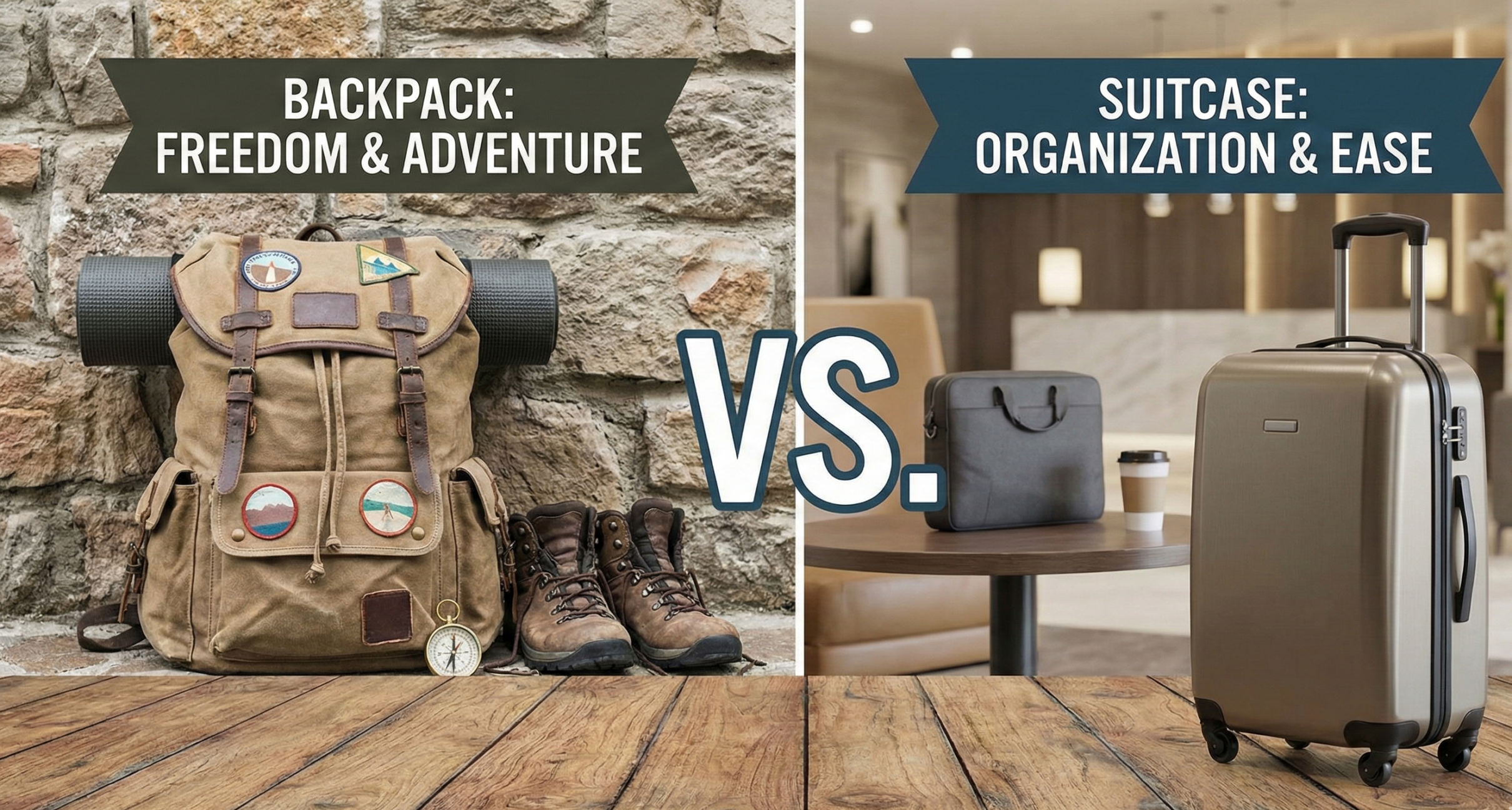
There are two types of travelers in this world: those who breeze through cobblestone streets with their hands free, and those who arrive at the hotel lobby with perfectly unwrinkled shirts.
The debate of backpack vs. suitcase is as old as modern tourism itself. It’s not just about storage; it’s about philosophy. Your choice of luggage dictates how you move, how you pack, and ultimately, how you experience your destination. Choose wrong, and you might find yourself dragging a 50-pound wheeled anchor up the narrow stairs of a Venetian apartment. Choose right, and your luggage becomes an invisible companion, facilitating rather than hindering your journey.
In this comprehensive guide, we are stripping away the marketing fluff. We will analyze mobility, capacity, organization, and professional perception to help you decide which gear deserves to accompany you on your next trip. Whether you are following a checklist for a 10-day Europe trip or heading to a business conference, the answer isn’t always obvious.
At a Glance: The Core Differences
Before we dive into the deep analysis, here is a high-level breakdown of how these two contenders stack up against each other.
| Feature | Travel Backpack | Rolling Suitcase |
|---|---|---|
| Mobility | Excellent (Stairs, crowds, dirt roads) | Limited (Smooth floors only) |
| Organization | Medium (Requires packing cubes) | High (Clamshell design, straps) |
| Protection | Low to Medium (Soft sides) | High (Hard shell options) |
| Weight | Lighter (3–5 lbs empty) | Heavier (7–12 lbs empty) |
| Appearance | Casual / Adventure | Professional / Polished |
| Fatigue Factor | Back strain over long periods | Arm/Wrist strain on bad terrain |
1. Mobility: The Cobblestone Test
The most critical factor in the backpack vs. suitcase debate is your destination’s terrain. If you are planning to visit one of the top 5 cheapest European cities, you are likely to encounter cobblestones, narrow sidewalks, and endless metro stairs.
The Backpack Advantage
A backpack offers ultimate freedom. You can run for a bus, navigate a crowded market without running over toes, and hike up five flights of stairs to a hostel or Airbnb without breaking your rhythm. Your hands are free to check maps on your phone or hold a coffee. For destinations with poor infrastructure—think Southeast Asia or rural South America—a backpack is almost mandatory.
The Suitcase Reality
Suitcases, particularly 4-wheeled spinners, are a dream on airport linoleum and hotel carpets. They remove the weight from your spine, allowing you to stand upright and relaxed. However, the moment you hit gravel, snow, or uneven pavement, a suitcase becomes a liability. Dragging a wheeled bag over cobblestones is not only deafeningly loud but physically exhausting.
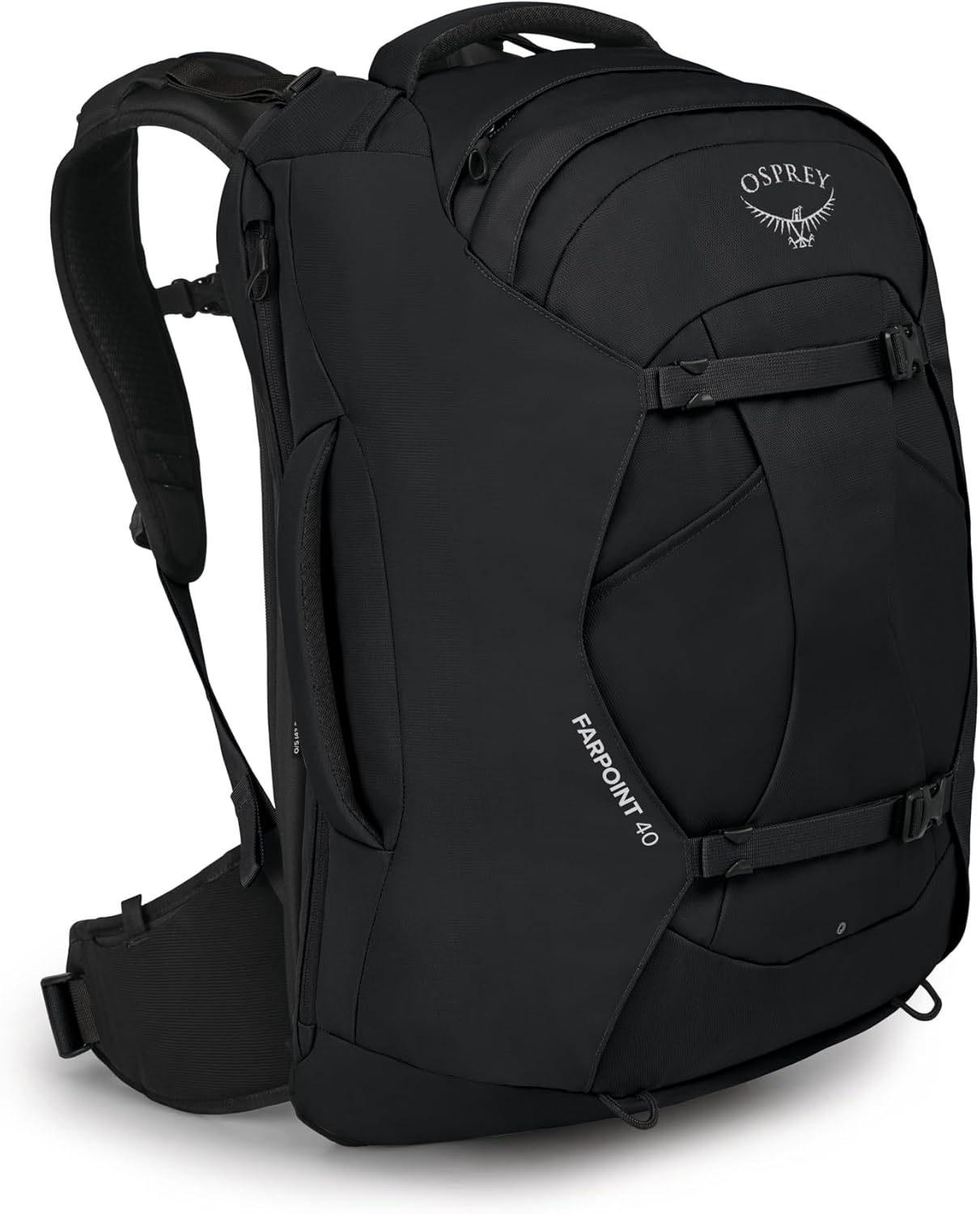
The Gold Standard for Backpackers: Osprey Farpoint 40
If mobility is your priority, the Osprey Farpoint is the industry leader. It features a suspension system that rivals hiking packs but opens like a suitcase for easy access.
Check Price on Amazon2. Capacity and Packing Efficiency
How much can you actually bring? And more importantly, how easily can you find it?
The “Stuffability” of Backpacks
Backpacks are generally soft-sided, meaning they are forgiving. You can often squeeze “just one more” jacket into the top. However, accessing items at the bottom of a top-loading backpack is a nightmare. This is why seasoned travelers advocate for clamshell backpacks (those that unzip fully like a suitcase). Even with the best backpack, you need to be strategic with weight distribution to save your back.
The Logic of Suitcases
Suitcases excel at visualization. When you open a clamshell suitcase, you see everything at once. Your clothes stay flatter, leading to fewer wrinkles—a crucial factor for business travelers. Hard-shell suitcases also provide a strict volume limit; if the zipper won’t close, you’ve packed too much. This can be a blessing for chronic over-packers trying to adhere to airline limits.
Regardless of your choice, effective packing requires strategy. Check out these 8 essential items to include in your carry-on bag to ensure you keep your critical gear accessible, whether it’s in a front pocket or a top lid.
3. The Accommodation Factor
Where you sleep dictates what you should carry. The infrastructure of your lodging is often overlooked during the luggage selection process.
Hotels and Resorts
If you are heading to a resort with bellhops, elevators, and wide corridors, a suitcase is the superior choice. You can roll it right to the closet stand. When comparing Airbnb vs. Resort, the resort environment is built for wheeled luggage.
Airbnbs and Hostels
Conversely, many European Airbnbs are located in historic buildings without elevators. Hauling a 20kg suitcase up four flights of a spiral staircase is a workout you didn’t sign up for. Furthermore, hostels rarely have space for large suitcases to be opened fully on the floor. A backpack can be tossed onto a bunk or stuffed into a narrow locker much more easily.

The Best Spinner: Samsonite Winfield 3 DLX
For those who prefer the roll, this polycarbonate hard-shell protects your belongings and glides effortlessly through terminals.
Check Price on Amazon4. Security and Durability
Your luggage is the only barrier between your possessions and the world. How much protection do you need?
Hard Shell Protection
A hard-shell suitcase is a vault. It is waterproof, slash-proof, and crush-proof. If you are transporting fragile items (electronics, wine, souvenirs), a suitcase offers peace of mind that a soft backpack cannot. Additionally, lockable zippers are standard on suitcases, whereas backpacks often have multiple pockets that are harder to secure completely.
The Baggage Handler Factor
If you plan to check your bag, remember that conveyor belts are cruel. Backpack straps can get caught in machinery, leading to damage. If you check a backpack, you must buy a cover or tape the straps down. Suitcases are designed for this abuse.
Pro Tip: Baggage fees are rising. Using one of the best 5 travel rewards credit cards can often get you free checked bags, making the decision to bring a larger suitcase less financially painful.
5. Summary: Pros and Cons
Still on the fence? Here is the breakdown of the major trade-offs.
✅ Backpack Pros
- Hands-Free: navigate phones and tickets easily.
- Versatile: Good for hiking, transit, and stairs.
- Lightweight: Maximizes airline weight allowance.
- Compact: Easier to fit in overhead bins.
- Soft: Can squeeze into tight spaces.
❌ Backpack Cons
- Physical Strain: Can cause back sweat and pain.
- Wrinkles: Clothes tend to bunch up.
- Packing: Hard to find items at the bottom.
- Security: Easier for pickpockets to slash/open.
✅ Suitcase Pros
- Effortless: No weight on your body.
- Protection: Hard shells protect fragile gear.
- Organization: Everything is visible at once.
- Professional: Looks better for business trips.
- Security: Easier to lock effectively.
❌ Suitcase Cons
- Terrain Limits: Useless on stairs and cobblestones.
- Bulk: Hard to store in small hotel rooms.
- Hands-Full: Requires one hand constantly.
- Wheel Damage: Wheels are a point of failure.
6. The Complete Sizing Guide: Liters vs. Inches Explained
One of the most confusing aspects of luggage shopping is the inconsistency of measurements. Backpacks are measured in liters; suitcases are measured in inches. Neither scale is intuitive without a reference point. Here is your definitive guide to understanding exactly what each size means in practical terms.
Backpack Volume Guide (Liters)
The liter measurement tells you the total internal volume of the bag. A helpful mental model: one liter is roughly the size of a 1-liter water bottle. So a 40-liter backpack holds the equivalent of 40 water bottles worth of gear.
💡 One-Bag Travel Rule: The one-bag travel movement (popularized on Reddit’s r/onebag community) recommends keeping all travel gear in a single 35–45L carry-on backpack regardless of trip length, relying on laundry services and strategic packing instead of volume. This eliminates checked baggage fees entirely and dramatically speeds up airport transit.
Suitcase Size Guide (Inches)
Suitcase dimensions refer to the exterior height of the bag. Most manufacturers measure the longest dimension. Understanding what each size is actually useful for will save you from buying a bag that’s wrong for your typical travel style.
⚠️ Size Warning: A 24-inch suitcase can legally hold 50 lbs of weight—but if it weighs 10 lbs empty, you only have 40 lbs of usable capacity before hitting the standard airline weight limit. A lightweight 40L backpack weighing 2.5 lbs empty gives you 47.5 lbs of usable capacity. The empty weight of your luggage is real weight you’re paying for.
7. Airline Carry-On Size Rules: The Complete 2025 Guide
Choosing carry-on-compatible luggage only matters if it actually fits in the overhead bin of the airline you are flying. Crucially, size limits vary significantly between carriers—particularly between full-service and budget airlines. Here is what you need to know before you pack.
Standard Carry-On Dimensions by Airline
The dimensions below represent the maximum size allowed in the overhead cabin. All measurements are Length × Width × Depth, including wheels and handles for suitcases.
| Airline | Max Carry-On Size | Max Weight | Personal Item Allowed? |
|---|---|---|---|
| United Airlines | 22″ × 14″ × 9″ (56 × 35 × 22 cm) | No limit | Yes |
| American Airlines | 22″ × 14″ × 9″ (56 × 35 × 22 cm) | No limit | Yes |
| Delta | 22″ × 14″ × 9″ (56 × 35 × 22 cm) | No limit | Yes |
| Southwest | 24″ × 16″ × 10″ (61 × 40 × 25 cm) | No limit | Yes (free) |
| British Airways | 22″ × 18″ × 10″ (56 × 45 × 25 cm) | 51 lbs / 23 kg | Yes (Economy+) |
| Ryanair | 21.5″ × 15.5″ × 7.8″ (55 × 40 × 20 cm) — Priority only | 22 lbs / 10 kg | Small bag only (free) |
| EasyJet | 22″ × 17″ × 9″ (56 × 45 × 25 cm) | No limit stated | Yes (small) |
| Spirit Airlines | 22″ × 18″ × 10″ (56 × 46 × 25 cm) | No limit | Yes (free) |
💡 Budget Airline Trap: Budget carriers like Ryanair actively enforce carry-on rules at the gate with physical sizers. If your bag doesn’t fit in the sizer, you will be forced to check it—at a fee of £50–£60 (approximately $65–$80) per bag. Always measure your bag against the airline’s specific dimensions before flying, not just the “standard” carry-on size.
The Carry-On Only Strategy: Is It Realistic?
Traveling carry-on only is one of the most liberating decisions a frequent traveler can make. It eliminates baggage fees, removes the risk of lost luggage, cuts 30–45 minutes from your airport experience (no check-in desk, no baggage claim), and forces you to pack efficiently—which almost always results in packing more intelligently.
The key to carry-on-only travel is the one week, one bag rule: pack for one week maximum, and do laundry if your trip extends beyond that. Most destinations—from European capitals to Southeast Asian cities to beach resorts—have laundry services that cost $5–$15 and return clothes within 24 hours. The economics are clear: even one baggage fee ($30–$60 each way) exceeds an entire week of laundry costs.
Baggage Fee Calculator: The True Cost of Checking a Bag
Before defaulting to a large checked suitcase, consider the real financial cost. For a round trip on a domestic US airline, one checked bag typically costs $35 each way, or $70 round trip. For a family of four, that is $280 in baggage fees for a single trip—enough to fund a significant upgrade elsewhere in your travel budget. Using one of the best travel rewards credit cards can waive these fees entirely, but only if you have the right card for the right airline.
8. Luggage Materials: What Your Bag Is Actually Made Of
The material of your luggage determines its weight, durability, flexibility, and cost. Both backpack fabrics and suitcase shells have a spectrum of options, and understanding the differences will help you make a smarter purchase decision that lasts for years.
Suitcase Shell Materials
Polycarbonate
The gold standard for hard-shell luggage. Extremely lightweight (crucial for weight limits), highly flexible—it bends under impact without cracking—and resistant to cracking from cold temperatures. Premium brands like Rimowa, Tumi, and Away use polycarbonate. Slightly more expensive but significantly outperforms alternatives in durability per gram.
Best for: Frequent flyers, checked luggage
ABS Plastic
Budget-friendly hard-shell option found in most affordable suitcases. Heavier than polycarbonate and more prone to cracking rather than flexing under stress. Perfectly adequate for occasional travelers who check their bags gently. Often used in entry-level spinner suitcases in the $50–$120 price range.
Best for: Infrequent travelers, budget shoppers
Aluminum
The premium prestige material, synonymous with Rimowa’s Original line. Extremely durable, completely rigid (no flex), and very heavy. Aluminum cases are status symbols as much as they are luggage. The weight penalty (approximately 2 kg heavier than polycarbonate equivalents) makes them less practical for carry-on travel with strict weight limits.
Best for: Style-conscious frequent travelers with premium budgets
Ballistic Nylon / Softside
Used in soft-sided suitcases and the highest-end backpacks. Extremely abrasion-resistant, lighter than hard shells, and more packable (soft suitcases can be stored under a bed when empty). Less protective of fragile items. Tumi’s ballistic nylon is legendary in the business travel world for its near-indestructibility.
Best for: Business travelers, light packers
Backpack Fabric Guide
420D / 210D Nylon (HT)
High-tenacity nylon is the standard for quality travel backpacks. The “D” stands for denier—a measurement of fabric thread thickness. Higher denier means more abrasion resistance but also more weight. 420D offers an excellent balance for travel backpacks. Most Osprey bags use this material. It resists tearing, scuffs, and light rain.
Cordura® Nylon
A branded variant of high-denier nylon licensed from Invista. Used in premium bags including certain North Face, Gregory, and Timbuk2 packs. Cordura is exceptionally resistant to abrasions, tears, and scuffs—the DuPont-tested benchmark is 10× the abrasion resistance of standard nylon. Premium but worth it for gear that gets real use.
UHMWPE / Dyneema
Ultra-high-molecular-weight polyethylene—the same material used in bullet-resistant vests. Extraordinarily strong-to-weight ratio, completely waterproof, and extremely lightweight. Used in premium ultralight packs. Downside: very expensive and has a distinctive appearance not everyone likes.
Ripstop Nylon / Polyester
A woven pattern where stronger threads are interspersed in a grid to prevent tearing from spreading. Used in budget to mid-range backpacks and rain covers. The ripstop pattern provides good tear resistance at a lower cost, though it lacks the abrasion resistance of Cordura. Good enough for casual travel.
9. 2-Wheel vs. 4-Wheel Spinner: The Wheel Debate Within the Suitcase World
If you have decided on a suitcase, you now face a secondary debate that many travelers get wrong: should you choose a traditional 2-wheel upright or a modern 4-wheel spinner? Both styles have genuine advantages, and the right choice depends entirely on your primary travel environment.
🔵 2-Wheel Uprights
How they work: Two fixed wheels on the bottom back edge. The bag tilts at a 45° angle and rolls behind you on two points of contact.
Advantages: More durable wheels (fewer moving parts), better on rough terrain and carpet, entire bag weight sits on two robust wheels rather than four smaller ones. Harder to tip over on inclines.
Disadvantages: Requires one hand to pull, can’t be pushed or moved sideways, slightly more physical effort in crowded spaces.
Best for: Business travelers navigating airports frequently, outdoor destinations with mixed terrain.
🟢 4-Wheel Spinners
How they work: Four 360-degree rotating wheels allow the bag to roll in any direction without tilting. You push rather than pull.
Advantages: No strain on arm or wrist—push it alongside you with a single finger. Effortless navigation in airports and wide hotel corridors. Can be stood upright and rolled hands-free on flat surfaces.
Disadvantages: Spinner wheels are smaller and more fragile. Completely useless on carpet, gravel, or uneven surfaces. Easily tips in inclines and light wind. More wheel mechanism means more failure points.
Best for: Airport-heavy travel, hotel-to-hotel trips, business travelers in modern terminals.
💡 The Hybrid Solution: Some premium suitcases (notably Briggs & Riley’s TranscendTM line) offer dual spinner wheels that can be locked into 2-wheel mode for rough terrain and unlocked into 4-wheel spinner mode for smooth surfaces. This versatility commands a premium price but genuinely solves the terrain problem.
10. Packing Strategies: Rolling vs. Folding vs. Bundle Packing
The method you use to pack your clothes matters almost as much as the container you put them in. Three primary packing methods dominate travel discussions, and each has a specific context where it performs best. Applying the wrong method to the wrong luggage type is a silent cause of wrinkles, wasted space, and back pain.
The Rolling Method
Rolling clothes into tight cylinders is the most space-efficient method for casual, wrinkle-resistant clothing: t-shirts, jeans, underwear, activewear, and synthetics. Rolled items can be packed vertically in a bag (like “filing” clothes rather than “stacking” them), making it easy to see everything at once—the primary organizational benefit of the famous KonMari method applied to packing. Rolling is the preferred method for backpackers because it compresses volume and distributes weight evenly.
What rolling does poorly: formal shirts, blazers, dresses, and suit trousers. The creases from rolling appear in horizontal bands across the garment, which pressing alone cannot always fix. For business travel involving formal clothing, rolling is not appropriate.
The Flat Folding Method
Flat folding is the traditional suitcase method: lay items flat, fold them in half, and stack them. It is the method your dry cleaner uses for a reason—it creates clean, straight creases along natural garment seams rather than random compression wrinkles. For formal wear, business clothes, and anything that must arrive presentable, flat folding inside a clamshell suitcase is the correct approach.
The downside is space inefficiency: flat folded clothing leaves air pockets between layers and uses more vertical depth than rolled clothes. For a backpack, flat folding is almost never the right choice.
The Bundle Wrapping Method
This underutilized technique wraps all your clothes around a central core object (like a travel organizer or shoes) in layers, like wrapping paper. Because items are never actually folded—they simply curve around the core—bundle packing produces fewer creases than any other method. It is particularly effective for suits and formal dresses. The downside is that unpacking and repacking requires rebuilding the entire bundle, making it impractical for multi-city trips where you are constantly accessing your luggage.
Packing Cubes: The Universal Upgrade
Regardless of your method or luggage type, compression packing cubes transform the interior of any bag into a structured drawer system. They work equally well in backpacks (providing the organizational structure that backpacks inherently lack) and suitcases (compartmentalizing clothing categories to prevent everything from shifting during transit). The compression feature reduces rolled clothing volume by 25–40%, effectively giving you more usable space in any bag size.
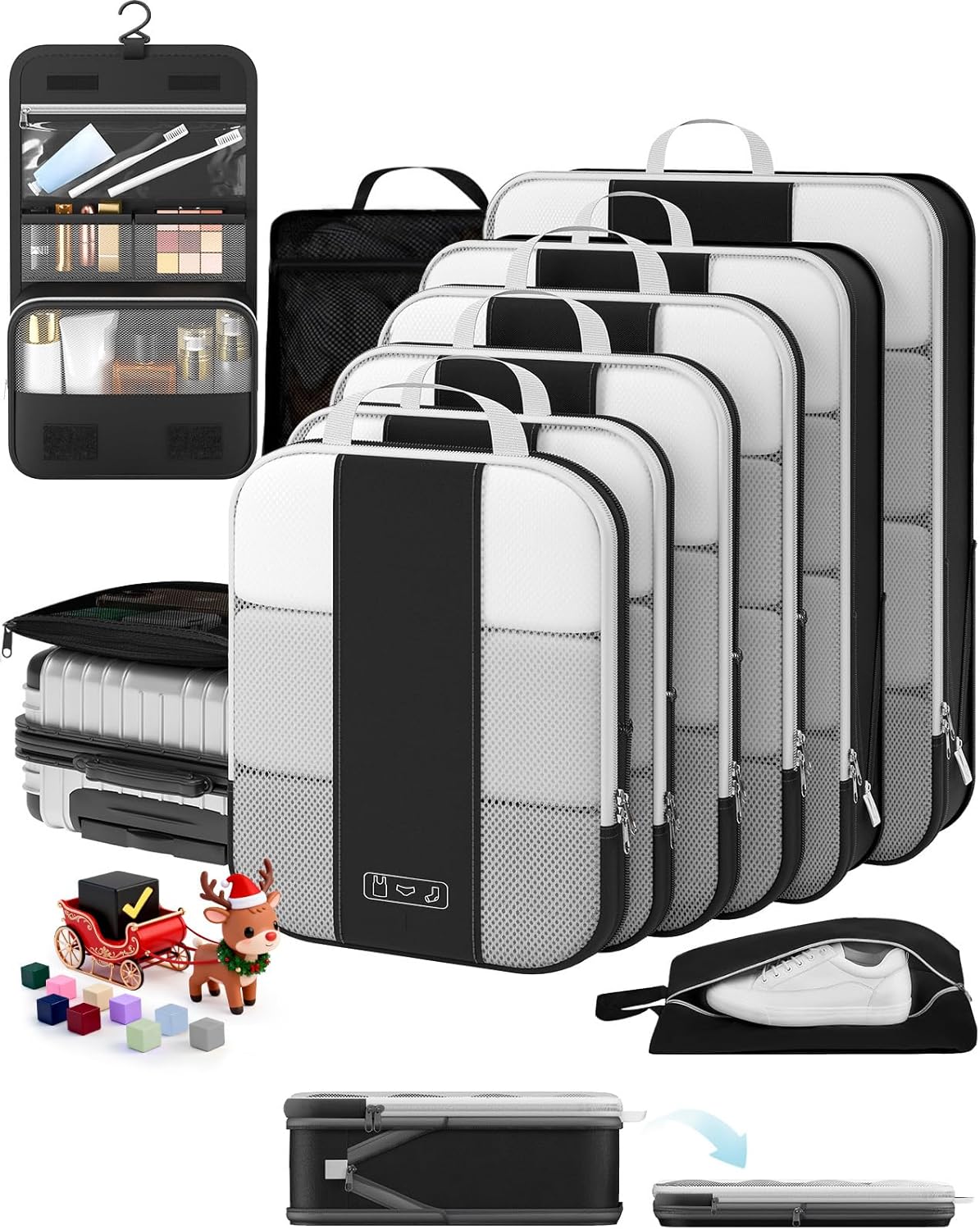
The Great Equalizer: Packing Cubes
Whether you choose a backpack or suitcase, packing cubes are non-negotiable for organization. They turn a chaotic backpack into a drawer system.
Check Price on Amazon11. Luggage by Trip Type: The Definitive Decision Matrix
The “right” luggage is always contextual. Rather than giving a blanket recommendation, the following section breaks down the optimal luggage choice for every major trip type. Think of this as a decision tree that eliminates guesswork for your next booking.
Weekend Trips (1–3 Nights)
Recommendation: 20–35L Backpack or 21″ Carry-On Suitcase
For weekend trips, carry-on is always the right choice—the logistics cost of checking a bag (time, fees, waiting at baggage claim) far outweighs any packing convenience a large bag provides. A 20–30L backpack fits under every airline seat. A 21″ spinner fits in every overhead bin. The choice between them depends on your destination: city break with Airbnb stairs → backpack. Resort with concierge service → suitcase.
One-Week Vacation (4–7 Nights)
Recommendation: 40L Backpack (carry-on) OR 24″ Checked Suitcase
This is the most common trip length and the most debated. The 40L carry-on backpack (like the Osprey Farpoint 40) is the ideal choice for budget-conscious travelers, backpackers, and anyone using public transit extensively. For resort vacations, beach trips, or cruises where you remain in one location, the 24″ suitcase is superior—more organization, no back strain, better clothing presentation.
Two-Week Trip (8–14 Nights)
Recommendation: 40–45L Backpack with Laundry Plan OR 26″ Suitcase
Two weeks is where packing philosophy matters most. Experienced travelers do two weeks comfortably in 40L by doing laundry once mid-trip. Newer travelers often over-pack into a large suitcase and regret the weight by day three. If this is your first extended trip, start with a 26″ checked suitcase and document what you actually use. You will find—almost universally—that you wore 60% of what you packed and wished you had packed lighter.
Business Travel
Recommendation: 22″ 4-Wheel Spinner Suitcase OR 40L Clamshell Backpack
Business travel has unique requirements: clothing must arrive wrinkle-free, a laptop and documents must be easily accessible, and you are typically moving through modern airports and hotels with excellent infrastructure. A quality 22″ spinner with a dedicated laptop sleeve and garment section is the classic business travel choice. For tech-forward business travelers who prefer to work standing up in airports and don’t want to check bags, a 40L clamshell backpack with a padded laptop compartment (like the Peak Design Travel Backpack) has become increasingly standard.
Multi-City Backpacking (2+ Weeks, Multiple Destinations)
Recommendation: 40–50L Travel Backpack. Non-negotiable.
If you are moving to a new city every 2–4 days across multiple countries—the classic European interrail trip, Southeast Asian island-hopping, or South American overland travel—a travel backpack is the only rational choice. A suitcase will destroy your trip. Cobblestones, hostel stairs, overnight bus floors, and remote train stations are hostile environments for wheeled luggage. Pack light, pack smart, and embrace the freedom.
Family Travel
Recommendation: One Large Checked Suitcase Per Adult + Small Backpack Per Child
Family travel with young children adds a dimension of complexity: you are already managing car seats, strollers, and snack bags. For families, the suitcase wins clearly—you need the organizational capacity, the protection for children’s gear, and the ease of rolling rather than carrying when your hands are occupied with children. Give each child their own small backpack (15–20L) to carry their entertainment for the flight; this gives children ownership over their space while keeping your main bag uncluttered.
Long-Term Travel or Digital Nomad Life
Recommendation: 35–45L Backpack + Small Day Pack
Living out of luggage for months at a time creates different priorities than vacation travel. Durability over everything—your bag must survive daily use for a year or more. Versatility over volume—you need access to your laptop in a café, your toiletries in a hostel, and your rain jacket on a sudden downpour. The digital nomad community has converged on 35–45L clamshell backpacks with dedicated laptop compartments as the optimal long-term travel solution. The Osprey Farpoint 40, Peak Design Travel Backpack 45L, and Tortuga Setout 45L are perennial community favorites.
12. Luggage Security: TSA Locks, Anti-Theft Features, and Smart Trackers
Your luggage’s security is a multi-layered issue that extends well beyond just choosing a hard shell. True luggage security involves your locking mechanism, your physical access points, and increasingly, your digital tracking capability.
TSA-Approved Locks: Why They Matter
TSA (Transportation Security Administration) agents have the legal authority to physically open and inspect any checked bag they select for examination. If your bag has a non-TSA lock and they need to inspect it, they will cut the lock—and you will receive no compensation. TSA-approved locks contain a universal master key system (there are currently 8 types of TSA keys) that allows agents to open your lock without destroying it. After inspection, they relock your bag and leave a notice inside.
- Combination TSA Locks: The simplest option. Set your own 3–4 digit code. No batteries, no charging. Best for infrequent travelers.
- Built-In TSA Locks: Premium suitcases like Samsonite, Travelpro, and Briggs & Riley include TSA-approved combination locks built directly into the zipper mechanism. These are harder to bypass than external locks.
- Key TSA Locks: Physical key locks that TSA agents can open with their master key. Less popular due to the risk of losing the key.
Anti-Theft Backpack Features to Look For
Backpack security is a genuine concern in tourist-heavy cities. Slash-and-grab attacks, in which thieves cut the bottom of a backpack to grab falling contents, are reported in cities including Barcelona, Rome, and Bangkok. The following features significantly reduce these risks:
- Hidden Zippers: Main compartment zippers that face your back rather than outward prevent opportunistic access without your awareness.
- Slash-Resistant Panels: Cut-resistant fabric panels woven into the back and bottom of the bag prevent slash attacks. Look for bags with stainless steel wire mesh embedded in the fabric.
- RFID-Blocking Pockets: A dedicated pocket with RFID-blocking material prevents electronic pickpocketing of contactless credit cards and passports. Increasingly standard in travel-specific backpacks.
- Lockable Zippers: Zippers that can accept a small combination lock (or be clipped together) on the main compartment add a meaningful deterrent even if they are not uncuttable.
Smart Luggage Tracking: AirTag, Tile, and Beyond
Lost or delayed luggage affects an estimated 7 per 1,000 passengers. While the statistical probability is low, the disruption—arriving at a resort with no clothes—is significant. Modern luggage tracking has become remarkably accessible. Apple AirTags ($29) can be slipped into a hidden pocket of any bag and tracked to within a few meters using the Apple Find My network. Similar devices exist in the Android ecosystem (Samsung SmartTag, Tile, Chipolo).
The practical limitation of trackers is that they rely on Bluetooth crowd-sourcing networks—they are only as useful as the density of other device users in your vicinity. In major airports and city centers, tracking is highly accurate. In remote locations, accuracy degrades. Nevertheless, for the $29 cost of an AirTag, the peace of mind and assistance in baggage disputes makes it a near-universal recommendation for any traveler who checks bags.
13. Budget vs. Premium Luggage Brands: Is the Price Difference Worth It?
The luggage market spans from $30 suitcases at discount retailers to $1,200 Rimowa aluminum cases. Understanding where the genuine performance differences lie—and where you are simply paying for branding—helps you make an intelligent purchase at any budget level.
The True Cost of Cheap Luggage
A $40 suitcase that fails after 8 flights and requires replacement is a worse financial decision than a $200 suitcase that lasts 10 years. The per-use cost calculation is the correct frame: a $200 bag used 100 times over 10 years costs $2 per use. A $40 bag replaced every 2 years costs $80 over the same period—and you also deal with the inconvenience of a zipper failure in an airport.
Luggage Brand Tiers: Honest Assessment
🟢 Budget ($30–$100)
Backpacks: AmazonBasics, Travelpack, Matein. Adequate for infrequent travel. Expect lesser fabric quality, heavier frames, and limited organizational features. Fine for 1–2 trips per year.
Suitcases: American Tourister, Rockland, COOLIFE. ABS plastic construction. Works reliably for 2–3 years of moderate use. Adequate wheels, basic organization.
🔵 Mid-Range ($100–$300)
Backpacks: Osprey, Gregory, Deuter, REI Co-op. The sweet spot. Osprey’s lifetime “All Mighty Guarantee” means they will repair or replace any bag regardless of cause—an extraordinary value proposition. These bags routinely last a decade.
Suitcases: Travelpro, Samsonite, Delsey, Away. Polycarbonate construction, quality spinner wheels, TSA locks. Travelpro is the brand used by most airline crews—a strong endorsement of durability.
🟡 Premium ($300–$700)
Backpacks: Peak Design, Tortuga, Tom Bihn. Superior organization systems, premium materials, thoughtful design for modern travel. Peak Design’s Travel Backpack 45L is widely considered the best-designed travel bag ever made.
Suitcases: Briggs & Riley, Tumi, Zero Halliburton. Briggs & Riley offers a lifetime guarantee including damage from airlines. Tumi’s ballistic nylon is near-indestructible. These bags outlast most other purchases you make.
🔴 Luxury ($700+)
Suitcases: Rimowa, Globe-Trotter, Louis Vuitton. You are paying primarily for materials prestige, heritage brand association, and statement-making aesthetics. Rimowa’s aluminum cases are genuinely superior in scratch resistance and rigidity. Globe-Trotter’s vulcanized fiber cases are handmade in England. The performance premium over Briggs & Riley is marginal; the status premium is significant.
14. The Minimalist Packing Philosophy: Pack Less, Travel Better
The minimalist travel movement—closely aligned with the one-bag travel and ultralight backpacking communities—operates on a counterintuitive premise: you have more freedom when you own less. Every item you pack is a physical and cognitive burden. The goal of minimalist packing is not deprivation; it is precision. You bring exactly what you need, nothing more, and everything you bring serves multiple purposes.
The 5-4-3-2-1 Packing Rule
For a one-week trip, experienced minimalist travelers follow the 5-4-3-2-1 rule as a ceiling for clothing:
- 5 pairs of underwear (quick-dry merino wool ideal)
- 4 pairs of socks
- 3 tops / shirts
- 2 bottoms (one casual, one smart/convertible)
- 1 pair of shoes (wear the heaviest pair on the plane)
Combined with a light jacket (worn on the plane), toiletry kit, and electronics, this fits comfortably in a 30–35L backpack and covers virtually any one-week trip with ease. The key is choosing fabrics—particularly merino wool and technical synthetics—that can be hand-washed and dried overnight in a hotel bathroom.
Clothing Fabric Strategy: Merino Wool and Synthetic Travel Clothing
The single biggest factor in enabling minimalist packing is choosing the right fabrics. Natural cotton—the most common fabric in everyday clothing—is heavy, slow to dry, prone to wrinkles, and odor-absorbing. It is the worst possible fabric for travel. The two best alternatives are:
Merino Wool: Naturally odor-resistant due to wool’s antimicrobial properties, which means you can wear a merino t-shirt 3–4 days without washing and without offensive odor. Temperature-regulating across a wide range (comfortable from 50°F to 80°F). Resistant to wrinkles. Lightweight and compressible. The premium cost ($60–$120 for a single t-shirt from brands like Wool & Prince or Unbound Merino) is offset by carrying fewer items overall.
Technical Synthetics (Polyester/Nylon Blends): Quick-dry fabrics designed for athletic use (Patagonia Capilene, Outlier Slim Dungarees, Arc’teryx basics) work equally well in travel contexts. They dry faster than merino (often within 1–2 hours of washing), are more durable, and are typically less expensive. The downside is less effective odor resistance.
The “Wear Once Before You Pack It” Test
Before finalizing your packing list, apply this filter to every item: wear it at home for a full day in the week before your trip. If you don’t wear it at home, you won’t wear it on your trip. This single test eliminates the “just in case” items that add weight and guilt without ever being used. Most travelers find they eliminate 20–30% of their initially planned packing list by applying this filter.
15. Sustainable Luggage: The Eco-Conscious Traveler’s Guide
Luggage manufacturing has a meaningful environmental footprint: most hard-shell suitcases are made from petroleum-derived plastics, and most backpacks are made from virgin synthetic fabrics. As sustainability becomes a higher priority for travelers, several brands have made genuine commitments to reducing this impact—though it’s worth separating meaningful initiatives from greenwashing.
Recycled Materials in Luggage
Several brands now offer bags made with recycled content. Patagonia uses recycled polyester made from post-consumer plastic bottles in many of its travel bags. Osprey has committed to using recycled fabrics across an expanding portion of its line. Db (formerly Douchebags) produces bags using recycled materials and partners with carbon offsetting organizations. When evaluating recycled content claims, look for the percentage of recycled material and third-party certifications (bluesign®, Global Recycled Standard) rather than general marketing language.
The Durability-Sustainability Connection
The most sustainable luggage purchase is also the most economical one: buy the most durable bag available, maintain it properly, and replace it as rarely as possible. A Briggs & Riley suitcase repaired (for free, under their lifetime guarantee) after 15 years of use has a dramatically lower lifetime environmental impact than three budget suitcases purchased over the same period, regardless of whether those budget bags contain any recycled content. Durability is sustainability in practice.
Luggage Repair vs. Replacement
Before replacing a damaged bag, explore repair options. Zipper failures—the most common luggage fault—can be repaired by most cobblers or luggage repair shops for $15–$30. Wheel replacements on premium suitcases are often available as manufacturer spare parts for $20–$50 and can be installed with basic tools. A repaired $250 Travelpro suitcase continues its service life; a discarded one ends up in landfill. Osprey, Patagonia, Arc’teryx, and Briggs & Riley all have formal repair programs that accept bags regardless of age.
16. Final Verdict: Which is Better for You?
There is no “best” luggage, only the best luggage for your specific trip.
Choose a Backpack If:
- You are moving locations frequently (every 1–3 days).
- You are traveling to Southeast Asia, South America, or old European cities with cobblestones.
- You want to remain agile and hands-free.
- You plan on using public transportation heavily.
- You are traveling carry-on only and want to avoid baggage fees entirely.
- You are a digital nomad or long-term traveler who needs to move fast.
Choose a Suitcase If:
- You are staying in one location for the majority of the trip.
- You have back problems or physical limitations.
- You are traveling for business and need wrinkle-free clothing.
- You are staying in hotels/resorts with elevators and taxi service.
- You are traveling with formal attire or fragile items that require protection.
- You are traveling with family and need maximum capacity.
Your Complete Pre-Trip Luggage Checklist
- Confirm your airline’s exact carry-on size and weight limits
- Weigh your empty luggage — add this to your expected packing weight
- Apply the “wear once before you pack it” test to every clothing item
- Pack using compression packing cubes regardless of bag type
- Insert an AirTag or Tile tracker in a hidden pocket
- Attach a TSA-approved lock to checked bags
- Add a distinctive luggage tag or ribbon to identify your bag at baggage claim
- Photograph your packed bag before checking in — useful for insurance claims
- Keep all valuables, medications, and electronics in your carry-on
Frequently Asked Questions
Yes, most travel backpacks (35L to 45L) comply with carry-on size limits. However, always check the dimensions of your specific airline, especially budget carriers in Europe like Ryanair and EasyJet, which have stricter and more actively enforced rules.
If fitted incorrectly, yes. A high-quality travel backpack transfers the weight to your hips via a padded hip belt, not your shoulders. If your shoulders hurt, the pack is either too heavy or adjusted poorly. The general rule: no more than 20% of your body weight in a backpack.
Duffel bags are a middle ground but often the worst of both worlds. They lack the wheels of a suitcase and the ergonomic suspension of a backpack, putting strain on one shoulder. However, wheeled duffel bags with shoulder straps (like the Osprey Transporter series) offer a genuinely useful hybrid for specific use cases including athletic travel and gear-heavy trips.
A medium checked suitcase (24–26 inches) is usually sufficient for two weeks for most travelers. Avoid the massive 29–30 inch trunks unless you are relocating; they are difficult to fit in taxis and regional trains, and the temptation to fill them leads to chronically overweight bags and excessive fees.
Hard-shell suitcases are generally harder to break into quickly. However, backpacks can be kept on your body, making them less likely to be snatched than a suitcase left unattended. For maximum security in backpacks, look for slash-resistant panels, hidden zippers, and RFID-blocking pockets.
Yes, but be prepared. European trains often have steep steps to board, and luggage racks fill up quickly. On high-speed trains (TGV, ICE, Eurostar), there are overhead racks and designated luggage areas at each end of the carriage. On regional trains, storage is more limited. You may have to lift a heavy suitcase above your head or leave it in a vulnerable open rack.
Hybrid bags are wheeled suitcases with deployable backpack straps. While they sound like the ideal solution, they are typically heavy, uncomfortable as backpacks due to the handle mechanism adding bulk, and have less internal space. They are most useful for specific terrains where you alternate between paved and unpaved surfaces regularly.
One-bag travel is a philosophy of traveling with a single carry-on backpack regardless of trip length, using smart packing, versatile clothing, and laundry services to compensate for lower volume. It eliminates checked baggage fees, removes the risk of lost luggage, and speeds up airport transit significantly. The r/onebag community on Reddit is the largest gathering of practitioners and resources.
For frequent travelers, yes. A $90 merino t-shirt that can be worn 3–4 days without washing effectively replaces 3–4 standard cotton shirts—at a higher upfront cost but lower total weight, volume, and long-term replacement cost. For infrequent travelers taking one or two trips per year, the investment is harder to justify.
Use a TSA-approved lock on the main zipper. Consider a luggage wrap service available at most major airports ($15–$20) for particularly fragile contents. Never pack irreplaceable items in checked luggage—they belong in your carry-on. Photograph the exterior of your packed bag before checking it; this documentation supports insurance claims in the event of damage.
Conclusion: The Journey Begins With the Right Bag
Ultimately, the choice between a backpack and a suitcase is a trade-off between comfort on the move versus comfort at the destination. The backpacker sacrifices organization for agility; the suitcase traveler sacrifices mobility for ease of access.
Before you zip up, take a moment to visualize your arrival. Are you stepping out of a taxi into a lobby? Take the suitcase. Are you navigating a metro map while walking 15 minutes to a hostel? Strap on the backpack. By aligning your gear with your itinerary, you ensure the journey is just as enjoyable as the destination.
The real lesson is that neither option is universally superior—the best travelers match their gear to the specific demands of each trip. Many experienced travelers own both: a 40L travel backpack for adventure and budget travel, and a quality 22″ spinner for business and resort travel. Knowing which to reach for, and why, is the mark of a genuinely seasoned traveler.
Once you have made your choice, don’t forget the rest of the preparation. Use this 7-step trip planning checklist to ensure every other detail is as sorted as your luggage.